Mr. October in April, or May, or August

Induction weekend in Cooperstown is the best baseball bash of the year. For me, it’s a house full of friends and family, an always fun porch party filled with baseball talk, pizza, and beer, and any number of surprises. One year, Bill Lee appeared on my porch!

Last year, Todd Radom, the foremost sports graphic designer in the country, author, and all-around mensch and good friend, was a last-minute addition to the festivities as part of the Dick Allen contingent. Todd’s arrival was the first great surprise heading into the weekeånd.

On Saturday, Todd and I strolled to Main Street, a few minutes’ walk from my house. A stop into Yastrzemski Sports was preordained. Yaz Sports is the perfect local card store. They have everything from high-end to low-end. My favorite place to look in is the $5 bin. You never know what’ll be there. 

When Baseball Nostalgia, another legendary card shop, closed in Cooperstown, some of its inventory found its way to Yaz. Baseball Nostalgia was created as a flagship store for TCMA/SSPC cards in the 1970’s, and some of the original snapshots from the cards would find their way into the cheapie section. 

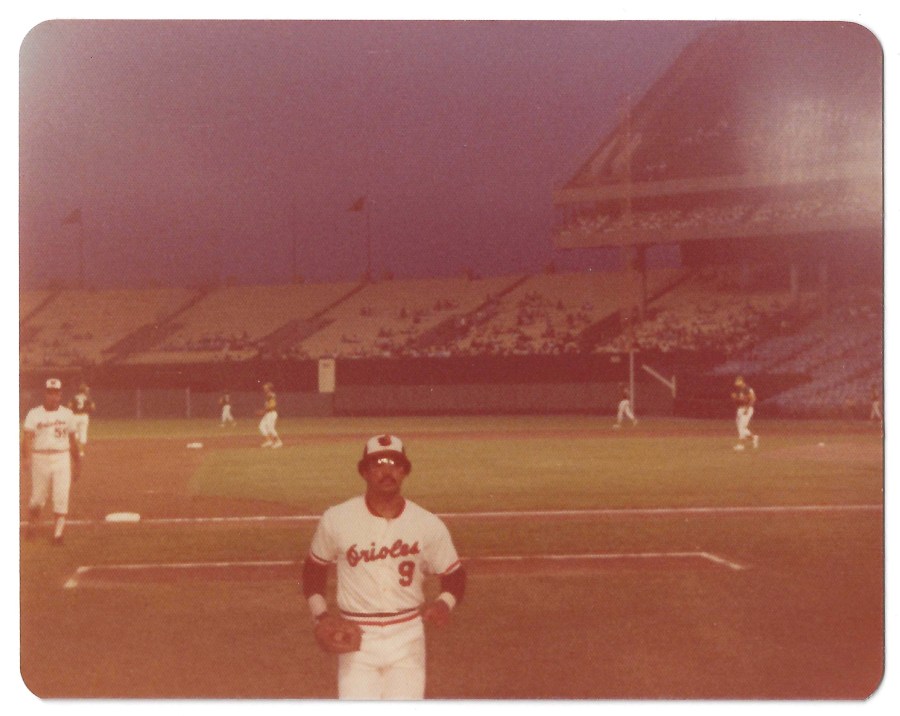
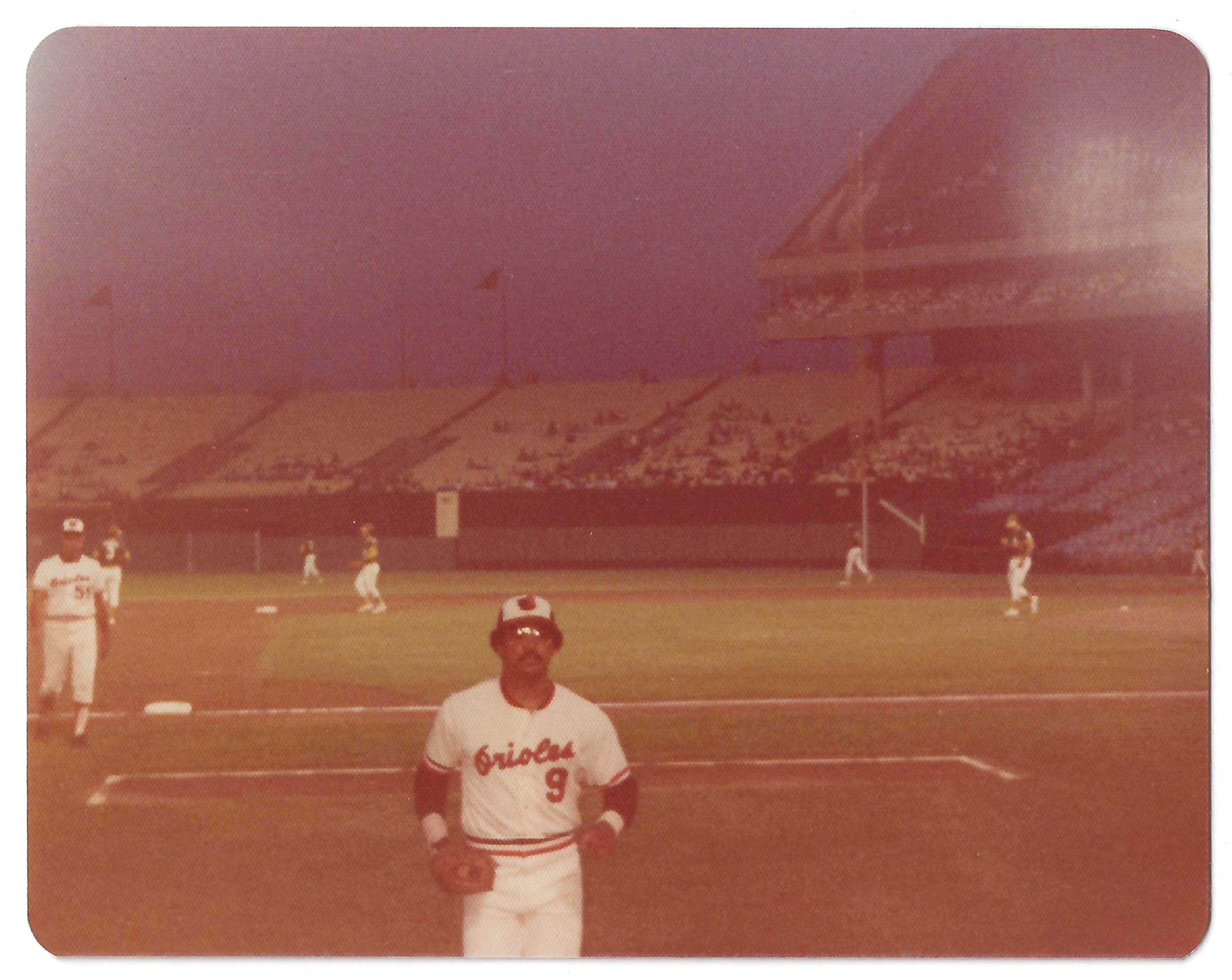
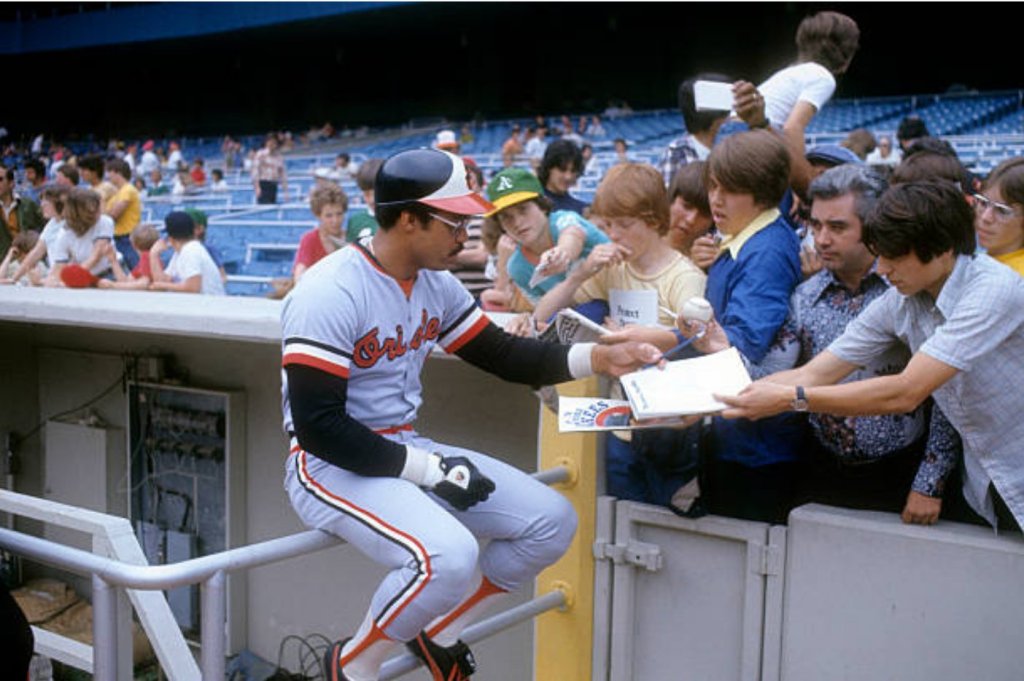
While browsing and chatting, I came across this photo of Reggie Jackson, which I assumed was from the Baseball Nostalgia archives. It’s a cool shot of Reggie as an Oriole, and that was enough for me. Until Todd and I got back home and sat at the kitchen table.

What was this picture, and why was it taken? Reggie spent the summer of 1976 in Baltimore, so that’s interesting, maybe enough to warrant bringing your camera to the game, maybe not. The key was in the background; Todd, as expected, clearly saw that the Oakland A’s were in town! Now that is worth recording – Reggie, in his new home, playing his old team. It seemed exciting to me, though clearly less to the sparse crowd at Memorial Stadium. 

I was quickly obsessed. When was this taken? When did the A’s come to Baltimore?

The first scheduled visit for the A’s was a three-game homestand between April 30-May 2. It was a big deal, and NBC had it featured as the Game of the Week, hoping Reggie would play. He had started the season late, a spring holdout for $200,000 per year from Oakland leading to a trade to Baltimore on April 2 and a delayed start to his season. Reggie probably sat out Friday night thinking that his first game of the season should be before a national audience!

Best laid plans, and so on. The game was rained out and rescheduled as part of a May 2 doubleheader. 

Todd and I tried to identify some of the players in the background as a starting point. We spotted Phil Garner, but that was no help. Garner played in every one of the A’s-O’s games. In the outfield was a player with a single-digit uniform number. Probably Bill North, but again, no help. It could also have been Cesar Tovar or Denny Walling, but that didn’t get us any further.

As our focus alternated between Retrosheet boxscores of all of the April games the A’s played in Baltimore and the photograph, we saw, relatively clearly, a lefty pitcher in the middle of the picture. Now we were getting somewhere. That could only be reliever Paul Lindblad. That was important and the key clue.

Obviously, our photographer recognized the historical import of Reggie’s first game against the only team he’d ever played for, got a fantastic seat behind the Orioles dugout, and took a great photo of Reggie. The photo had to have been taken before the bottom of the 5th, 6th, or 7th, when Lindblad would have been around the mound as the Orioles got ready to bat. Mystery solved!

But was it? I wasn’t so sure. The bleachers are nearly empty, and the stated attendance for the May 2 doubleheader was 24,819, pretty solid for Baltimore, though you’d expect more for Reggie’s first appearance against the A’s. Maybe people had left, tired after Game 1, but by the 5th inning? No way. Also, the sunset that day was at 8:01, and it’s clearly nighttime. Mystery unsolved!

The A’s returned to Maryland for a three-game stand from August 23-25. Vida Blue, a lefty, pitched a complete game shutout in Game 1, but Blue wasn’t a white lefty. The 23rd was easily eliminated. 

On the 24th, Lindblad pitched, the only lefty appearing in a game that saw both Mike Torrez and Stan Bahnsen pitch for Oakland. Attendance was abysmal, 9,482, so that checks. And it was a night game!

The 25th was easy to ignore. It was a righty-only night of pitchers for Oakland – Paul Mitchell, Dick Bosman, and Jim Todd. 

This photo was taken on August 24, entering either the bottom of the 8th or 9th inning. Reggie was headed to the dugout for the Orioles’ turn at bat. Mystery re-solved!

Reggie, looking right at the camera, and me, knew I’d get it all along.
The Three Lives of Reggie Jackson

Reggie Jackson Signs Autographs at Yankee Stadium May 14-16 1976. Focus on Sports photograph.

Sometimes photographs are great because of the story that they tell. It took a while for the story in this photograph to unfold. Like Ebenezer Scrooge in A Christmas Carol, this photo tells of Reggie Jackson’s past, present, and future in 1976.

Past

Jackson joined the Kansas City Athletics in 1967 and moved with the team to Oakland in 1968. With the Athletics, he was a six-time all-star, won a most valuable player award, and was the face of the team for a decade. Then the new era of free agency entered baseball in 1976, and it struck Oakland like a thunderbolt. Oakland owner Charles Finley tried to trade or sell many of the team’s marquee players. He was hoping to get something in return for them before losing them in the free-agent process. On April 2, Jackson, with Ken Holtzman and minor leaguer Bill VanBommel was traded to the Baltimore Orioles for Don Baylor, Paul Mitchell, and Mike Torrez.

Jackson had a love-hate relationship with Oakland and Finley. He enjoyed playing on a team that had been to the post-season five straight times and won the World Series three of those years. Jackson wanted to stay in Oakland because he and the other players knew the team had a unique chemistry. However, he and the other players hated playing for Finley. At the start of the 1976 season, Finley gave everyone on the team a 20% maximum pay cut. He knew he would lose most of the players to free agency after the season, so he decided to pay as little as possible. Jackson had his salary cut by $30,000.

In the photograph, there is a kid in the crowd wearing an Oakland Athletics hat. He is desperately reaching toward Jackson, trying to get an autograph. No one else in the group of autograph seekers seems to be working as hard as he is. Jackson probably does not see the kid because he is in his peripheral view. However, because of how the photograph is framed, it appears Jackson is ignoring him. It conveys Jackson’s bitterness toward Finley for taking him away from the teammates he loved playing within Oakland. At the same time, he could be trying to ignore his past in Oakland to look toward his future.

Present

Jackson may have had mixed emotions about leaving Finley and his teammates in Oakland. His feelings about landing in Baltimore were clear; he did not want to play on the East Coast. He claimed that his businesses outside of baseball in Oakland and Arizona would suffer if he were not on the West Coast. He asked the Orioles to make up the difference with an increase in his contract. The Orioles’ season started on April 9, just a week after the trade, and Jackson had still not joined the team. There was some question if he would join the team at all. Could he sit out the season and become a free agent at the end of the year? No one knew the answer because free agency was so new. The Orioles agreed to give him back the 20% pay cut Finley had taken to match his contract from 1975. On May 2, Jackson made his Baltimore Orioles debut, and it happened to be against his former team, the Oakland Athletics. He went 0-2 with a walk and an RBI and was hit by a pitch thrown by Rollie Fingers.

Things started rocky when Orioles’ manager Earl Weaver fined Jackson for not wearing a necktie during a road trip to Milwaukee. Jackson did not like wearing a tie because he thought it was an East Coast tradition, and he was a West Coast guy. However, for the rest of the road trip, he wore a different tie every day. He also received what he thought was an undeserved talking-to from Weaver for showing up five minutes late to batting practice. For the rest of the season, Jackson never got comfortable in Baltimore and sulked about how he was unappreciated.

The photograph taken between May 14-16, slightly less than two weeks into his time with the Orioles, shows how uncomfortable he appears in his new uniform. Sitting on the railing, he keeps his distance instead of standing at the wall to engage with the fans. His blank emotions and limp body language show his interest in signing autographs.

Future

At the end of the 1976 season, everyone wondered what team Reggie would sign with as a free agent. The Montreal Expos offered him the most money, but he was not interested in playing in Canada for the last-place team. San Diego Padres owner Ray Kroc offered him a chance to return to the West Coast. Jackson was not interested in playing for a team that finished 73-89. Finally, George Steinbrenner and the New York Yankees made their pitch to Reggie. Jackson, who once said, “If I played in New York, they would name a candy bar after me,” was going to get his wish. The situation had all the glamour of a large city with the fame and endorsements that Jackson craved. He was also excited about joining a team that had played in the previous season’s World Series. Jackson signed for 3.5 million dollars over five years. It was the largest contract in baseball history at the time.

What is Jackson doing in the photograph? He is reaching for the fan’s scorecard so he can sign it. However, there is more to it than that; the scorecard is a New York Yankees scorecard. It is like George Steinbrenner is handing him a contract to sign eight months before it happened. In Jackson’s mind, did he already know he was leaving Baltimore? Was he already planning on going to New York?

The photograph nicely captures Jackson’s past with the Oakland Athletics, his present with the Baltimore Orioles, and his future with the New York Yankees.