Induction weekend in Cooperstown is the best baseball bash of the year. For me, it’s a house full of friends and family, an always fun porch party filled with baseball talk, pizza, and beer, and any number of surprises. One year, Bill Lee appeared on my porch!
Last year, Todd Radom, the foremost sports graphic designer in the country, author, and all-around mensch and good friend, was a last-minute addition to the festivities as part of the Dick Allen contingent. Todd’s arrival was the first great surprise heading into the weekeånd.
On Saturday, Todd and I strolled to Main Street, a few minutes’ walk from my house. A stop into Yastrzemski Sports was preordained. Yaz Sports is the perfect local card store. They have everything from high-end to low-end. My favorite place to look in is the $5 bin. You never know what’ll be there.
When Baseball Nostalgia, another legendary card shop, closed in Cooperstown, some of its inventory found its way to Yaz. Baseball Nostalgia was created as a flagship store for TCMA/SSPC cards in the 1970’s, and some of the original snapshots from the cards would find their way into the cheapie section.
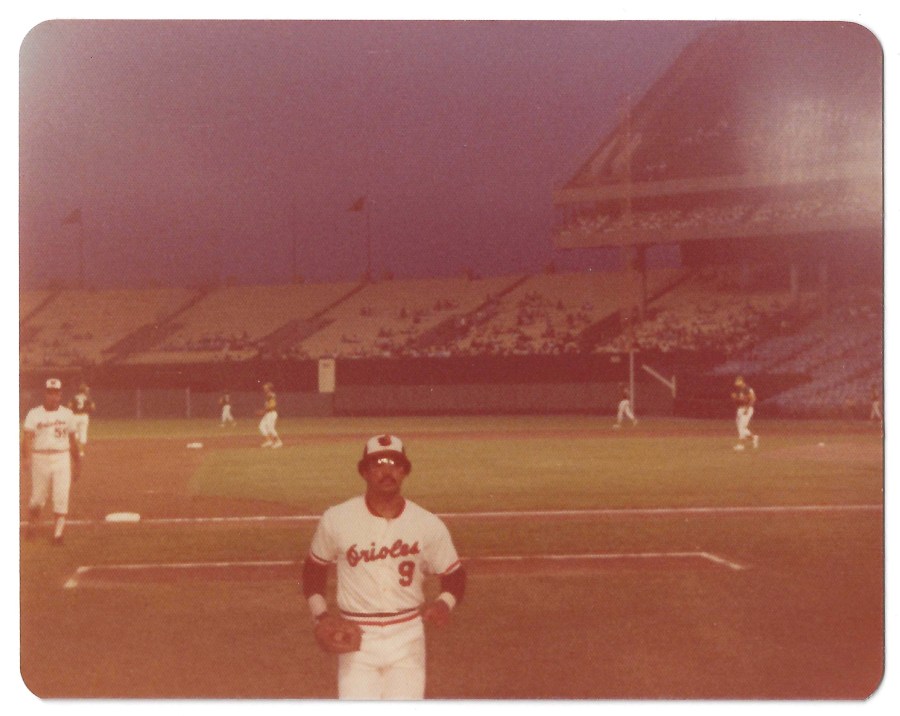
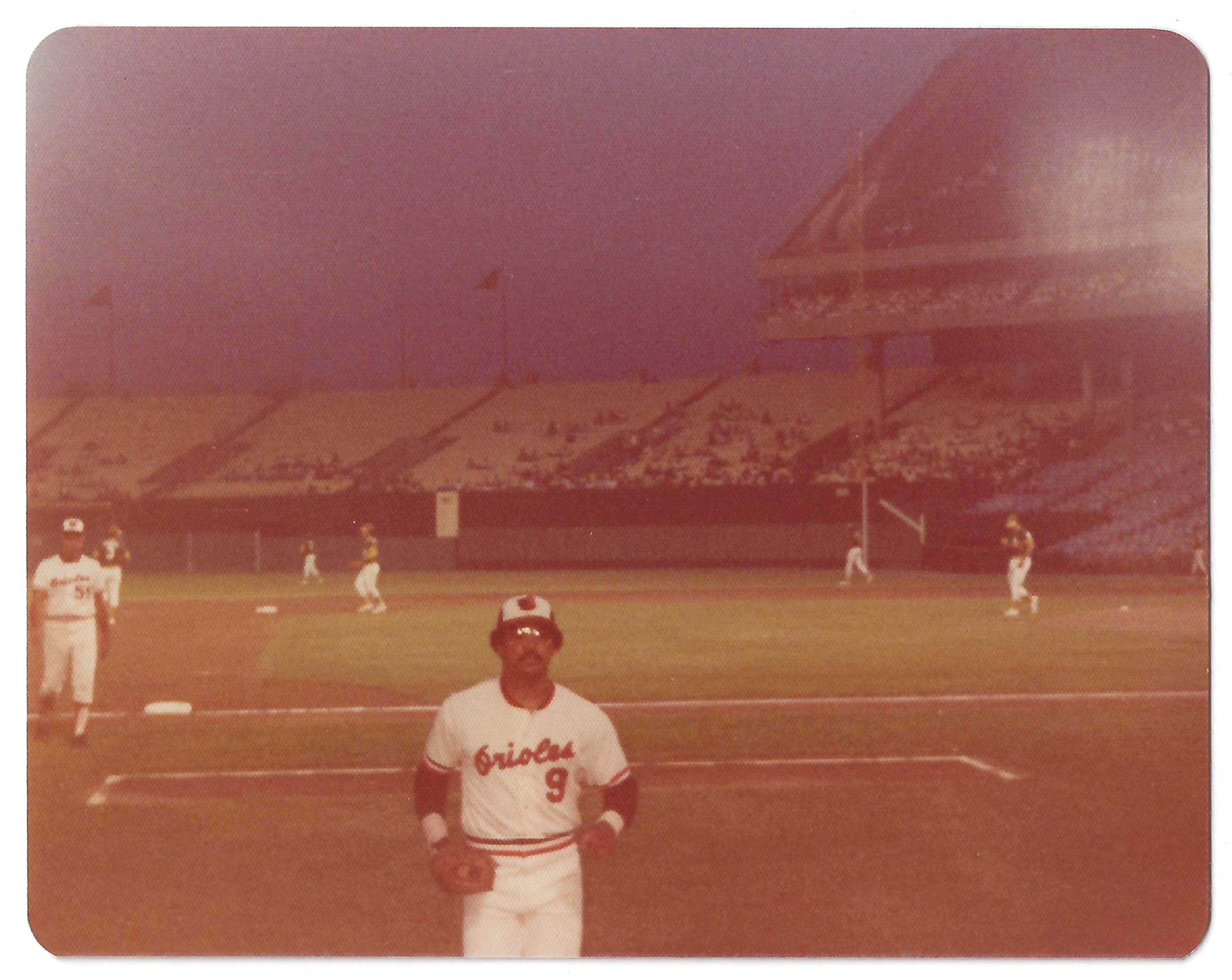
While browsing and chatting, I came across this photo of Reggie Jackson, which I assumed was from the Baseball Nostalgia archives. It’s a cool shot of Reggie as an Oriole, and that was enough for me. Until Todd and I got back home and sat at the kitchen table.
What was this picture, and why was it taken? Reggie spent the summer of 1976 in Baltimore, so that’s interesting, maybe enough to warrant bringing your camera to the game, maybe not. The key was in the background; Todd, as expected, clearly saw that the Oakland A’s were in town! Now that is worth recording – Reggie, in his new home, playing his old team. It seemed exciting to me, though clearly less to the sparse crowd at Memorial Stadium.
I was quickly obsessed. When was this taken? When did the A’s come to Baltimore?
The first scheduled visit for the A’s was a three-game homestand between April 30-May 2. It was a big deal, and NBC had it featured as the Game of the Week, hoping Reggie would play. He had started the season late, a spring holdout for $200,000 per year from Oakland leading to a trade to Baltimore on April 2 and a delayed start to his season. Reggie probably sat out Friday night thinking that his first game of the season should be before a national audience!
Best laid plans, and so on. The game was rained out and rescheduled as part of a May 2 doubleheader.
Todd and I tried to identify some of the players in the background as a starting point. We spotted Phil Garner, but that was no help. Garner played in every one of the A’s-O’s games. In the outfield was a player with a single-digit uniform number. Probably Bill North, but again, no help. It could also have been Cesar Tovar or Denny Walling, but that didn’t get us any further.
As our focus alternated between Retrosheet boxscores of all of the April games the A’s played in Baltimore and the photograph, we saw, relatively clearly, a lefty pitcher in the middle of the picture. Now we were getting somewhere. That could only be reliever Paul Lindblad. That was important and the key clue.
Obviously, our photographer recognized the historical import of Reggie’s first game against the only team he’d ever played for, got a fantastic seat behind the Orioles dugout, and took a great photo of Reggie. The photo had to have been taken before the bottom of the 5th, 6th, or 7th, when Lindblad would have been around the mound as the Orioles got ready to bat. Mystery solved!
But was it? I wasn’t so sure. The bleachers are nearly empty, and the stated attendance for the May 2 doubleheader was 24,819, pretty solid for Baltimore, though you’d expect more for Reggie’s first appearance against the A’s. Maybe people had left, tired after Game 1, but by the 5th inning? No way. Also, the sunset that day was at 8:01, and it’s clearly nighttime. Mystery unsolved!
The A’s returned to Maryland for a three-game stand from August 23-25. Vida Blue, a lefty, pitched a complete game shutout in Game 1, but Blue wasn’t a white lefty. The 23rd was easily eliminated.
On the 24th, Lindblad pitched, the only lefty appearing in a game that saw both Mike Torrez and Stan Bahnsen pitch for Oakland. Attendance was abysmal, 9,482, so that checks. And it was a night game!
The 25th was easy to ignore. It was a righty-only night of pitchers for Oakland – Paul Mitchell, Dick Bosman, and Jim Todd.
This photo was taken on August 24, entering either the bottom of the 8th or 9th inning. Reggie was headed to the dugout for the Orioles’ turn at bat. Mystery re-solved!
Reggie, looking right at the camera, and me, knew I’d get it all along.
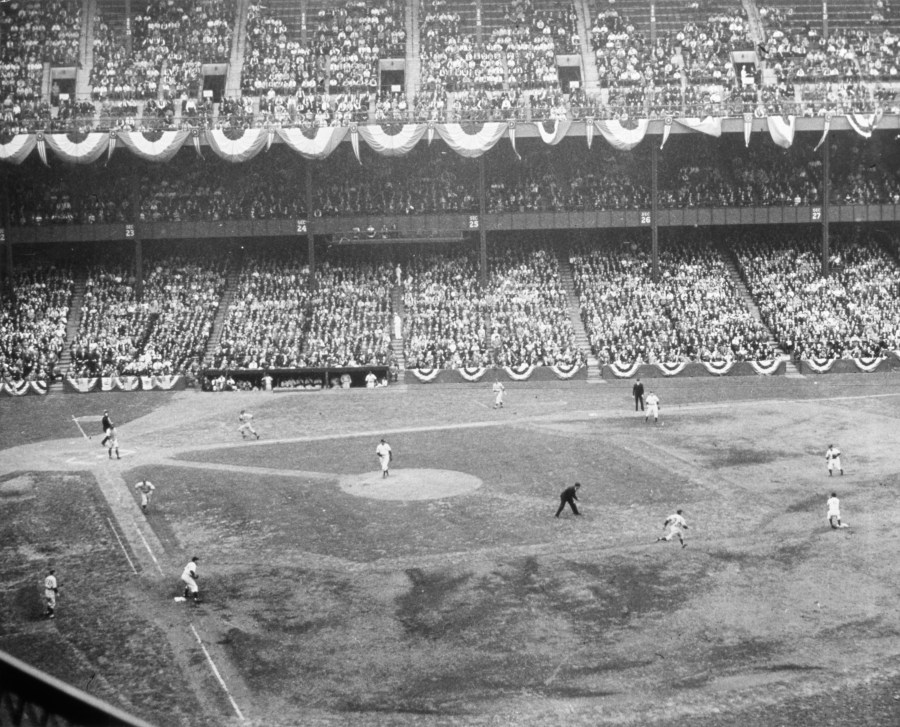
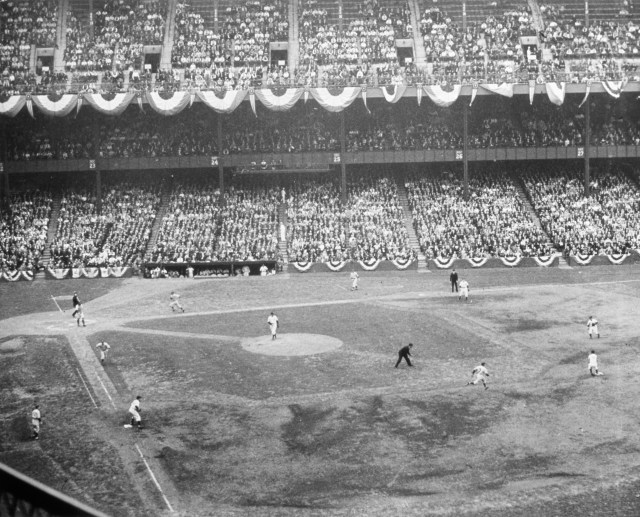
I was working in the SABR-Rucker collection, trying to add missing information, and I came across the photograph above. When I searched the internet, I found it had previously been identified as Game 3 of the 1943 World Series at Yankee Stadium. After reexamining the photograph, I realized it is neither from 1943 nor from the World Series. I will go step-by-step to show the research done to determine which game this photograph is from. To all my school math teachers who said, “Please show your work.” Well, here it is.
The first task was to confirm that it is Yankee Stadium. The facing of the second deck, featuring rectangular designs and numbered sections, clearly distinguishes it as Yankee Stadium.
The biggest clue that the photograph is not from the 1943 World Series came from the bunting hanging on the facing of the third deck.
This photograph shows a well-known incident that occurred during Game 1 of the 1943 World Series when a plane flew over Yankee Stadium. Overlayed with the red border is the bunting from our photograph. The bunting in our photograph includes pennants with stars and stripes hanging down, whereas the bunting in the 1943 photograph does not. So our photograph is probably not from 1943.
I started looking to see if I could find images of the Yankee Stadium bunting for other World Series of that era. After examining photographs from several World Series in which the Yankees participated, I was able to rule out 1939, 1942, and 1943 based on the bunting. This photograph from the October 3, 1941, Daily News proved to be a match to the bunting from our photograph. So our photograph has to be from the 1941 World Series, right? Well no. Let’s see how that was determined.
It took some work to rule out the 1941 World Series. Only Games 1 and 2 were played at Yankee Stadium, which helped narrow down the amount of information I needed to be weeded out. I wanted to determine which team was in the field and which team was batting, so I looked closer at the pitcher on the mound. The pitcher is wearing a New York Yankees uniform. With this in mind, we can begin examining the other players on the field and matching them up with play-by-play game records.
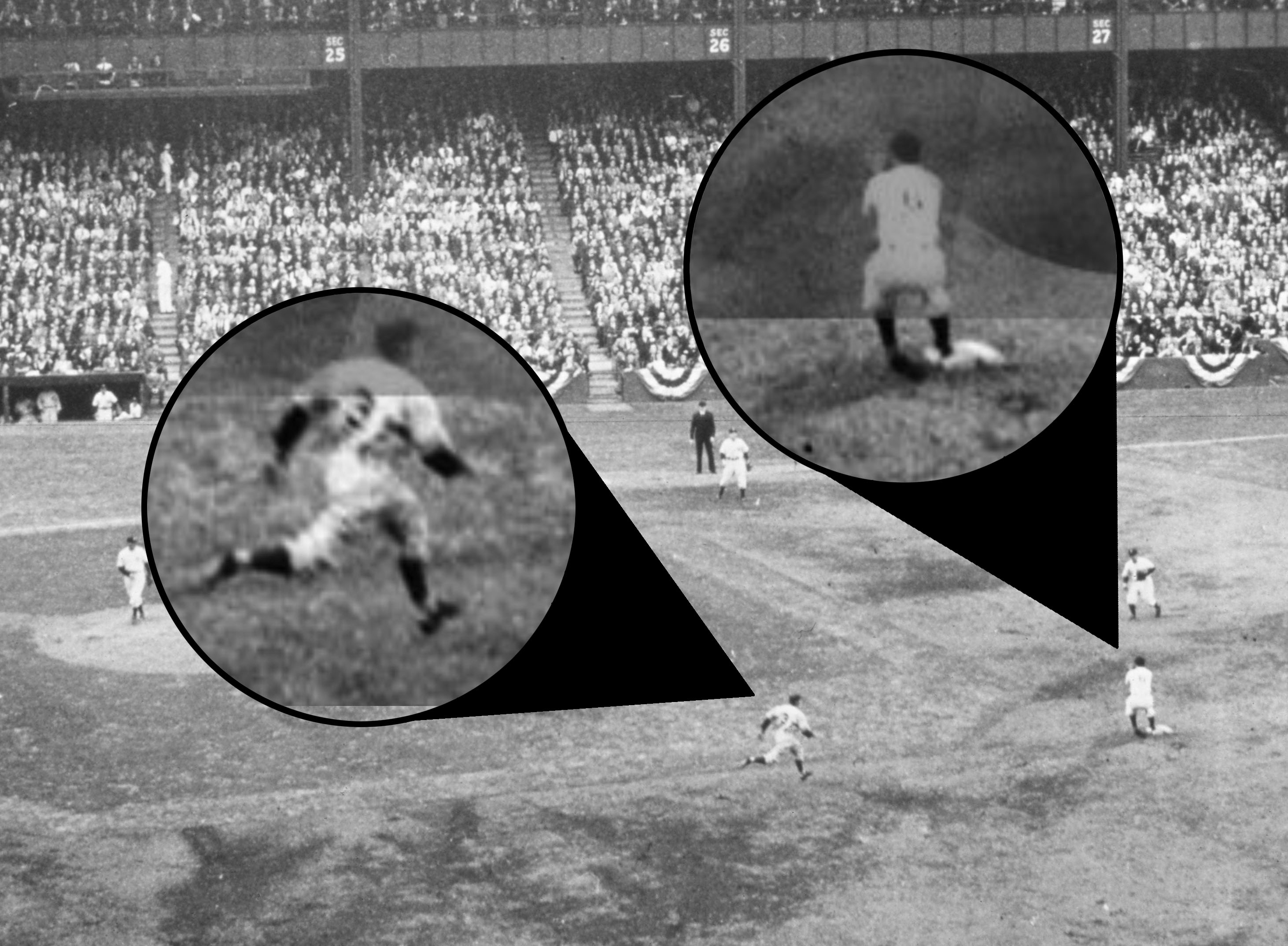
When looking at our photograph, I can tell that the play started with runners on first and third base. The batter hit the ball to the shortstop, who flipped the ball to the second baseman for what was probably a double play. Using Baseball-Reference.com, I searched the play-by-play records for the first two games of the World Series to identify a matching situation. Runners on first and third, and a 6-4-3 double play by the visiting team. I found nothing! Coming up blank, I started to look more closely at the players and their uniform numbers.
I focused on the Yankees’ second baseman and the runner heading to second base. Refer to the photo in question with magnified insets below. The Yankees’ second baseman is wearing number 6, which matches up with Joe Gordon. However, Gordon played in five World Series with the Yankees: 1938, 1939, 1941, 1942, and 1943. The unknown base runner is wearing number 3. The player who wore number 3 for the Brooklyn Dodgers in the 1941 World Series was Pete Coscarart. Great, except for the fact that Coscarart did not play in Game 1 or 2 of that year’s World Series. That ruled out Coscarart. Checking the teams that played in the World Series against the Yankees in 1938, 1939, 1942, and 1943, and the players that wore number 3 for those teams, also ruled out those years.
I started thinking about other games besides the World Series that might have bunting around the field. They would normally bring out the bunting on opening day and maybe on the Fourth of July. I delved into the Yankees’ 1941 home opener, which was played against the Philadelphia Athletics on April 15. Looking at the boxscore, I found Joe Gordon played second base for the Yankees, so that fits, and Pete Suder wore number 3 for the Athletics, so that fits.
A jersey number that had escaped me was that of the first base coach. He is wearing number 27. Since Baseball-Reference does not list the jersey numbers of coaches, I looked on eBay until I found a 1941 Philadelphia Athletics scorecard. There, I found that Coach Earle Mack wore number 27, another match for our photograph. See the scorecard just below with a magnified inset from the photo in question.
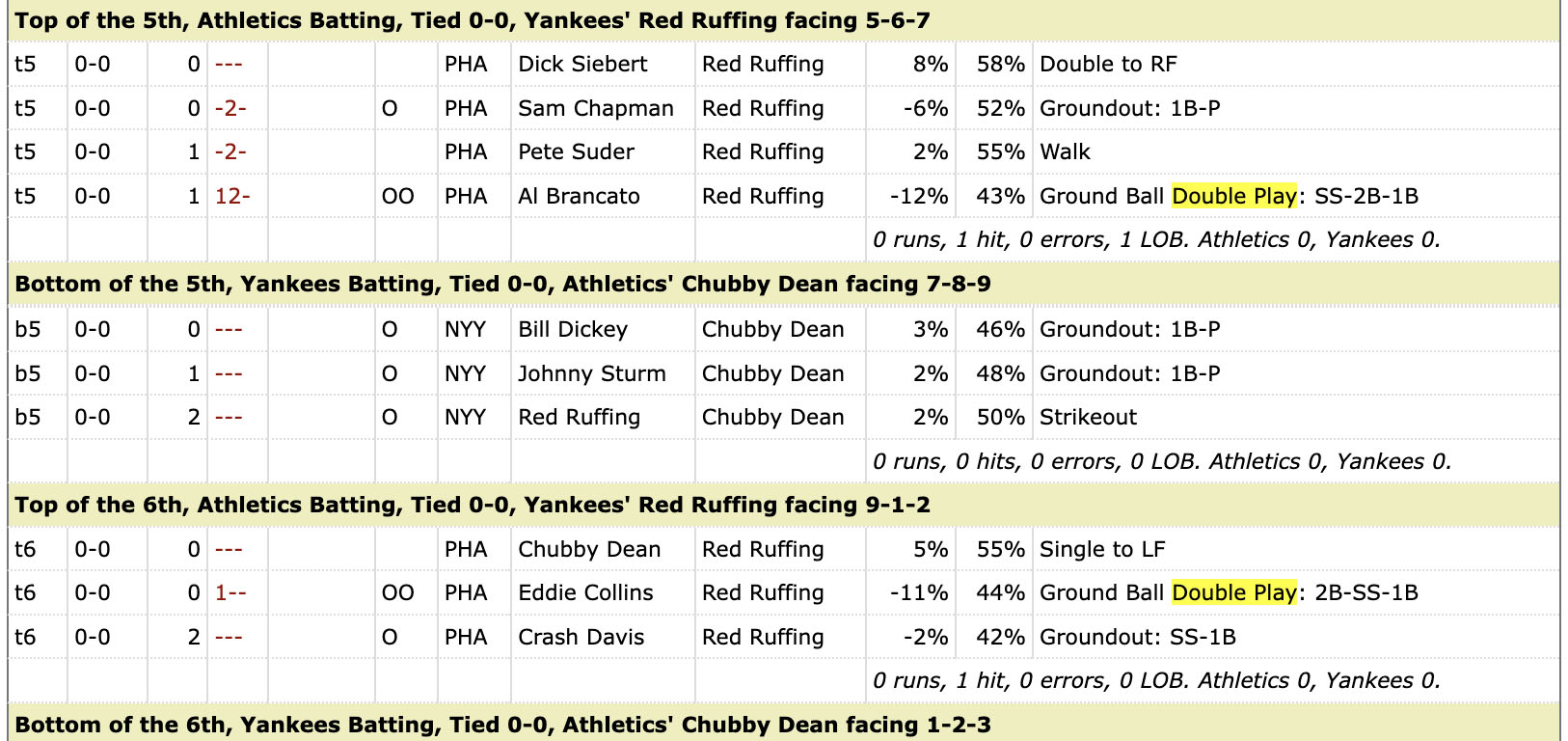
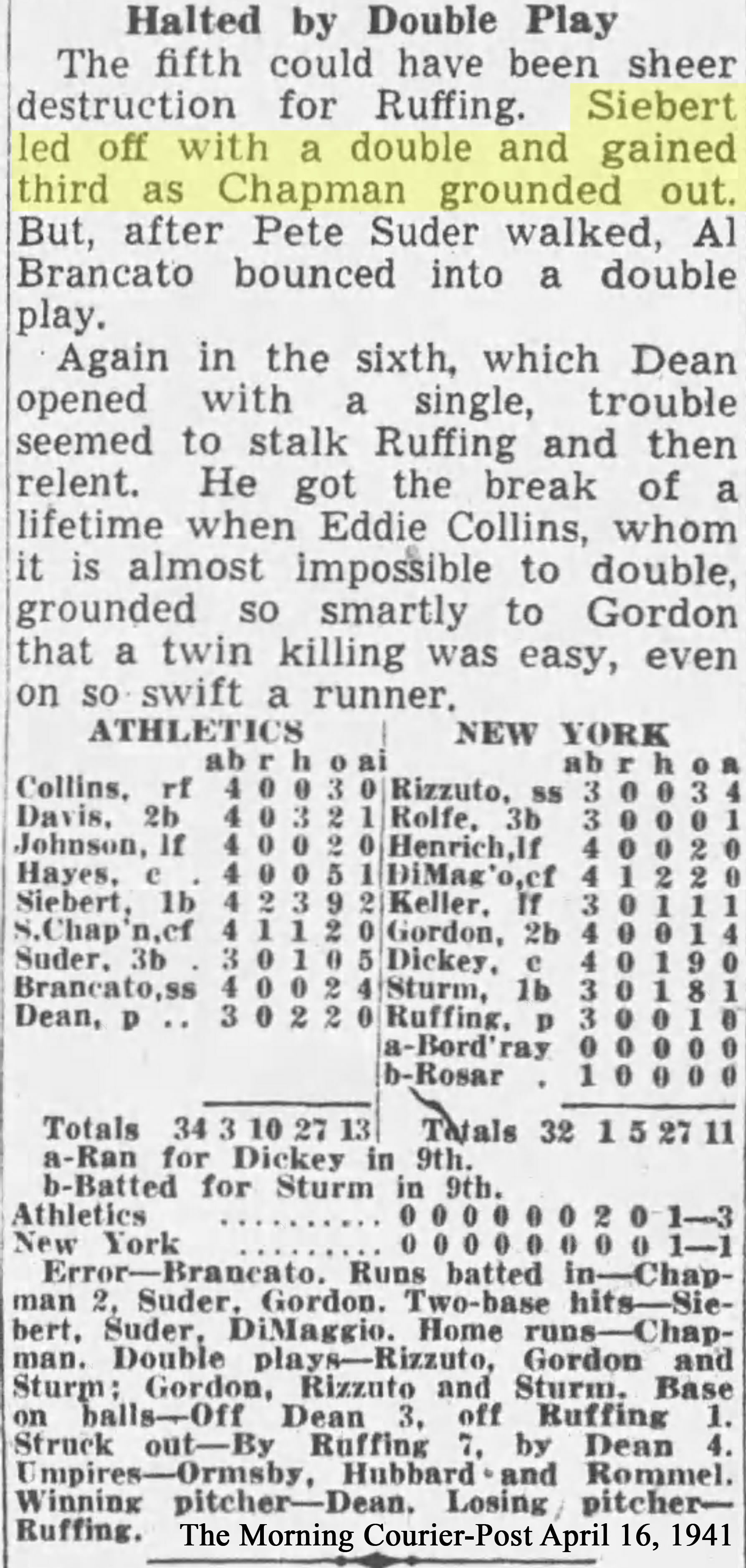
Looking back at Baseball-Reference for the play-by-play of the 1941 New York Yankees home opener, we find the Athletics hit into two double plays. One by Al Brancato in the Top of the 5th inning and one by Eddie Collins Jr. in the top of the 6th inning.
The double play hit by Brancato is interesting because Pete Suder is the runner on first base. However, according to this play-by-play, Dick Siebert is on second base, and we are looking for a runner on third base. Could Siebert really have run from second base almost all the way to home plate as shown in our photograph? Even with a running start, could Siebert have gone that far?
So close and just one mystery to solve in Dick Siebert. Then I found the missing piece in the April 16 edition of the Morning Post Newspaper (Camden, NJ). “Siebert led off with a double and gained third as Chapman grounded out.” The play-by-play on Baseball-Reference was incomplete; Siebert was on third base, not second base, when Brancato hit into a double play. (Baseball-Reference and Retrosheet have already been informed about the new information) Now all the pieces fit. The bunting on the grandstand was from 1941, not 1943. Pete Suder was the runner wearing jersey number 3 on his way to second base. Al Brancato did hit into a 6-4-3 double play. And Dick Siebert was on third base, not second base.
Conclusion: The photograph is not from Game 3 of the 1943 World Series at Yankee Stadium as originally described. It is from the April 15, 1941 Yankee Stadium home opener against the Philadelphia Athletics.
Let’s face it. When it comes to photos, the Babe Ruth, Hank Aaron, and Willie Mays fans have it easy. A pic of the Babe pitching? No problem, take your pick! How about the Hammer hawking breakfast cereal? Sure, we’ve got that too! Or the Say Hey Kid making an incredible catch? Where do we even begin!
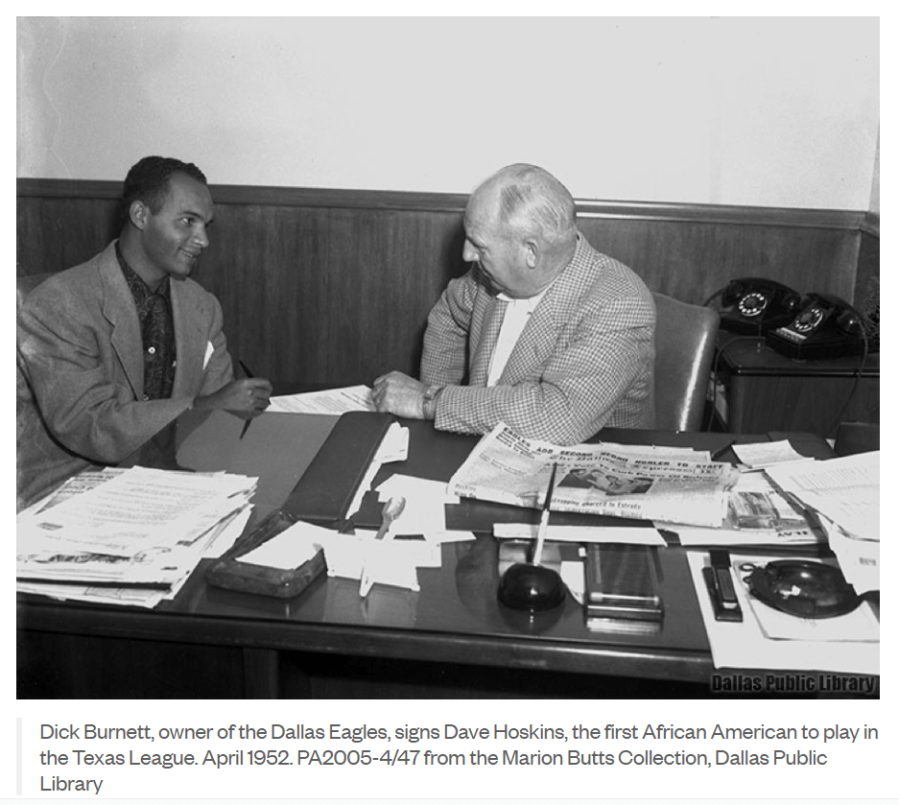
Of course, when the player of interest is a bit more obscure, finding that perfect photo can feel like a miracle. Such was certainly the case for me when my research and collecting interests in Texas League pioneer Dave Hoskins led me to the sort of photo I wouldn’t have imagined existed: Hoskins signing his contract to join the Dallas Eagles in 1952 as the Texas League’s first Black player.
True, the occasion was historic, so why shouldn’t there be a picture? But to see it so sharp and vivid, that was another matter altogether. Even better, the same Marion Butts Collection at the Dallas Public Library has several other tremendous photos of Hoskins from his historic 1952 season.
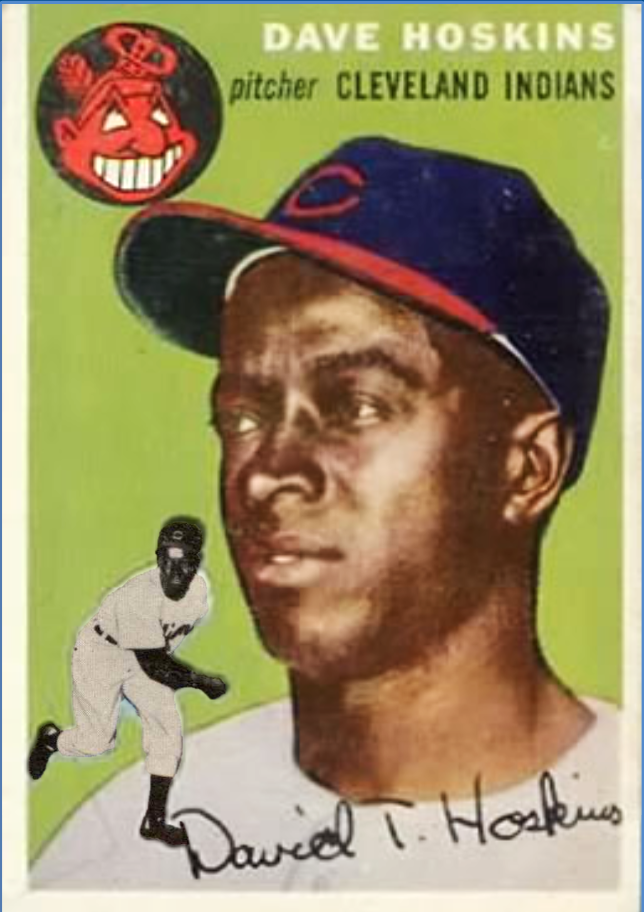
Still, there was a part of me not fully ready to celebrate this miracle. Granted I didn’t have a ton of other early 1950s images of Dave Hoskins against which to compare, but I couldn’t help thinking the ballplayer in the photo didn’t really look like Hoskins.
1954 Topps baseball card
The result was that I shied away, out of an abundance of caution, from including the photo in the various articles and presentations I was working on. Maybe it was Dave Hoskins, but maybe it wasn’t, right? Of course, we SABR members aren’t big on leaving things in limbo, and in this case the answer really was hiding in plain sight.
Though all my attention had been on the ballplayer in the photo, there was a newspaper right there on Dick Burnett’s desk, the not yet digitized Dallas Express, and while the date wasn’t readable the headline was: “EAGLES ADD SECOND NEGRO HURLER TO STAFF.”
Case closed. The player in question was not Dave Hoskins but Puerto Rican pitching legend Jose Santiago, who joined the Eagles several weeks after Hoskins.
Custom baseball card
Just to put a bow around things, I sent my findings to Brandon Murray, archivist for the Dallas Public Library. Here was his response:
“I checked the microfilm, and the photo ran in the May 31, 1952, issue of the Dallas Express. It is indeed Jose Santiago according to the caption. I’ve updated the information in our new content management website and our internal records.“
So the bad news is that a would-be historic photograph documenting the integration of the Texas League really doesn’t exist after all—or at least remains unknown to me personally. But the good news, and this matters here in the world of SABR, is that the pictorial record just got a tiny bit more accurate. Plus, this is a case where Hoskins’ loss is Santiago’s gain. Santiago was not only the “Larry Doby of the Texas League” but also the circuit’s first Afro-Latino player. His signing deserved a photo, and now it has one!
Discovery and Primary Research, Jim Chapman; Supplementary Research, Justin McKinney; Editor, Mark Fimoff.
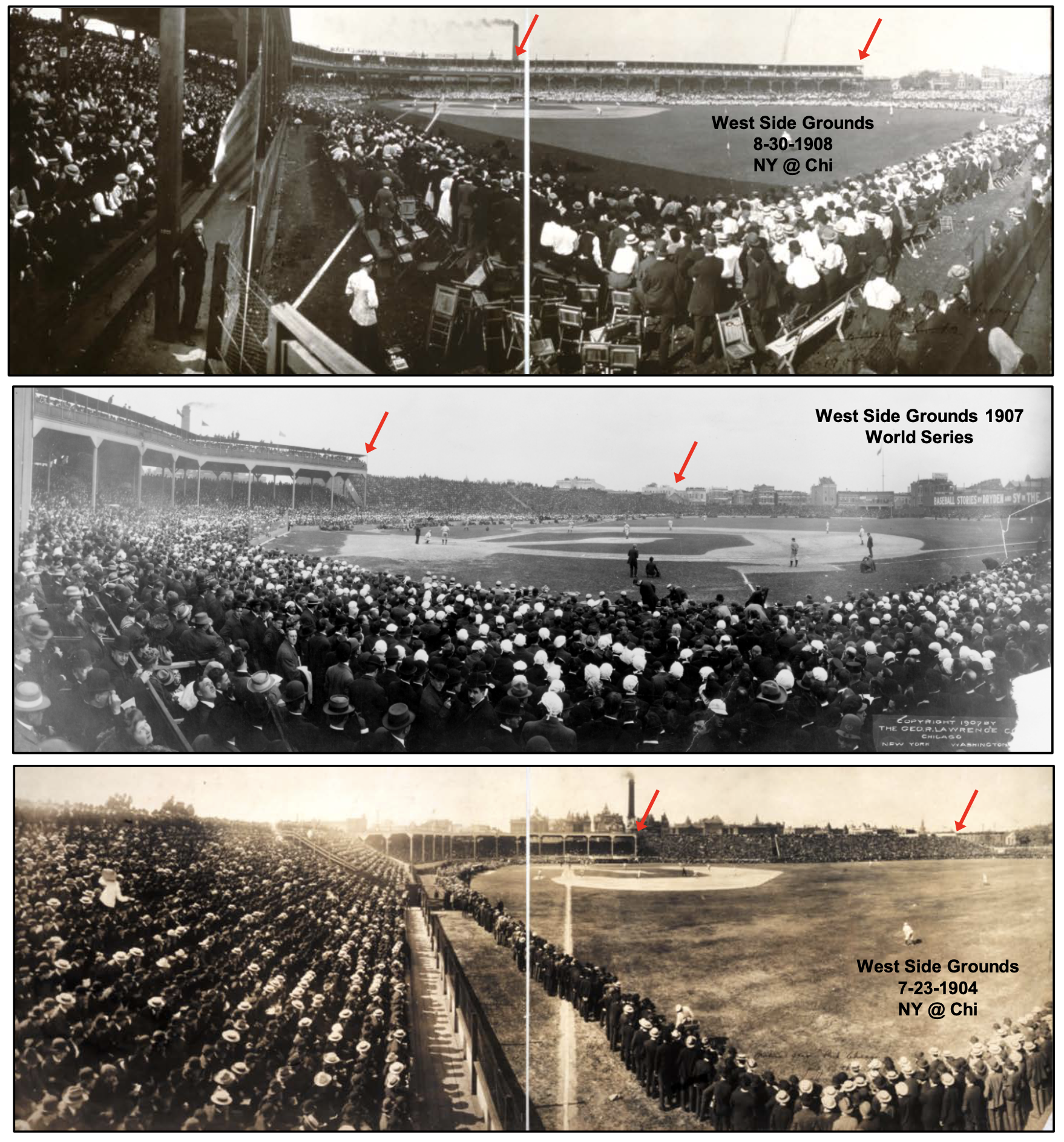
Fabulous panoramic photos of the Cubs’ home West Side Grounds (WSG) can be found on the covers of Deadball Stars of the American League and Deadball Stars of the National League, depicting scenes from 1908 (just below) and 1907 (2nd from top), respectively. This ballpark was home to the Chicago NL club from 1893 through 1915.
Photos taken of and in WSG from the period 1901–1915 are plentiful and easily found. Over those years, a series of modifications and additions are apparent. During the 1908 season, upper deck seating was added running down both the left and right field foul lines. The left field line addition is seen in the 1908 photo when comparing it to the 1907 and 1904 photos (red arrows). Analysis of WSG photos and debunking of bogus claims has been covered here before: Reflecting the Past Number 2016:1 Jan. 2016 Reflecting the Past Number 2014:1 April 2014, Pictorial History Committee Newsletter Number 2010:3 October 2010
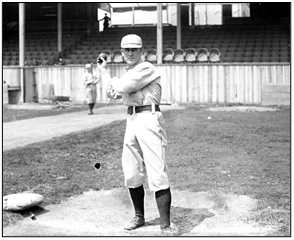
Some photos from the Chicago History Museum’s Chicago Daily News collection, taken inside the park in 1901, are shown here, with Bert Cunningham posing left, and Rube Waddell standing in front of some dirty laundry hanging in front of the center field clubhouse. The collection has no WSG photos prior to 1901.
We also present a view from the 1902 season that depicts Jim St. Vrain on the mound with a clear view of the left field line grandstands, just below. An image of Dusty Miller from the same year provides a view of the roofed grandstands just behind home plate. Though the ballpark opened in 1893, we had never seen any earlier WSG photos anywhere. The 1890s at WSG were oddly dark.
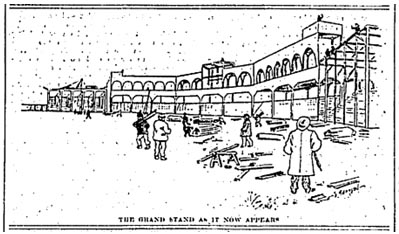
A few known woodcut images from Chicago newspapers did create some illumination. The WSG grandstand under construction is shown below as it appeared in the 04-14-1893 Chicago Record. The description therein reads:
New West Side Ball Grounds…Seats for Thirteen Thousand…A small army of workmen is engaged on the new ball grounds of the National League club at Lincoln and Polk streets…put in readiness for the opening Sunday game on May 13.
These grounds will be the scene of the Sunday games played by the league club this year…The present calculation is for a seating capacity of 13,000…Mr. Hart says that no more will be admitted to games than can be supplied with seats…Experience has shown…[that] crowds are much more unruly if not seated, and inasmuch as we expect to have the best decorum at Sunday games, we will not tempt the disorderly element by letting them in without having a place for them to sit.”
The grandstand is to be the largest in the country, but no work has yet been done on the bleachers [take noteof that]…they may eventually skirt the entire outfield…The worst defect about the grounds is a short right field…
The grandstand faces southeast, the main entrance being at the corner of Lincoln and Polk streets, but there will also be gates at which tickets will be sold to the bleachers.
A contemporary 1893 drawing of the plan for West Side Grounds appeared in the Chicago Tribune as the ball park neared completion.
The caption read: The above cut shows the plan of the new West Side baseball grounds at Lincoln and Polk streets, now rapidly approaching completion. The grounds can be reached by the Ogden Avenue, Van Buren, Harrison, Taylor, and Twelfth street cars. They [the grounds] are 475 feet square, exclusive of the carriage yard [i.e. parking lot]. The seating capacity is enormous, consisting of 3,000 folding arm chairs, 500 arm chairs in fifty-six private boxes, 4,500 seats in a covered pavilion, and 5,000 open ones. Eight hundred thousand feet of timber were used in the construction of the stands. The diamond will be 90 feet from the grandstand. The right field and left field fences are 340 feet from the home plate, the extreme center filed is 560 feet. The Cincinnatis will open the park May 14. It is probable that after this season all the games will be played there.
We should take note of the planned capacity of 13,000. That’s all very nice, but still no photo.
My jaw dropped when collector/researcher Jim Chapman sent me this scan:
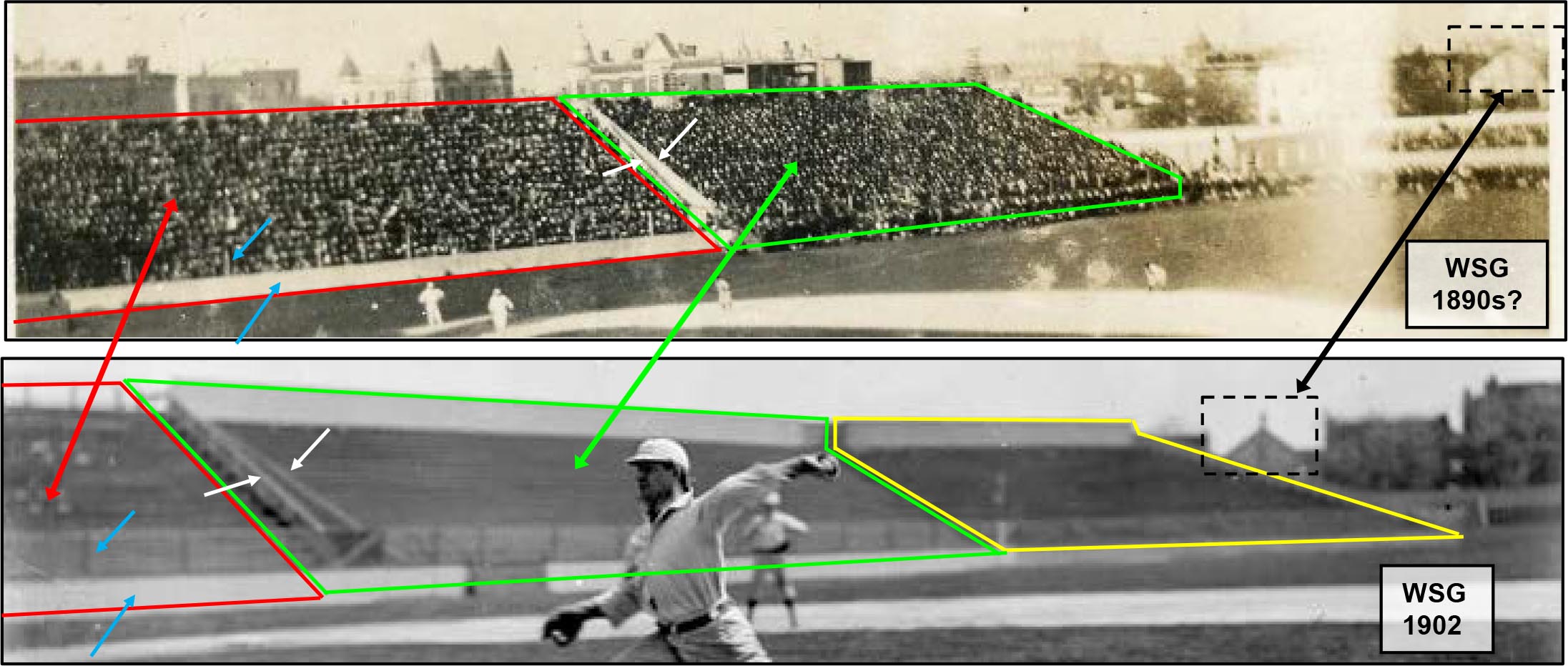
It was in a scrapbook with a label below the photo reading, “Ball Park West Side – Chicago.” Though there is some difference in ballpark structure when compared to the 1902 version of West Side Grounds, it was apparent that this was indeed an image of the same place, and if the seemingly contemporary caption written on the photo is to be believed, this dates to when the N.L. had a team in Baltimore. So, when would a Chicago vs. Baltimore matchup been possible at the West Side Grounds? That would have been between 1893 and 1899, after the West Side Grounds were built and both teams played in the National League. Let’s first compare this photo to West Side Grounds in 1902.
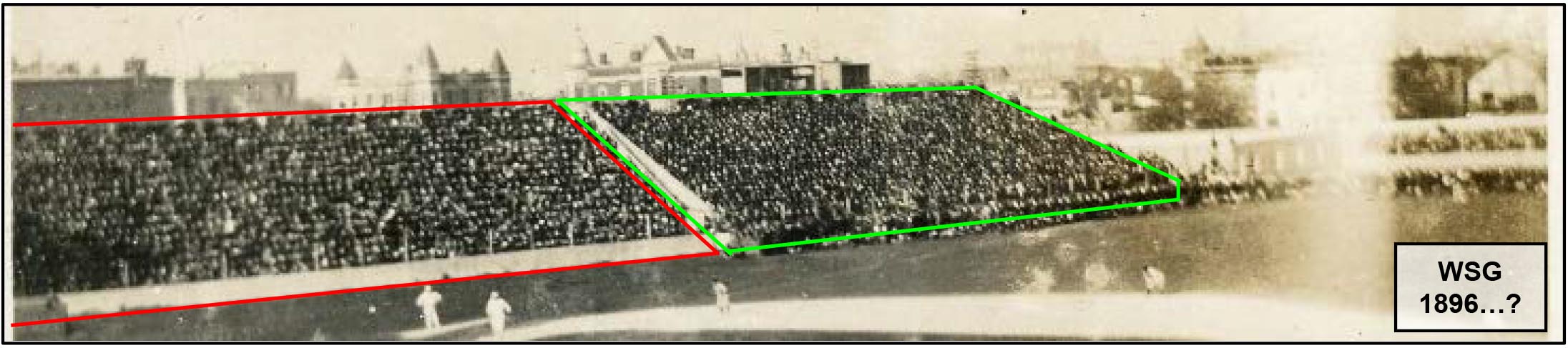
Below we have the left field line area seating from the photo in question at top, and the left field line seating at West Side grounds as seen in 1902 at bottom. For spatial reference, the dotted black line squares denote the same building in both images. The green and red boxes outline the same sections of seating in both images. The yellow outlined section of seating is present in 1902, but is missing from the photo in question. It is reasonable to think that the scrapbook photo is therefore at least pre-1902. Note particularly the double dividing fences between the red and green sections (white arrows) which seem to have a unique structure and are identical in both photos. Also note that matching details for the fencing in front of the seating (solid base for bottom half, screen with fence posts for top half, light blue arrows).
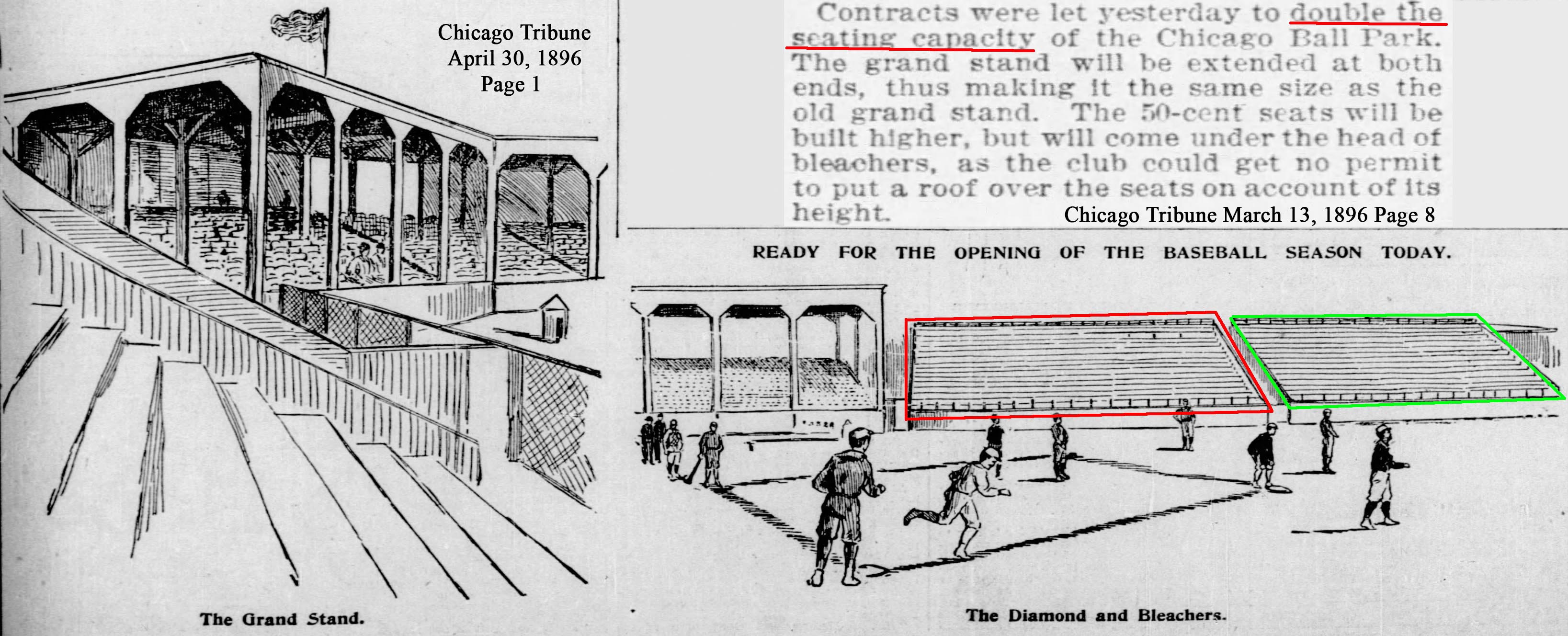
The March 13, 1896 edition of the Chicago Tribune, page 8, is reproduced below. Also, a permit for the new construction was reported in the Tribune on April 3, 1896. While we can’t be sure whether or not any seating was actually provided for the red and green areas when the park opened in 1893, it appears that the red and green sections in the photo in question matches that in the 1902 photo (and, as previously stated, this includes the details of the dividing fence and fencing in front of the seating areas). Therefore it is a good bet that the photo in question depicts these new “bleachers” dating it to 1896 or later.
A woodcut depicting the new construction (above) appeared in the Chicago Tribune on April 30, 1896. The red and green seating areas are marked and the photo in question is again reproduced below the woodcut. The date of the further addition of the yellow section remains unknown. We only know that was after 1896 and earlier than 1902.
The Tribune’s phrase “double the seating capacity” raises some confusion. As previously shown, the original plan was for 13,000 seats. We can be certain that the 1896 construction did not come close to expanding the ball park to 26,000 seats. One source* pegs capacity at 14,200 in 1908, and that is after the addition of the yellow section, expanded outfield bleachers, and a modest amount of upper deck seating. Our best guess is that when it opened in in 1893, the park had substantially less than the planned for 13,000 seats (initially no seats in red and green areas?). We expect that the initial planned capacity may have been reached after the new construction in 1896. Then, a crowd of, say, over 15,000, would still result in noticeable fan overflow onto the field.
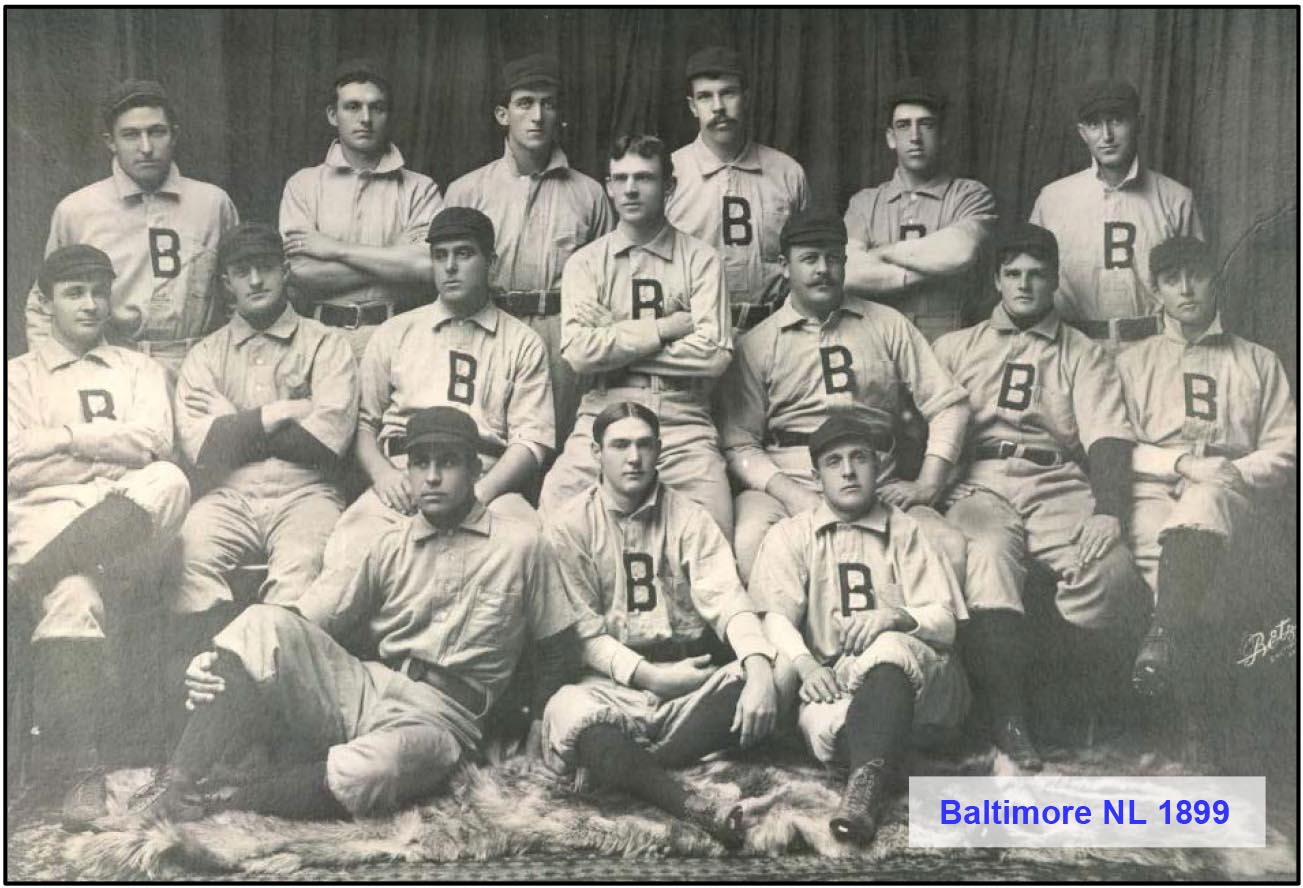
For Chicago, the 1896-1899 seasons were pretty miserable. To the contrary, for Baltimore, there was a National League pennant in 1896 (as well as 1894-5) and 2nd place finishes in 1897 and 1898. It seems like a good guess that one of those squads could draw an overflow crowd to WSG. Let’s see if we can narrow down the date. We can start by focusing in on the uniforms.
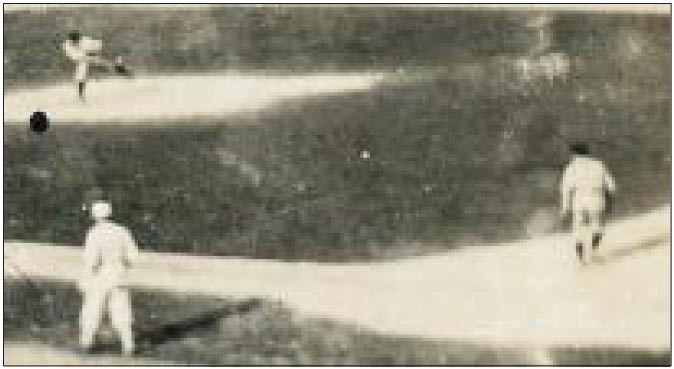
Zooming in on our photo, the truth is we can’t see much. One team is all in white, the other appears to be a few shades darker (like road gray) with dark caps and socks.
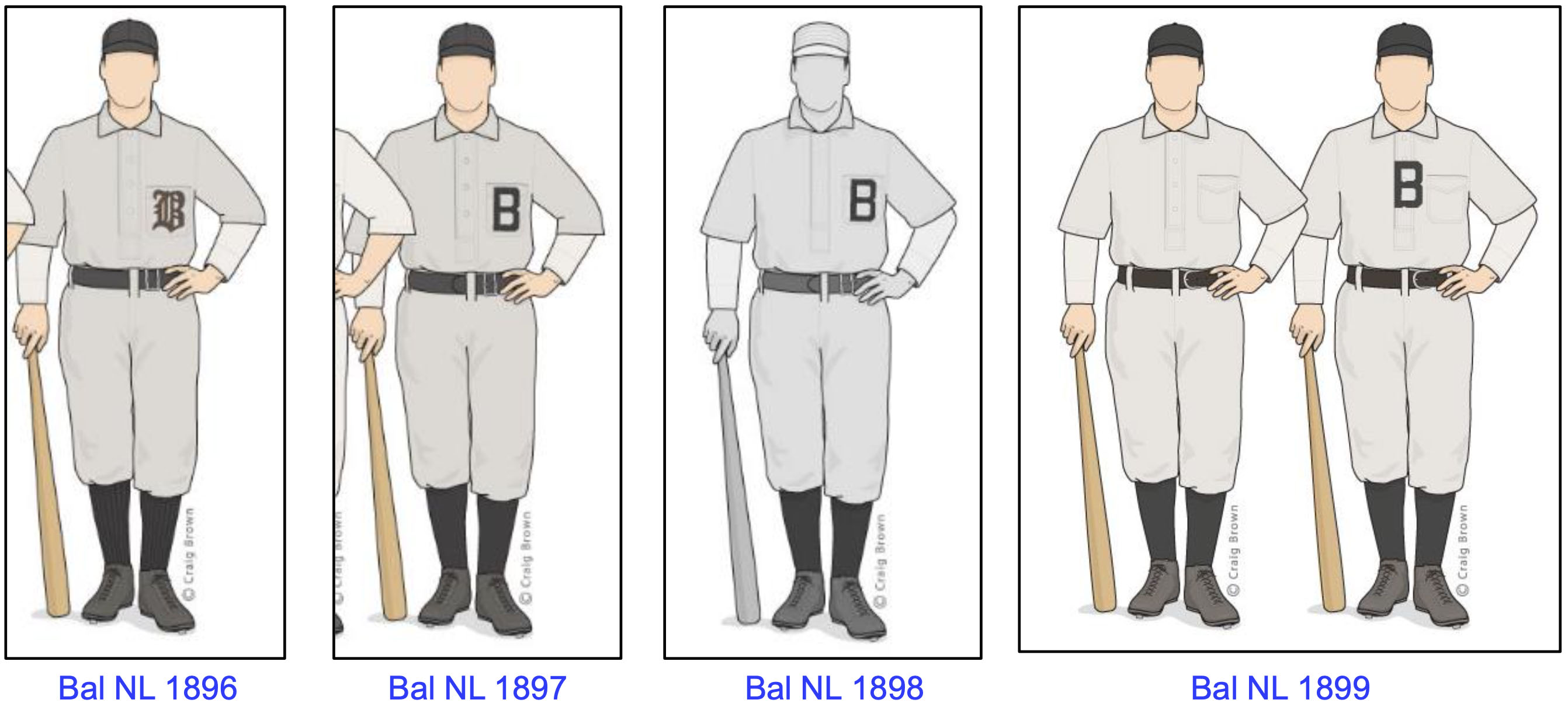
For 1899 things are a bit more interesting with the addition of a logo on the cap. If you are interested as to why there is a “Y”, it was a recognized representation used for the City of Chicago. Details are here, again courtesy of Craig Brown’s site. https://www.threadsofourgame.com/1899-chicago/
Given the lack of sharp detail for the photo under discussion, all we can say is that any of the above uniforms are consistent with it.
In the WSG photo the visitors are wearing dark caps and socks. Comparing this to Craig Brown’s road uniform renderings below, this is again consistent with the 1896 and 1897 seasons, but not 1898. The 1898 Baltimore team photo, taken on the road, does show white (or gray) caps. The 1899 team photo and also Threads rendering far right does show a reversion to dark caps and socks. This also indicates a likely date range for the WSG photo to 1896-1897, with 1899 still possible.
Given the large overflow crowd present in the WSG photo, let’s take a look at attendance figures for Baltimore visits to WSG in 1896, 1897 and 1899. These numbers are from the Chicago Tribune and The Daily Inter-Ocean reports. Note that the largest crowd for a Baltimore visit in 1898 was only 7,500, so that along with the uniform mismatch for both teams adds certainty to the elimination of 1898 from contention. The three candidates are shown in red.
1896
May 14 Thur
2,500
May 15 Fri
4,500
May 16 Sat
9,000
May 17 Sun
18,921
July 7 Tue
4,600
July 8 Wed
6,100
1897
May 30 Sun
17,800
May 31 Mon
2,650
July 15 Thur
4,135
July 16 Fri
5,184
July 17 Sat
10,280
July 18 Sun
12,250
1899
May 19 Fri
2,700
May 20 Sat
7,000
May 21 Sun
17,617
July 22 Sat
7,500
July 23 Sun
9000
July 24 Mon
2,700
July 25 Tue
3,000
Red indicates an expectation of considerable fan overflow onto the field.
It appears from the photo that the Baltimore pitcher was a right-hander. For the dates in red, righty Bill Hoffer pitched in 1896 and 1897, and righty Joe McGinnity was the hurler in the 1899 game. That is consistent with the photo, but no help in narrowing down the date.
The largest crowd was for the 1896 game, and the May 18, 1896 Chicago Tribune described the overflow of fans onto the field (see right). For the 1897 game, TheDaily Inter Ocean described a crowd “which poured out on the field.” Given the attendance figures, it seems that this must have also occurred for the 1899 game.
The 1899 game seems the less likely of the three due to the home team in the photo wearing light colored socks. What we can say is that, to date, this the earliest known photo of West Side Grounds and that it is a National League Baltimore vs. Chicago game action image that took place on one of three possible dates in the 1890s. That’s not bad.
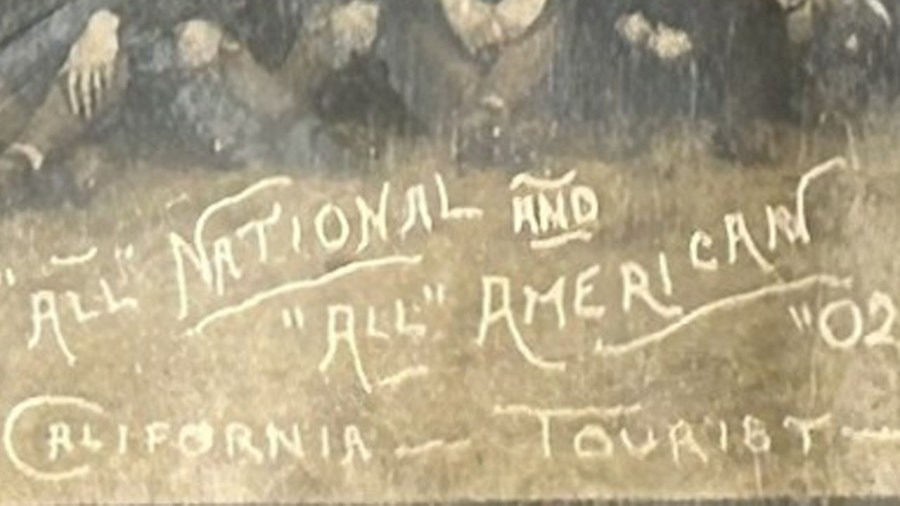
A group photograph of major league baseball players on a 1902 post-season tour of the Midwest and West Coast appears on page 136 of The Life, Times, and Tragic Death of Pitcher “Win” Mercer, written by SABR-member Jimmy Keenan. The photo is labeled “ALL” NATIONAL AND “ALL” AMERICAN “02” CALIFORNIA TOURIST, and the photographer’s name (presumably) is in the lower left corner–G.H. Meyer of Kansas City, Missouri. Those who had played for National League teams during that season are wearing dark uniform shirts and caps in the photo, and those who had played in the American League are wearing white shirts with contrasting collars and light-colored caps. Bob Harley, the grandson of Dick Harley, had sent the photo to Keenan. Recently, a scan of another print of the same photo was posted on an online collectors’ forum, with a request for player identifications. After confirming who was on the tour, I suggested the following identifications:
Back Row (L-R): Mike Kahoe, Jack Chesbro, Bill Donovan, Sam Crawford, Jake Beckley, Joe Cantillon, Win Mercer, Harry Davis, Dick Harley, Bill Bernhard, Monte Cross.
Front Row (L-R): Dick Cooley, Claude Ritchey, Charley Irwin, Charley Dexter, Willie Keeler, child mascot, Topsy Hartsel, Billy Sullivan, Nap Lajoie.
Fielder Jones is on the far right, between the front row and the back row, behind Lajoie.
Most of these IDs seem pretty certain, but the image of the player on the lower left (that I have identified as Cooley) is blurred. Cy Young and Honus Wagner had been on the tour for a few early games, but are definitely not in this picture. Jesse Tannehill, Addie Joss, Jimmy Williams, and Bill Coughlin were with the group for most or all of the tour; of these, only Tannehill was a National Leaguer in 1902 who could potentially be the man on the lower left, instead of Cooley. The teams had scheduled two games in Kansas City, but it is unclear whether both games took place. In the one game that is described in the newspapers, Tannehill pitched for the All-Nationals, making it unlikely that this photo was taken at that game unless I have failed to recognize him. I could not find a complete box score for that game to confirm who else played that day other than pitchers and catchers. Dick Cooley was a native Kansan who had received a lot of press coverage as the tour approached and was unlikely to have missed games in the Missouri/Kansas region; he would probably have been in any group photo taken during that stretch of the tour. The photo may have been taken at one of the other game sites near Kansas City, or during a second game in Kansas City if it occurred.
A few other players joined the tour after it had left the Kansas City area. These included Tom Leahy, Jack Burns, Gene DeMontreville, Bill Bradley, and Bill Dahlen. Dolly Gray, who was still a minor leaguer in ’02, pitched a few games for the All-Americans in California; he would reach the major leagues in 1909. Sylvester Loucks, a career minor leaguer, pitched for the All-Nationals on the West Coast.
Joe Cantillon, then a National League umpire, but later the manager of the Washington Nationals (1907-1909), organized the tour. The original itinerary was as follows:
October 12-Chicago Illinois, 13-Cedar Rapids, Iowa, 14-Des Moines, Iowa, 15-Sheldon Illinois, 16-Lamar Iowa, 17-Sioux City, Iowa, 18 and 19-Omaha Nebraska, 20-St. Joseph Missouri, 21 and 22-Kansas City Missouri, 23-Topeka Kansas, 24-Sabine Kansas, 25 and 26-Denver Colorado, 27-Colorado Springs Colorado, 28-Pueblo Colorado, 29-Trinidad Colorado, 30-Las Vegas New Mexico, 31-Santa Fe New Mexico.
November 1-Albuquerque, New Mexico, 2-El Paso, Texas, 3-Benson, Arizona, 4-Tucson, 5-Phoenix, 6-San Bernardino, California, 9-Los Angeles, 10 through 29-other sites in southern California, 30-San Francisco.
After two to three weeks in the San Francisco Bay area, the teams would perhaps sail to Honolulu for some exhibitions in Hawaii. The All-Americans preceded the tour with a two-game set against the National League champion Pittsburg Pirates on October 7 and 8.
Ultimately, the teams never got to Hawaii; they remained in California through mid-January. After returning east, Dick Harley was quoted as saying, “It was the greatest trip I ever had in all my experience. We had a fine crowd of fellows and we all enjoyed ourselves immensely. The scenery in the various states which we visited was simply grand and the climate was wonderful. At some places, particularly Denver, Albuquerque, and Las Vegas, the climate affected our ballplaying to a considerable extent. Being so accustomed to playing in the East, the rare atmosphere, of course, interfered with our wind. This was particularly noticeable in running, and after making a dash around the bases we were frequently compelled to lie down for several minutes before we could again breathe naturally. The air also had an odd effect on our batting. We would seem to hit the ball as hard as ever, but somehow or other it didn’t seem to go as far or as quickly. The reason, I guess, was that the air affected our eyesight somewhat, and we did not time the ball the way we thought we were doing. From a financial viewpoint, the trip was a success. After having a good time and visiting many points of interest, we cleared more than $550 each over and above all expenses.”1
Though financially successful, the tour was marked by a significant tragedy. On the night of January 12/13, Win Mercer died, apparently by suicide at the Occidental Hotel in San Francisco. He had registered there under an alias; the teams were staying at another hotel. Mercer’s death caught his tour-mates by surprise; he had not seemed depressed. Several suicide notes were found, though some aspects of the notes have led some to suggest that Mercer may not have written them. An excellent discussion of these notes and the events leading to Mercer’s death are in Keenan’s biography referenced above. The last few scheduled games of the tour were played after this event, with the final game serving as a benefit for Mercer’s mother; a sum of $1575 was raised for the cause. Joe Corbett, who had pitched for Washington and Baltimore in the 1890s and would pitch for the Cardinals in 1904, was in the box for the All-Nationals in that game, and Ham Iburg pitched for the All-Americans, though he had played for the Phillies in 1902, his only major league season. Former major league outfielder Bill Lange served as an umpire in the game.
Harley said, “The death of Mercer was a shock to every one of us. He was one of the finest fellows I ever travelled with. Win always was ready for a joke or a good time and made friends with everyone he met on the trip.”2
1 From the Philadelphia Press, quoted in the Washington Evening Star and the Buffalo Courier Express, January 26, 1903.
2 Ibid.
The Win Mercer photo was published in the San Francisco Call and Post on January 14, 1903.
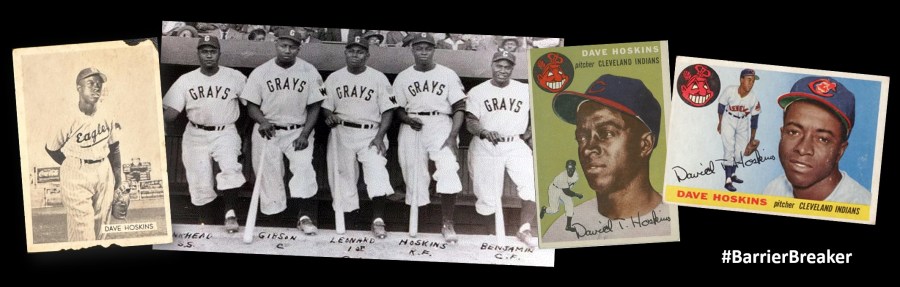
For a player who is part Jackie Robinson, part Shohei Ohtani, Dave Hoskins remains a relatively unknown player in our game’s history. A former member of the Homestead Grays Murderers Row, Hoskins not only integrated the Texas League in 1952 but electrified it, braving verbal abuse and death threats to win 22 games on the mound for the Dallas Eagles (CLE-AA), tally one of the league’s top batting averages at the plate, and set attendance records everywhere he played. It was no surprise then that Cleveland Indians general manager Hank Greenberg saw fit to promote Hoskins to the big club for the 1953 season.
Mound opportunities for Hoskins proved limited as the Tribe already boasted the top four-man rotation in the league. Nonetheless, Hoskins made the most of his appearances, posting an excellent 9-3 win-loss record that trailed only Eddie Lopat of the Yankees in winning percentage among AL hurlers with 12 or more decisions. Hoskins proved he could hit American League pitching as well, tallying a .259 batting average that topped that of the team’s starting first baseman, right fielder, and catcher.
Though the 1954 season would be a historic one for Cleveland, Hoskins saw his usage dwindle significantly, starting only one contest and seeing only 26.2 innings vs. 112.2 the previous year. Underscoring his diminished role, Hoskins was left off the ballclub’s postseason roster and was not invited back for the 1955 season, rounding out the final six years of his career instead as a journeyman pitcher with various minor league and Venezuelan Winter League teams.
Game action photographs of Hoskins, whether with Cleveland or any other team, are few and far between, so I felt incredibly fortunate when my Hoskins eBay search yielded this wonderful color photograph.
The seller (in Australia, no less!) advertised the image as “Pitcher Dave Hoskins of the Cleveland Indians 1953 Baseball OLD PHOTO” and went on to specify size as 8.5 x 11 inches. Assuming Hoskins was indeed the man on the mound, which the action pose on my Dave Hoskins rookie card seemed to support, this photo had a definite home in my collection.
Of course none of us at SABR Pictorial can look at a photo like this and bypass the opportunity to learn even more: questions like where and when the photo was taken, what game action is taking place, and who the various subjects on the field might be. Though such questions can prove unanswerable with some photos, that will not be the case here.
Where and when?
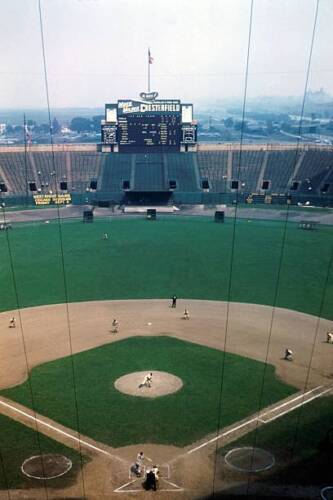
Thanks to the prominent centerfield scoreboard, we know immediately we are looking (perhaps from the press box) at Cleveland Stadium. In other words, this is a home game for Hoskins. Still, that leaves 14 options for the specific game since Hoskins pitched at home 14 times in 1953. Fortunately, we also have a significant detail along the wall in left-center. Though the lettering is a little tough to make out, it reads that the team’s next night game will be against Chicago on Friday, September 4.
Before examining this clue further, I’ll point out first that it affirms 1953 as the year. September 4 indeed fell on a Friday that year, whereas it fell on a Saturday in 1954, the pitcher’s only other season with the team.
But can this same clue pinpoint a specific date, not simply a year, for the photograph? As it turns out, yes, quite easily. When Hoskins took the mound on September 3, the next night game was September 4. Backing up to his previous appearance, one in relief of Bob Feller on August 30, the next night game would have instead been August 31. Therefore, we are looking at September 3.
What’s going on in the photo?
With the photograph’s date firmly established as September 3, 1953, we can now say much more about the game it portrays. Let’s start with some context for the matchup.
En route to winning 111 games and the American League pennant the following year, the 1953 squad was a very, very good one despite entering the September 3 contest in third place. Cleveland’s record at the time was 78-54, a healthy 24 games above .500, but this still left then one game behind the second place White Sox and 10.5 games behind the league leading Yankees. With 22 games left on the schedule, the Tribe was not yet mathematically eliminated but not exactly in contention either.
Visiting the Forest City that day was a sixth place Philadelphia Athletics team, having already dropped the opener of this short two-game set 6-3 the night before. Cleveland would win this game as well, riding a complete game effort by Hoskins to a 9-4 victory. Hoskins would contribute at the plate also, reaching base twice, scoring once, and driving in two. The win, coupled with a White Sox loss, moved the Indians into second place where they would ultimately finish the season.
That being the general context, what other information does the photograph capture? Let’s start with the detail of a right-handed batter at the plate with runners at first and second (and possibly third).
Per the Baseball-Reference play-by-play, here are the only two instances in the game when both of these conditions would have been met.
Top of 1st – Gus Zernial batting, runners on first and second, one out
Top of 4th – Joe DeMaestri batting, runners on first and second, one out
It further appears that the batter has a double-digit uniform number. If so, this rules out DeMaestri who wore #2 for the team, leaving the Zernial at-bat the only possibility.
While the game information shown on the scoreboard is tough to make out, it appears at least consistent with such a point in the contest, that is: 0 R, 1 H for Philadelphia and 0 R, 0 H for Cleveland.
The result of the play itself, though probably not on the pitch shown, was a ground ball out to third with both runners advancing. With the next batter, Carmen Mauro, grounding out to first, Hoskins would escape the inning unscathed.
Who’s in the photo?
Though the best of our sleuths here will (and should!) search for more, I’ll complete my analysis of the photo itself simply by identifying the other subjects present. This of course comes from the Baseball-Reference game log rather than any ability on my end to discern and recognize these men visually.
Cleveland – Jim Hegan (C), Bill Glynn (1B), Bobby Avila (2B), George Strickland (SS), Larry Doby (CF)
Philadelphia – Eddie Robinson (runner on 1st), Dave Philley (runner on 2nd)
Umpires – Red Flaherty (HP), Charlie Berry (2B)
Who’s not in the photo?
Though off camera, fielding the third base position that day would have been eventual league MVP Al Rosen. Watching the action from the Cleveland dugout would have been the team’s “big four” starters, not to mention slugger Luke Easter and Hall of Fame manager Al Lopez. Finally, over in the visitors dugout would have been opposing manager Jimmy Dykes and—if you can believe it—pitching coach Chief Bender!
So yes, baseball card collectors, in attendance that day were pitchers, impossibly enough, with cards in the T206 and 1982 Donruss sets! And if you don’t know ump (and football legend) Charlie Berry’s story, well here you go!
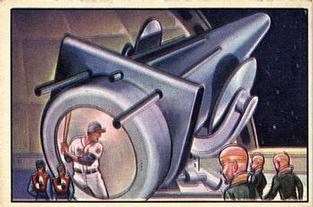
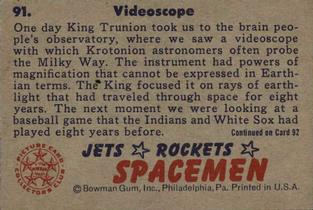
Now if you’ll excuse me, I’m off to find a photograph of the next day’s game. With the White Sox in town and catcher Hegan in the lineup, it may well be the very game King Trunion and his Krotonion astronomers picked up years later by videoscope! Let me update my eBay searches and get back to you!
Author’s note:For more on Dave Hoskins and his impact on the Texas League, see my SABR Games story, “Dave Hoskins wins 20th game for Dallas Eagles on night held in his honor.“
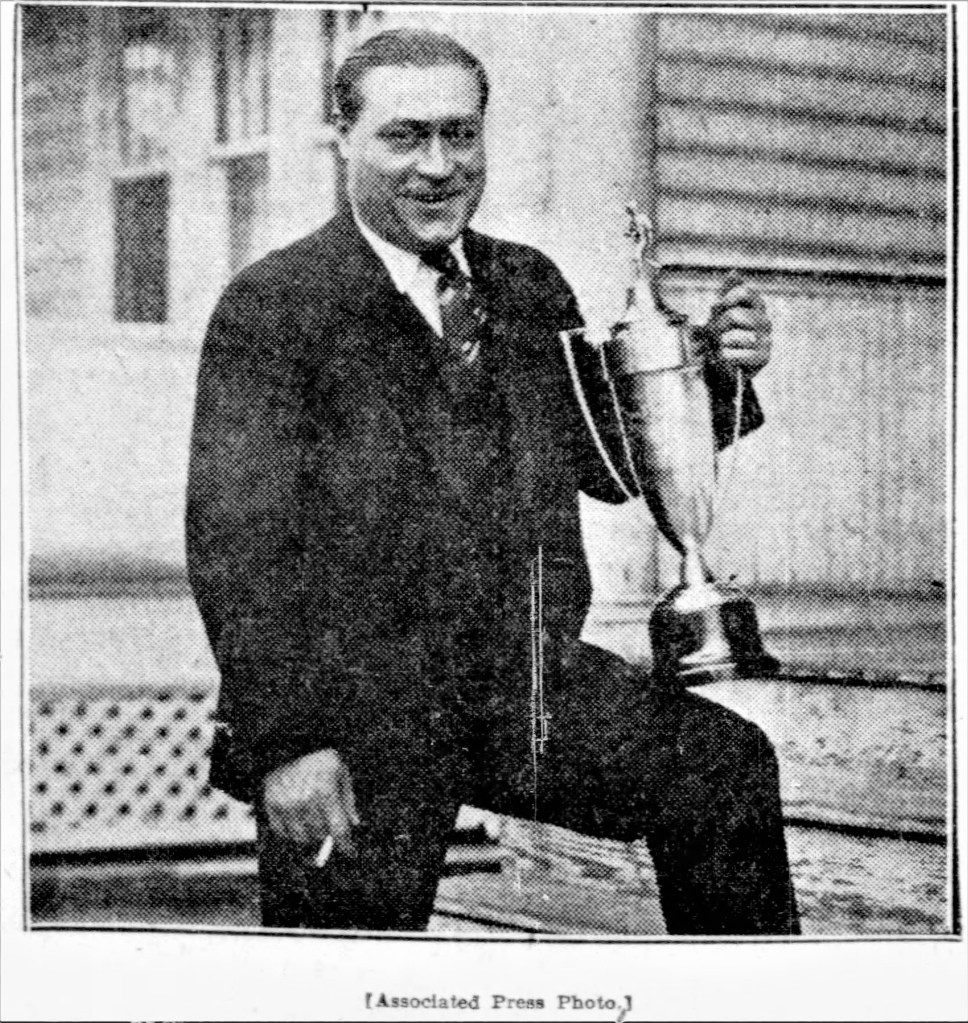
On November 13, 1930 the Martinsburg, WV police department escorted Hack Wilson, several civic leaders, and a pair of marching bands from Wilson’s home on John Street to the town square, where thousands had gathered to celebrate the home run hero. Local luminaries, including Mayor Chris Dailey, spoke at a grand ceremony that culminated in the presentation of a “handsome silver loving cup, suitably engraved” to Wilson. Photographers from World Wide Photo and the Associated Press snapped pictures of Wilson posing proudly with the trophy in front of his home.
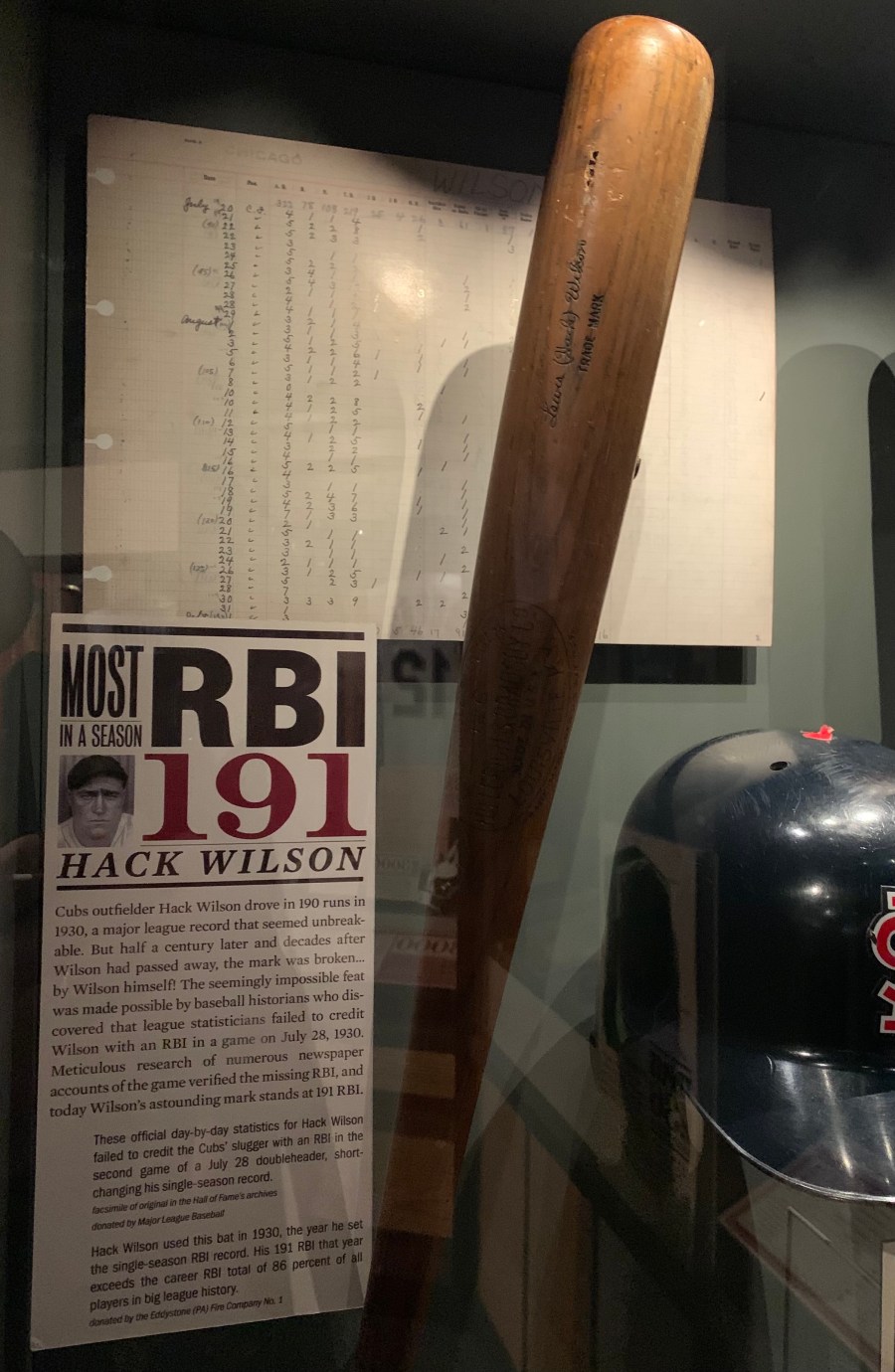
Hack Wilson’s 1930 season for the Cubs was one for the ages. Wilson set the National League record with 56 home runs, only the second player besides Babe Ruth to have eclipsed fifty in a season at the time. He slashed .356/.454/.723. (In fact, his 1.177 OPS is still a Cubs’ team record.) Wilson’s 1930 season, however, is probably best remembered for those 191 RBIs, a record that stands today—and may never be broken.
After Wilson’s Cubs teammate Rogers Hornsby was voted National League MVP in 1929, the league abandoned the custom (and the accompanying $1000 reward). The Baseball Writers’ Association of America conducted an informal MVP vote following the 1930 season and Wilson was the top vote-getter, topping Cardinals’ infielder Frankie Frisch by six votes. However, this putative MVP Award has never been officially recognized by baseball. Accordingly, a loving cup presented by some admiring locals wound up being the most enduring hardware commemorating Wilson’s incredible season. But what ever became of that handsome trophy?
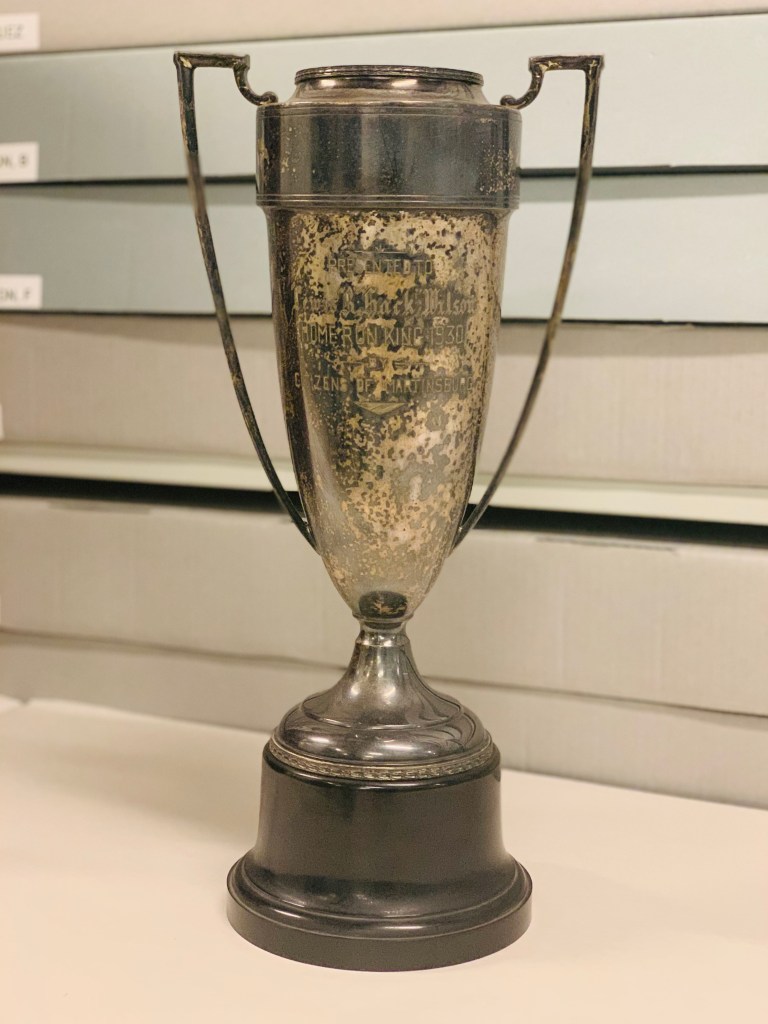
Well, it turns out the award survived and is archived at the National Baseball Hall of Fame and Museum in Cooperstown. The cup has tarnished and sustained some damage, including the loss of the ballplayer that appeared to have adorned the top.
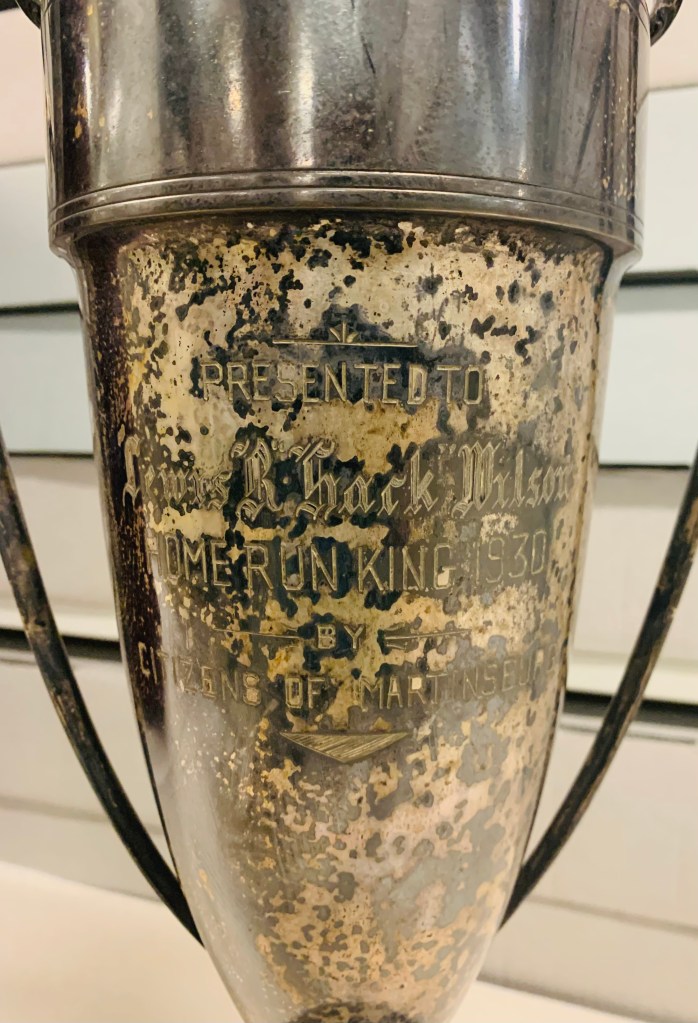
The engraving is still legible, however:
PRESENTED TO
Lewis R. “Hack” Wilson
HOME RUN KING 1930
By
Citizens of Martinsburg
Author holding Hack’s trophy. Photo credit: Bill Pearch
A loving cup, indeed.
Notes:
Very special thanks to Tom Shieber for allowing the author to see and hold the subject loving cup and Jason Schwartz for arranging the viewing with Tom in advance.
Sources:
“1930 Home Run King is Voted ‘Most Valuable’,” Messenger-Inquirer (Owensboro, Kentucky), October 8, 1930. (The Cubs agreed to pay Wilson $1000 prize that had previously accompanied the award.)
“Martinsburg Does ‘Whalen’ for Hack,” Evening Sun (Hanover, Pennsylvania), November 14, 1930.
“Cubs’ Home Run King Greeted in Home Town,” Chicago Tribune, November 17, 1930.
“Home Run King Who Succeeded Ruth Poses with His Family and Trophy,” Portland (Maine) Press Herald, November 17, 1930.
“Leo Durocher was like my father away from home.”–Willie Mays
“What can I say about Willie Mays after I say he’s the greatest player any of us has ever seen. If he could cook, I’d marry him!” – Leo Durocher
“Leo Durocher has the uncanny ability to make a bad situation worse.”-Branch Rickey
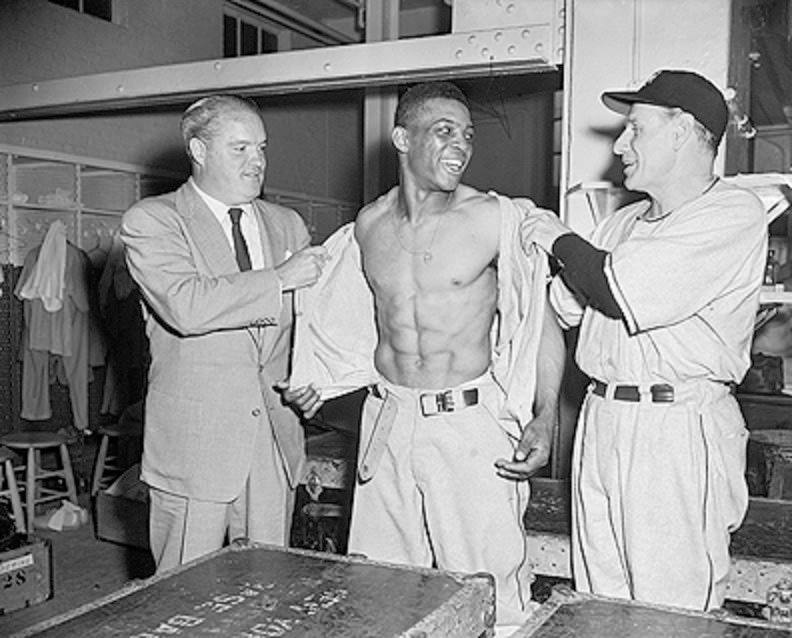
New York Giants owner Horace Stoneham (left) and manager Leo Durocher (right) help Willie Mays (center) with his jersey.
A while back I wrote about Jackie Robinson and Leo Durocher. It always makes me sad whenever I think about how things might have been significantly better for Jackie if he had the bold and brash Leo Durocher leading interference for him back in 1947, the year Jackie broke the infamous color barrier.
Instead, Leo had been suspended for what many think were frivolous reasons by Commissioner Happy Chandler just as the season began; and so he was not around to protect Jackie. In my opinion, Leo never would have let anyone get away with giving his star player grief. Had they done so, Leo would have given it right back…and they would have regretted it.
That got me thinking about Leo Durocher and Willie Mays, and how Leo acted as a mentor and father-figure for Willie during his rookie year of 1951. In the case of Leo and Willie Mays, we don’t have to speculate. We know what happened.
Leo had his faults…lots of them. As many players hated his guts as loved him. But, as I’ve been saying for a long time, in spite of what you might think about him, his greatest and most lasting contribution to baseball was taking a young, homesick Willie Mays under his wing and guiding him during his difficult transition into the major leagues. In doing so, Leo allowed Mays to blossom into arguably the greatest player in the history of the game. I don’t know if there was anyone else around at the time besides Durocher who could have done this.
I always love to think about the wonderful scene in the Giants’ clubhouse after rookie Willie Mays got off to his disastrous start going 0-12 and eventually 1-26. Giants’ coach Freddie Fitzsimmons saw Willie sitting alone in front of his locker crying. “Leo,” Franks said, “I think you better have a talk with your boy over there.”
What would have become of the Willie Mays if Leo wasn’t there to console him at this crucial time? I still get goose-bumps whenever I think about it. Leo went over to Willie and asked, “What’s the matter, son?” Willie turned to his manager and with tears streaming down his cheeks, replied:
“I don’t belong up here…I can’t play here…I can’t help you Missa’ Leo. Send me back to the minors.”
Leo smiled, patted Willie on the back, and simply said:
“Look son, I brought you up here to do one thing. That’s to play center field. You’re the best center fielder I’ve ever seen. As long as I’m here, you’re going to play center field. Tomorrow, next week, next month. As long as Leo Durocher is manager of this team you will be on this club because you’re the best ball player I have ever seen.”
The rest, as they say, is history. On his 24th at bat, Willie hit a homer over the left field fence off Warren Spahn who later joked, “I’ll never forgive myself. We might have gotten rid of Willie forever if I’d only struck him out.”
Years later, Willie was asked in an interview to expand on his relationship with Leo. Here’s what he said:
“I had such a good time with Leo. I met so many good people in Hollywood. Jeff Chandler used to come to spring training with me, Pat O’Brien, all the movie stars. Leo was like my father away from home. When I went to California I stayed with Leo in his house. His kid, Chris Durocher, was my roommate on the road. Chris would go to the black areas and stay with me. Leo trusted me. He knew that if his kid was going to stay with me, nothing was going to happen to that kid.”
Yes, Leo Durocher had his faults. He was “the All-American Out” as Babe Ruth so famously branded him. He was a scrappy, marginal player who couldn’t hit, but won three pennants and one World Series title as a manager. So you can debate back and forth whether he belongs in the Hall of Fame. To me, he’s a Hall-of-Famer just for the way he took care of a frightened and homesick rookie named Willie Mays.
If only he had had the chance to do the same for Jackie Robinson!
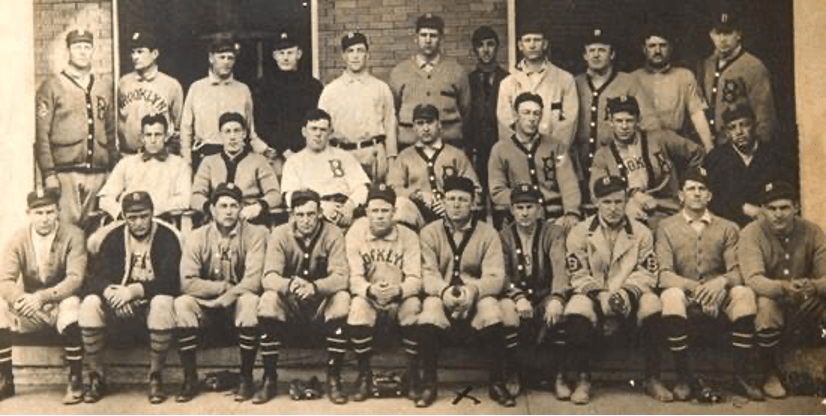
The December 2018 issue of the SABR Pictorial History Committee newsletter included an article about two images of the Brooklyn National League baseball team from the first decade of the twentieth century. One of those images was from a real photo postcard (RPPC of the 1910 Superbas:
George Bell –Tim Jordan –Ed Lennox –Red Downey –Elmer Knetzer –Frank Schneiberg –Paul Sentelle –John Hummel–Doc Scanlon–Harry Lumley–Bill Bergen Rube Dessau –? King –Nap Rucker –George Hunter –Kaiser Wilhelm –Harry McIntyre–? Ulrich Otto Miller –Tex Erwin –Zach Wheat –Pryor McElveen –Al Burch –Bill Dahlen –Tommy McMillan–George Schirm –Jake Daubert –Hi Myers
The article stated that “We had last names only for the RPPC. It took a bit of research, but we figured out the first names for all but two of those present in the photo, including a few who did not make the roster. We still need first names for King and Ulrich.”
Searching the archives of the Brooklyn Standard Union and the Brooklyn Daily Eagle provides the identity for these two players. (The Standard Union is archived at https://fultonsearch.org/, along with many other newspapers. The Daily Eagle is available online at https://bklyn.newspapers.com/#.) The Standard Union edition of January 22, 1910, has an article titled “Thirty-One Players the Nucleus for Dahlen’s First Division Hopefuls”, about the players who will train with Brooklyn in Hot Springs, Arkansas. Ulrich is described as a catcher from New Bedford in the New England League. That identifies him as Fred Ulrich (also identified as Randolph Ulrich in the news reports), who had played for New Bedford in 1909. Another catcher that was reportedly set to train with the team was “little Johnny King, the Brooklyn boy”. Later articles in these newspapers, from March, 1910, confirmed that Ulrich and King were with the Superbas when the team was in Hot Springs. King, who had previously played semi-professional ball, did not make the major league team that season. An article in the Daily Eagle on April 11th stated that he was going to play for the York (Pennsylvania) team (in the Tri-State League), but he does not appear on the York team’s records for that season and (according to a later Daily Eagle article) instead played for the Brooklyn Edison Electric Company team. Ulrich was kept on the Brooklyn roster at the start of the season, but he did not accompany the team on road trips nor did he appear in a home game, and he eventually went back to play for New Bedford.
That information would seem to complete the identities of the personnel in the RPPC, but there are more uncertainties to resolve. This photo of the 1910 Brooklyn team was printed in both the Standard Union and the Daily Eagle on March 20, 1910, with the players’ last names (the same names that were indicated in the PHC newsletter article):
Look closely at the newspaper photo. The images of the players identified as Lennox, Sentelle, and Lumley (third, seventh, and tenth players from the left, respectively, in the back row) have been pasted in over the faces in the actual photo. The clarity of the image in the RPPC makes it apparent that this was the original image, and that it had been altered before being published in the newspapers.
By perusing the baseball articles from March, 1910, in these papers, we know that the Brooklyn team arrived in Hot Springs on March 4, 1910, with all of the players identified in the newspaper caption except Harry Lumley and Ed Lennox. Lumley was delayed by floods near his home and joined the team on March 9th, and Lennox was ill and joined the team sometime after Lumley. It is likely that the original photo was taken before the arrival of these two. Paul Sentelle (also spelled Sentell) was with the team at this time; we can only guess why he missed the group photograph. The players listed in the caption are the only ones who are mentioned in the articles as training with the team that month. One other person is indicated as being with the team during that time–trainer Dan Comerford (also spelled Commerford). He appears in a well-known photo of the team that was published in the Daily Eagle on April 10, 1907, in the bottom row at the far left:
When we compare Comerford from the 1907 photo to the man in Sentelle’s position in the back row of the 1910 photo, we have a match:
That leaves two men to be identified in the RPPC; third from left and second from right in the back row. The man who is third from the left appears to be wearing dark pants with a light-colored shirt; this may not be a baseball uniform. It is entirely possible that he was not a ballplayer, but was instead a clubhouse man or groundskeeper at Hot Springs. The man who is second from the right appears to have on a shirt with a 1909 New York Highlanders logo on his left sleeve. This person could be someone who had been on the Highlanders’ roster and was trying to catch on with Brooklyn for 1910. (At that time, ballplayers typically wore their uniforms from a previous season during spring training.) It is also possible that a minor league team had a similar logo, or that the logo isn’t what it seems from the angle that we see it in the RPPC. The identity of these two men remains a mystery.
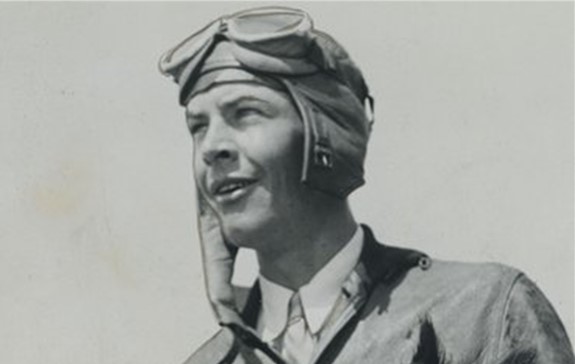
Long before Stan Hack was named Cubs pilot in 1954, “Smiling Stan” was literally an airplane pilot, quite possibly the first player ever to fly himself to spring training.
Born and raised in Sacramento, Hack’s first professional experience came with his hometown Pacific Coast League Sacramento Senators in 1931. He appeared in 164 games for the Senators, where he hit .352, legged out 13 triples, and racked up 300 total bases. Following the season, the Cubs purchased Hack from Sacramento for the hefty sum of $40,000 (nearly $750,000 today).
Hack appeared in 72 games for the 1932 Cubs and slashed .236/.306/.365, with two home runs and five stolen bases. He had a single appearance in the 1932 World Series as a pinch runner for Gabby Hartnett, who had reached on an error in Game Four.
Almost immediately after the World Series ended, Hack began taking flying lessons in Sacramento and was granted his pilot’s license in January 1933. Using his World Series bonus share, Hack purchased a 225-horsepower Stearman biplane for $4400 and announced he would be flying himself from Sacramento to the Cubs training camp at Catalina Island, located 22 miles off the coast of southern California.
Chicago Tribune, February 19, 1933
On February 19, Hack and two passengers escaped injury as Hack was attempting to land his airplane at Sacramento’s municipal airport. Witnesses reported seeing Hack approach at an excessive speed when his plane suddenly swerved and tipped over onto its wing, causing extensive damage. Despite the accident, Hack announced his intent to repair the craft immediately and fly it to Catalina.
Hack had invited Cubs outfielder Frank Demaree, a fellow Sacramentan, to fly with him to Catalina Island, but Demaree declined. Demaree quipped, “they couldn’t give me an airship, much less sell me one. I have yet to take my first ride in an airplane.” (Perhaps news of the crash landing influenced his decision?)
Following spring training, Hack’s flying instructor, Kenneth Kleaver, was hired to fly the plane to Chicago so Hack would have it available just “to ride around in.”
Hack began the 1933 season on the Cubs roster but was used sparingly by player-manager Charlie Grimm, appearing in just three April games as a pinch runner. He was demoted to the Albany Senators of the International League on May 3, sent along with outfielder Vince Barton.
Hack hit .299 in 137 games for Albany and was recalled to the Cubs once the Senators’ season ended. Irving Vaughn of the Chicago Tribune, however, was not impressed, “the .300 mark. . .isn’t much for the International League.”
Hack flew himself back to Chicago, along with his terrier Splinters, to re-join the Cubs. This photo appeared in the (Minneapolis) Star Tribune on September 10, 1933.
Stan Hack and his dog, Splinters
Backside of photo, including clipped caption
Back in Chicago, Hack worked his way into the lineup as the 1933 campaign closed and ended up holding onto the Cubs’ starting third base job for the next decade. Hack soared in his career as he recorded 2193 hits, posted a career slash line of .301/.394/.397, was a five-time All-Star, and garnered MVP votes in eight different seasons. His lifetime bWAR of 55.5 ranks 15th overall for third basemen.
Following his final Major League season in 1947, Hack was named manager for the Cubs’ farm team in Des Moines. He worked his way up through the minor leagues and was named Cubs skipper for the 1954 season. It is unknown whether Hack flew himself to Chicago to pilot the Cubs.
Notes:
Stan Hack appeared in 17 World Series games after 1932 and slashed .348/.408/.449/.857 across 1935 (L-DET), 1938 (L-NYY) and 1945 (L-DET).

























 SABR's Pictorial History Committee