By Cary Smith
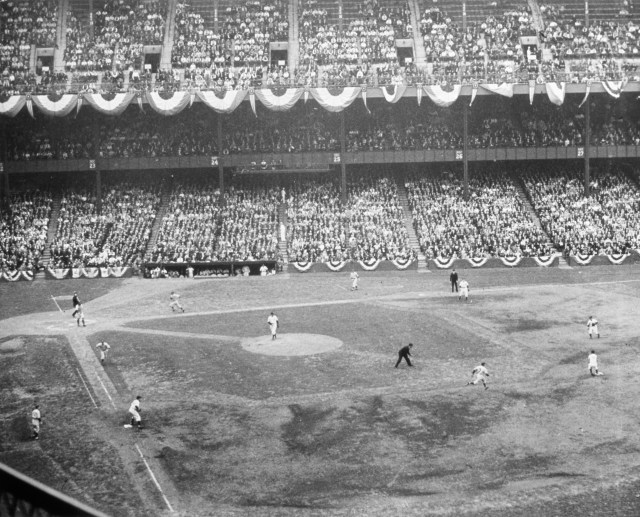
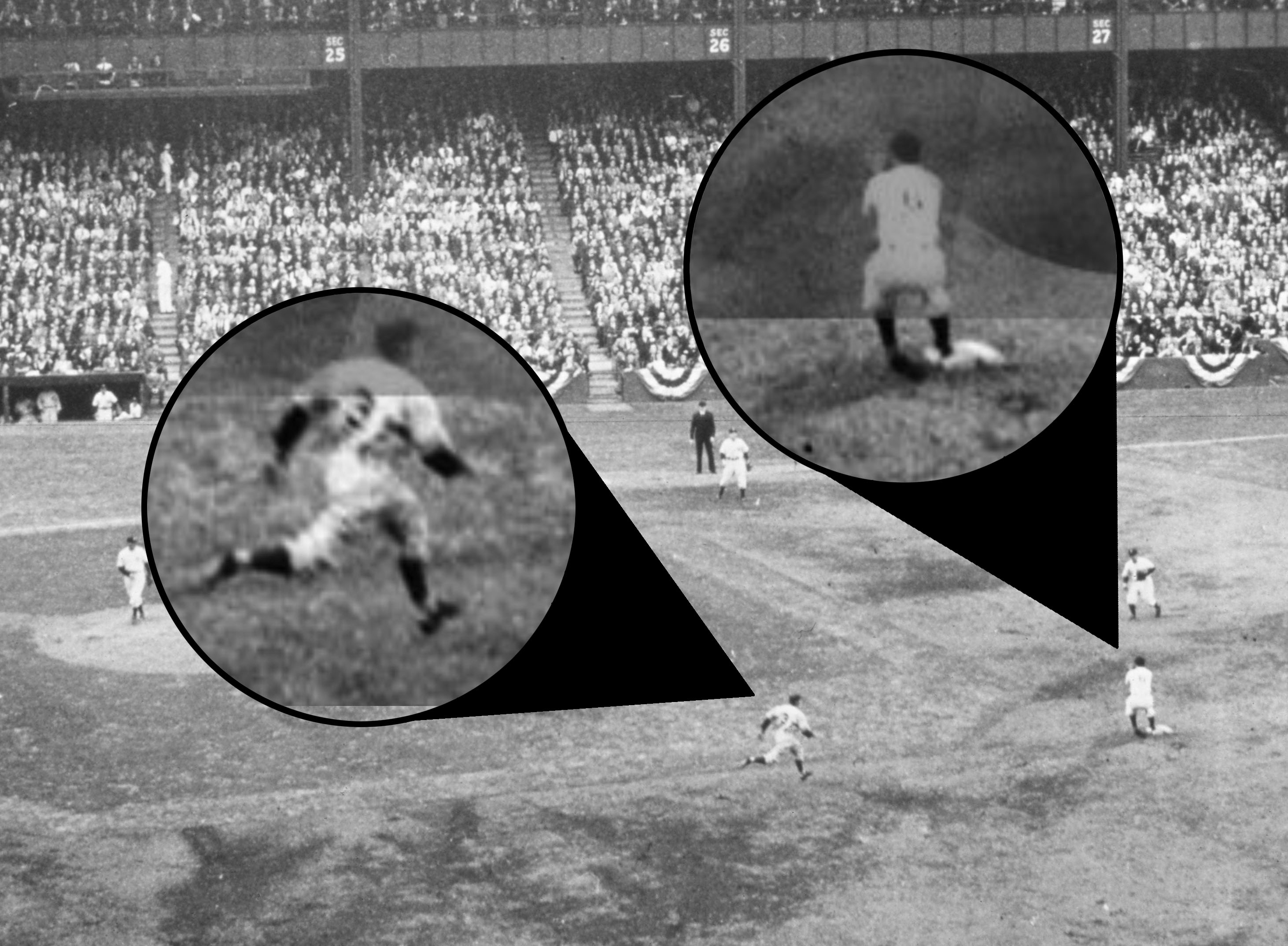
I was working in the SABR-Rucker collection, trying to add missing information, and I came across the photograph above. When I searched the internet, I found it had previously been identified as Game 3 of the 1943 World Series at Yankee Stadium. After reexamining the photograph, I realized it is neither from 1943 nor from the World Series. I will go step-by-step to show the research done to determine which game this photograph is from. To all my school math teachers who said, “Please show your work.” Well, here it is.
The first task was to confirm that it is Yankee Stadium. The facing of the second deck, featuring rectangular designs and numbered sections, clearly distinguishes it as Yankee Stadium.

The biggest clue that the photograph is not from the 1943 World Series came from the bunting hanging on the facing of the third deck.

This photograph shows a well-known incident that occurred during Game 1 of the 1943 World Series when a plane flew over Yankee Stadium. Overlayed with the red border is the bunting from our photograph. The bunting in our photograph includes pennants with stars and stripes hanging down, whereas the bunting in the 1943 photograph does not. So our photograph is probably not from 1943.
I started looking to see if I could find images of the Yankee Stadium bunting for other World Series of that era. After examining photographs from several World Series in which the Yankees participated, I was able to rule out 1939, 1942, and 1943 based on the bunting. This photograph from the October 3, 1941, Daily News proved to be a match to the bunting from our photograph. So our photograph has to be from the 1941 World Series, right? Well no. Let’s see how that was determined.


It took some work to rule out the 1941 World Series. Only Games 1 and 2 were played at Yankee Stadium, which helped narrow down the amount of information I needed to be weeded out. I wanted to determine which team was in the field and which team was batting, so I looked closer at the pitcher on the mound. The pitcher is wearing a New York Yankees uniform. With this in mind, we can begin examining the other players on the field and matching them up with play-by-play game records.
When looking at our photograph, I can tell that the play started with runners on first and third base. The batter hit the ball to the shortstop, who flipped the ball to the second baseman for what was probably a double play. Using Baseball-Reference.com, I searched the play-by-play records for the first two games of the World Series to identify a matching situation. Runners on first and third, and a 6-4-3 double play by the visiting team. I found nothing! Coming up blank, I started to look more closely at the players and their uniform numbers.
I focused on the Yankees’ second baseman and the runner heading to second base. Refer to the photo in question with magnified insets below. The Yankees’ second baseman is wearing number 6, which matches up with Joe Gordon. However, Gordon played in five World Series with the Yankees: 1938, 1939, 1941, 1942, and 1943. The unknown base runner is wearing number 3. The player who wore number 3 for the Brooklyn Dodgers in the 1941 World Series was Pete Coscarart. Great, except for the fact that Coscarart did not play in Game 1 or 2 of that year’s World Series. That ruled out Coscarart. Checking the teams that played in the World Series against the Yankees in 1938, 1939, 1942, and 1943, and the players that wore number 3 for those teams, also ruled out those years.
I started thinking about other games besides the World Series that might have bunting around the field. They would normally bring out the bunting on opening day and maybe on the Fourth of July. I delved into the Yankees’ 1941 home opener, which was played against the Philadelphia Athletics on April 15. Looking at the boxscore, I found Joe Gordon played second base for the Yankees, so that fits, and Pete Suder wore number 3 for the Athletics, so that fits.
A jersey number that had escaped me was that of the first base coach. He is wearing number 27. Since Baseball-Reference does not list the jersey numbers of coaches, I looked on eBay until I found a 1941 Philadelphia Athletics scorecard. There, I found that Coach Earle Mack wore number 27, another match for our photograph. See the scorecard just below with a magnified inset from the photo in question.

Looking back at Baseball-Reference for the play-by-play of the 1941 New York Yankees home opener, we find the Athletics hit into two double plays. One by Al Brancato in the Top of the 5th inning and one by Eddie Collins Jr. in the top of the 6th inning.
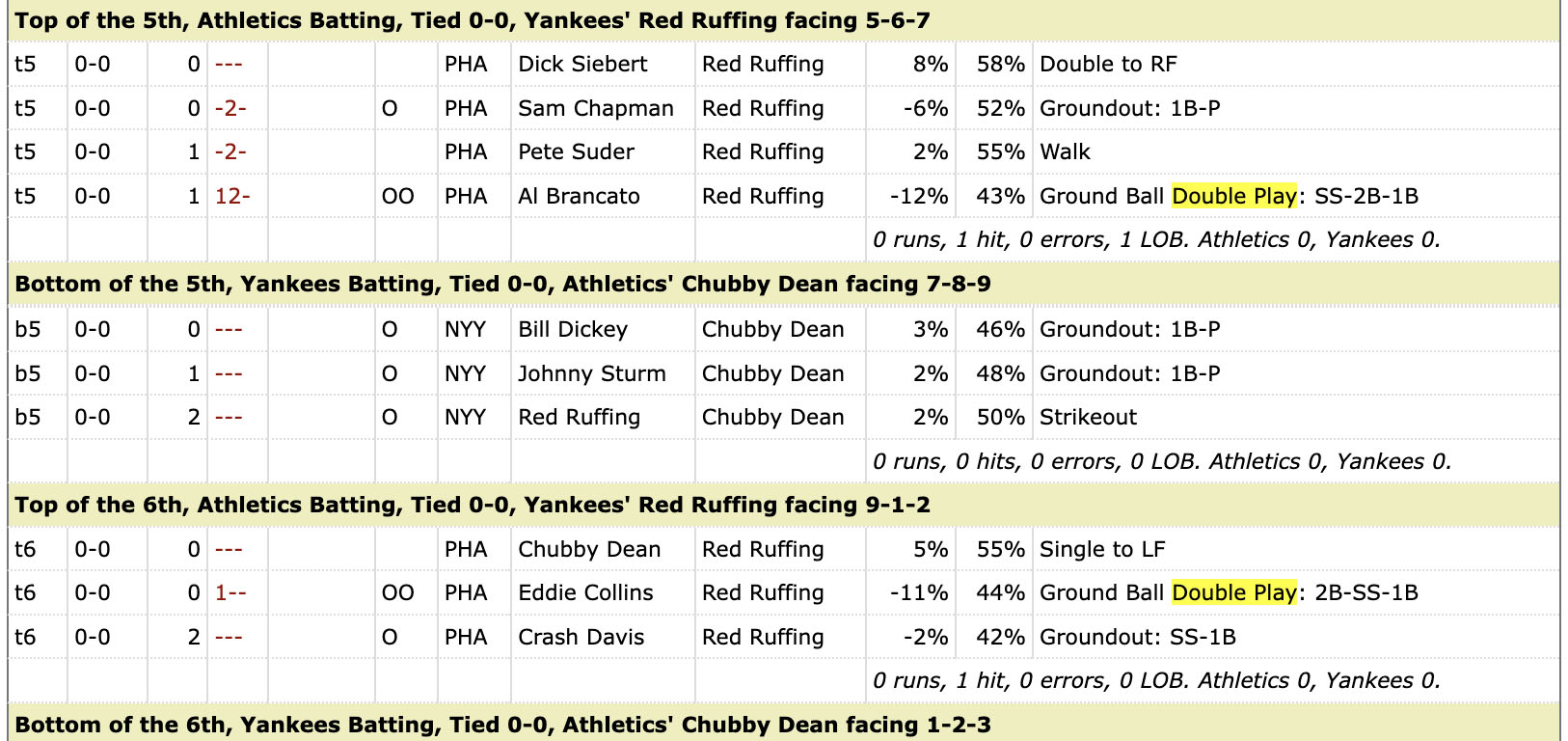
The double play hit by Brancato is interesting because Pete Suder is the runner on first base. However, according to this play-by-play, Dick Siebert is on second base, and we are looking for a runner on third base. Could Siebert really have run from second base almost all the way to home plate as shown in our photograph? Even with a running start, could Siebert have gone that far?
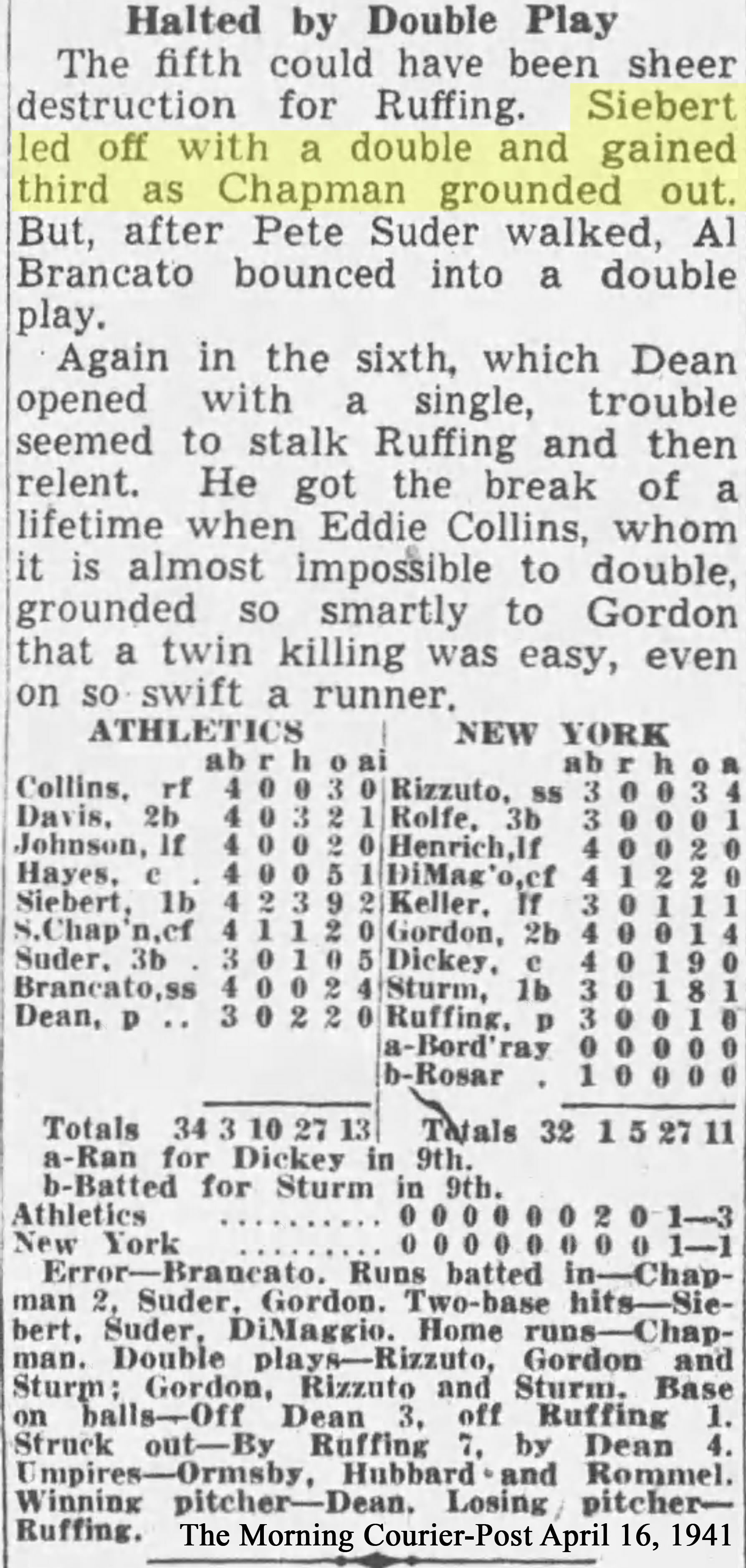
So close and just one mystery to solve in Dick Siebert. Then I found the missing piece in the April 16 edition of the Morning Post Newspaper (Camden, NJ). “Siebert led off with a double and gained third as Chapman grounded out.” The play-by-play on Baseball-Reference was incomplete; Siebert was on third base, not second base, when Brancato hit into a double play. (Baseball-Reference and Retrosheet have already been informed about the new information) Now all the pieces fit. The bunting on the grandstand was from 1941, not 1943. Pete Suder was the runner wearing jersey number 3 on his way to second base. Al Brancato did hit into a 6-4-3 double play. And Dick Siebert was on third base, not second base.
Conclusion: The photograph is not from Game 3 of the 1943 World Series at Yankee Stadium as originally described. It is from the April 15, 1941 Yankee Stadium home opener against the Philadelphia Athletics.
Find the Al Brancato Hits into Double Play Photograph in the SABR-Rucker collection.
 SABR's Pictorial History Committee