
Discovery and Primary Research, Jim Chapman; Supplementary Research, Justin McKinney; Editor, Mark Fimoff.
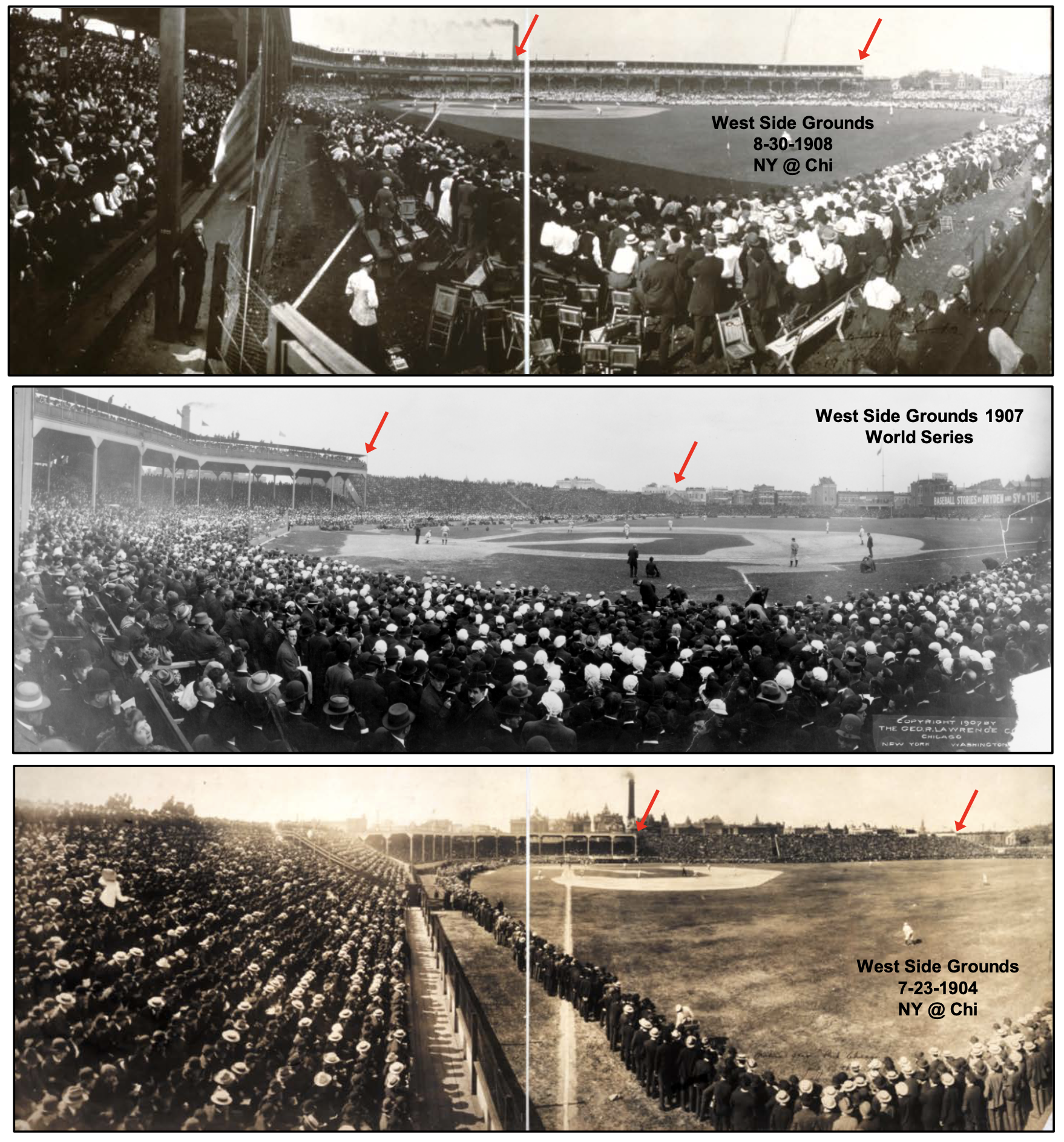
Fabulous panoramic photos of the Cubs’ home West Side Grounds (WSG) can be found on the covers of Deadball Stars of the American League and Deadball Stars of the National League, depicting scenes from 1908 (just below) and 1907 (2nd from top), respectively. This ballpark was home to the Chicago NL club from 1893 through 1915.
Photos taken of and in WSG from the period 1901–1915 are plentiful and easily found. Over those years, a series of modifications and additions are apparent. During the 1908 season, upper deck seating was added running down both the left and right field foul lines. The left field line addition is seen in the 1908 photo when comparing it to the 1907 and 1904 photos (red arrows). Analysis of WSG photos and debunking of bogus claims has been covered here before:
Reflecting the Past Number 2016:1 Jan. 2016
Reflecting the Past Number 2014:1 April 2014,
Pictorial History Committee Newsletter Number 2010:3 October 2010
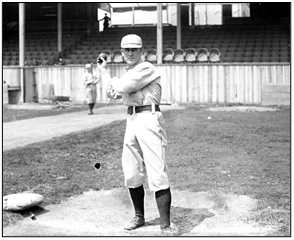
Some photos from the Chicago History Museum’s Chicago Daily News collection, taken inside the park in 1901, are shown here, with Bert Cunningham posing left, and Rube Waddell standing in front of some dirty laundry hanging in front of the center field clubhouse. The collection has no WSG photos prior to 1901.

We also present a view from the 1902 season that depicts Jim St. Vrain on the mound with a clear view of the left field line grandstands, just below. An image of Dusty Miller from the same year provides a view of the roofed grandstands just behind home plate. Though the ballpark opened in 1893, we had never seen any earlier WSG photos anywhere. The 1890s at WSG were oddly dark.

A few known woodcut images from Chicago newspapers did create some illumination. The WSG grandstand under construction is shown below as it appeared in the 04-14-1893 Chicago Record. The description therein reads:
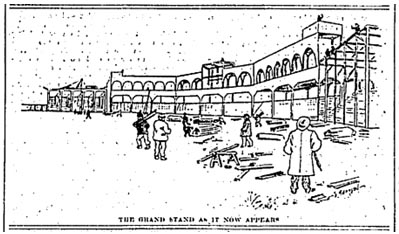
New West Side Ball Grounds…Seats for Thirteen Thousand…A small army of workmen is engaged on the new ball grounds of the National League club at Lincoln and Polk streets…put in readiness for the opening Sunday game on May 13.
These grounds will be the scene of the Sunday games played by the league club this year…The present calculation is for a seating capacity of 13,000…Mr. Hart says that no more will be admitted to games than can be supplied with seats…Experience has shown…[that] crowds are much more unruly if not seated, and inasmuch as we expect to have the best decorum at Sunday games, we will not tempt the disorderly element by letting them in without having a place for them to sit.”
The grandstand is to be the largest in the country, but no work has yet been done on the bleachers [take note of that]…they may eventually skirt the entire outfield…The worst defect about the grounds is a short right field…
The grandstand faces southeast, the main entrance being at the corner of Lincoln and Polk streets, but there will also be gates at which tickets will be sold to the bleachers.
A contemporary 1893 drawing of the plan for West Side Grounds appeared in the Chicago Tribune as the ball park neared completion.

The caption read: The above cut shows the plan of the new West Side baseball grounds at Lincoln and Polk streets, now rapidly approaching completion. The grounds can be reached by the Ogden Avenue, Van Buren, Harrison, Taylor, and Twelfth street cars. They [the grounds] are 475 feet square, exclusive of the carriage yard [i.e. parking lot]. The seating capacity is enormous, consisting of 3,000 folding arm chairs, 500 arm chairs in fifty-six private boxes, 4,500 seats in a covered pavilion, and 5,000 open ones. Eight hundred thousand feet of timber were used in the construction of the stands. The diamond will be 90 feet from the grandstand. The right field and left field fences are 340 feet from the home plate, the extreme center filed is 560 feet. The Cincinnatis will open the park May 14. It is probable that after this season all the games will be played there.
We should take note of the planned capacity of 13,000. That’s all very nice, but still no photo.
My jaw dropped when collector/researcher Jim Chapman sent me this scan:

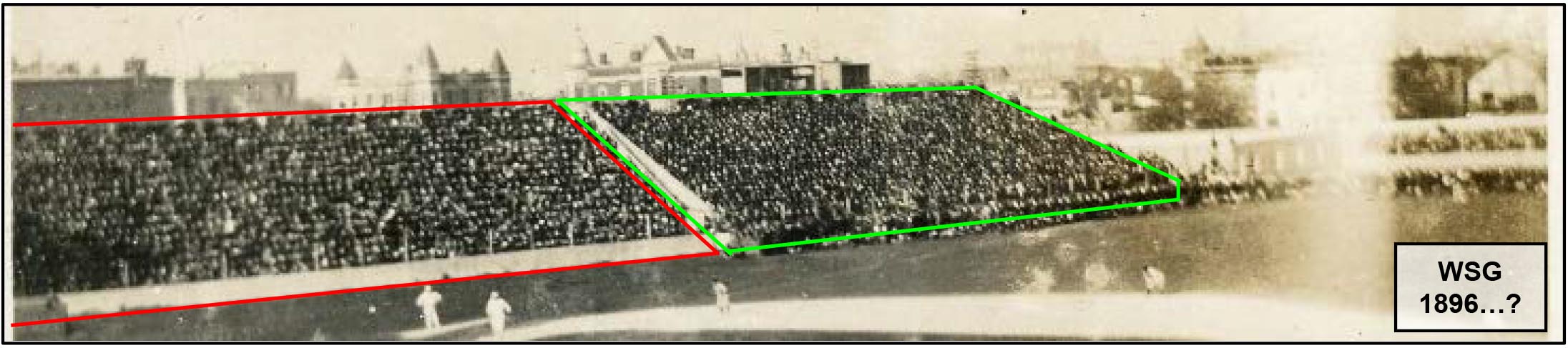
It was in a scrapbook with a label below the photo reading, “Ball Park West Side – Chicago.” Though there is some difference in ballpark structure when compared to the 1902 version of West Side Grounds, it was apparent that this was indeed an image of the same place, and if the seemingly contemporary caption written on the photo is to be believed, this dates to when the N.L. had a team in Baltimore. So, when would a Chicago vs. Baltimore matchup been possible at the West Side Grounds? That would have been between 1893 and 1899, after the West Side Grounds were built and both teams played in the National League. Let’s first compare this photo to West Side Grounds in 1902.
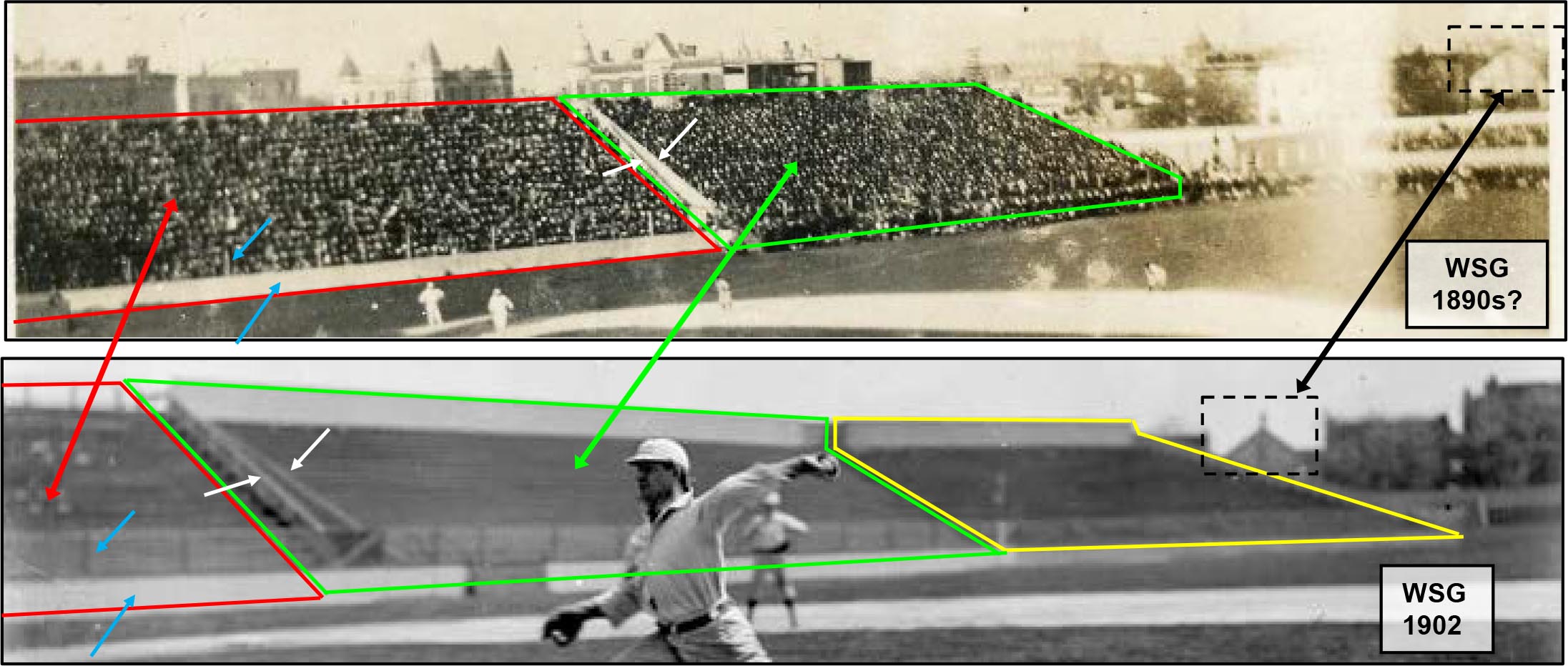
Below we have the left field line area seating from the photo in question at top, and the left field line seating at West Side grounds as seen in 1902 at bottom. For spatial reference, the dotted black line squares denote the same building in both images. The green and red boxes outline the same sections of seating in both images. The yellow outlined section of seating is present in 1902, but is missing from the photo in question. It is reasonable to think that the scrapbook photo is therefore at least pre-1902. Note particularly the double dividing fences between the red and green sections (white arrows) which seem to have a unique structure and are identical in both photos. Also note that matching details for the fencing in front of the seating (solid base for bottom half, screen with fence posts for top half, light blue arrows).
The March 13, 1896 edition of the Chicago Tribune, page 8, is reproduced below. Also, a permit for the new construction was reported in the Tribune on April 3, 1896. While we can’t be sure whether or not any seating was actually provided for the red and green areas when the park opened in 1893, it appears that the red and green sections in the photo in question matches that in the 1902 photo (and, as previously stated, this includes the details of the dividing fence and fencing in front of the seating areas). Therefore it is a good bet that the photo in question depicts these new “bleachers” dating it to 1896 or later.
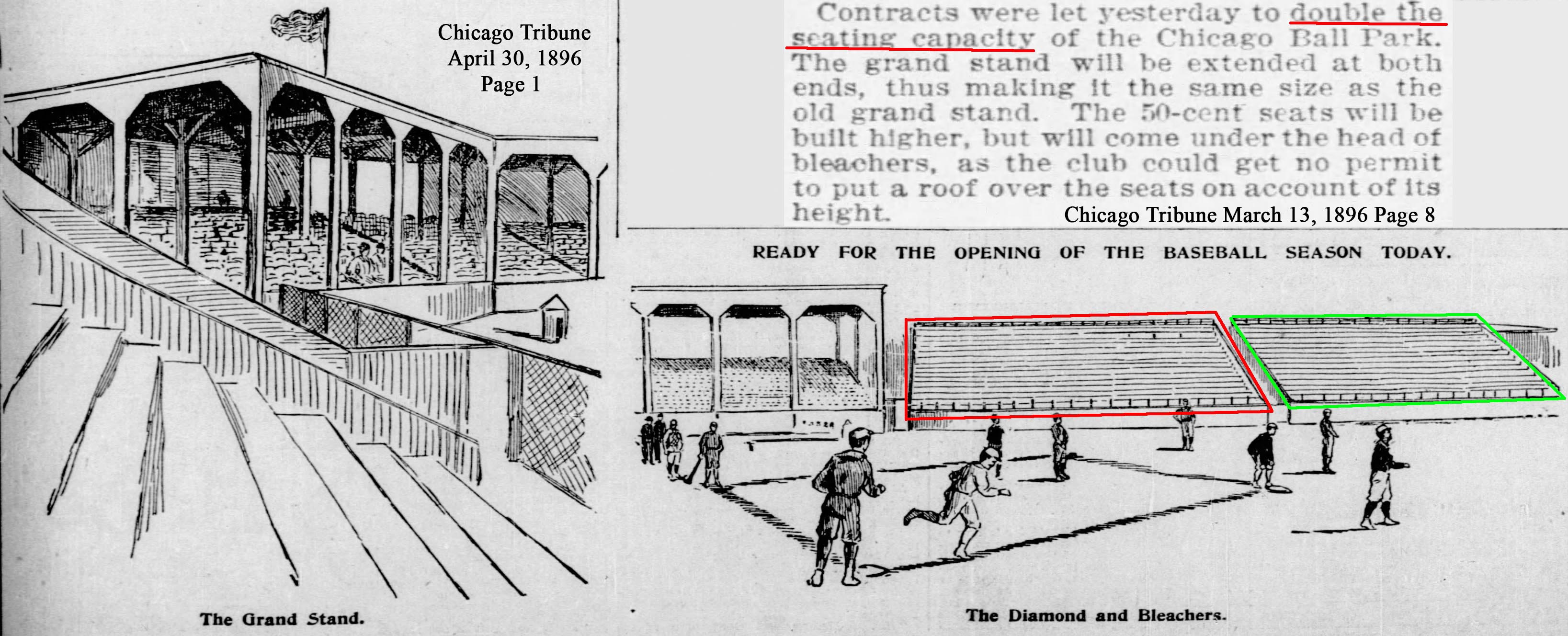
A woodcut depicting the new construction (above) appeared in the Chicago Tribune on April 30, 1896. The red and green seating areas are marked and the photo in question is again reproduced below the woodcut. The date of the further addition of the yellow section remains unknown. We only know that was after 1896 and earlier than 1902.
The Tribune’s phrase “double the seating capacity” raises some confusion. As previously shown, the original plan was for 13,000 seats. We can be certain that the 1896 construction did not come close to expanding the ball park to 26,000 seats. One source* pegs capacity at 14,200 in 1908, and that is after the addition of the yellow section, expanded outfield bleachers, and a modest amount of upper deck seating. Our best guess is that when it opened in in 1893, the park had substantially less than the planned for 13,000 seats (initially no seats in red and green areas?). We expect that the initial planned capacity may have been reached after the new construction in 1896. Then, a crowd of, say, over 15,000, would still result in noticeable fan overflow onto the field.
For Chicago, the 1896-1899 seasons were pretty miserable. To the contrary, for Baltimore, there was a National League pennant in 1896 (as well as 1894-5) and 2nd place finishes in 1897 and 1898. It seems like a good guess that one of those squads could draw an overflow crowd to WSG. Let’s see if we can narrow down the date. We can start by focusing in on the uniforms.
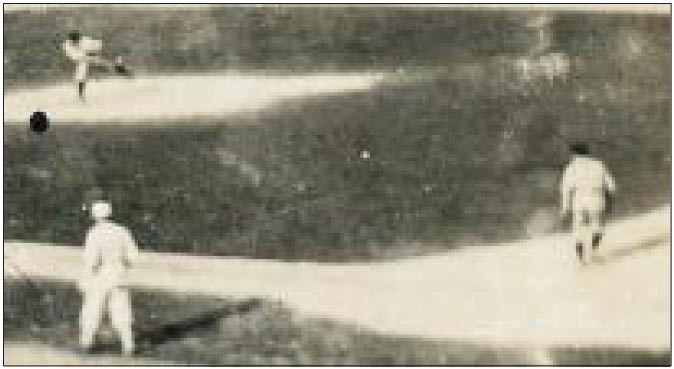
Zooming in on our photo, the truth is we can’t see much. One team is all in white, the other appears to be a few shades darker (like road gray) with dark caps and socks.

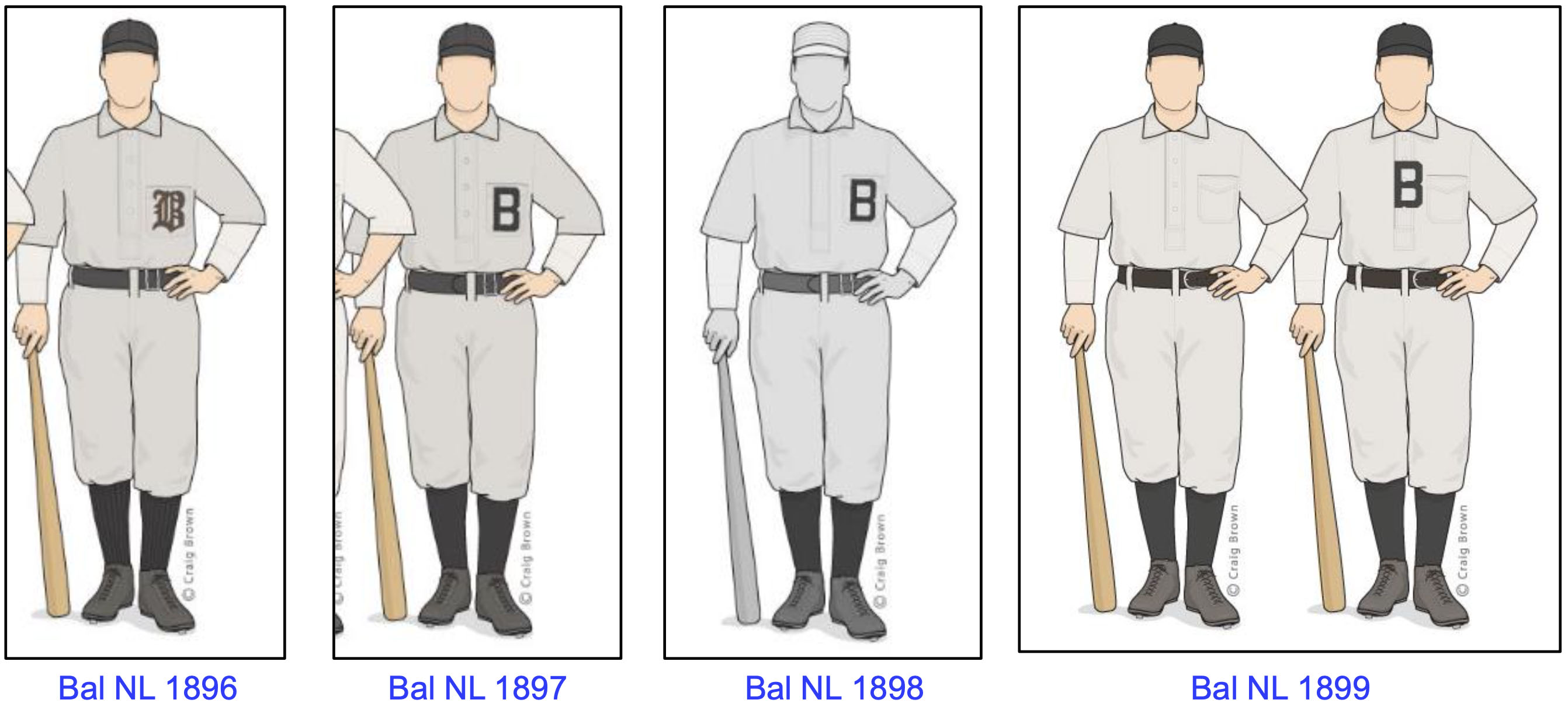
The all white uniform above left is dated 1896-1897 on Craig Brown’s Threads of Our Game site:
https://www.threadsofourgame.com/1896-chicago/ It surely matches what we see in the 1896 team photo from the 1897 Spading guide above right. For 1898, Craig shows a change to colored socks and cap bills (below left). This is verified in the 1898 team photo below right. See https://www.threadsofourgame.com/1898-chicago/

For 1899 things are a bit more interesting with the addition of a logo on the cap. If you are interested as to why there is a “Y”, it was a recognized representation used for the City of Chicago. Details are here, again courtesy of Craig Brown’s site. https://www.threadsofourgame.com/1899-chicago/

Given the lack of sharp detail for the photo under discussion, all we can say is that any of the above uniforms are consistent with it.
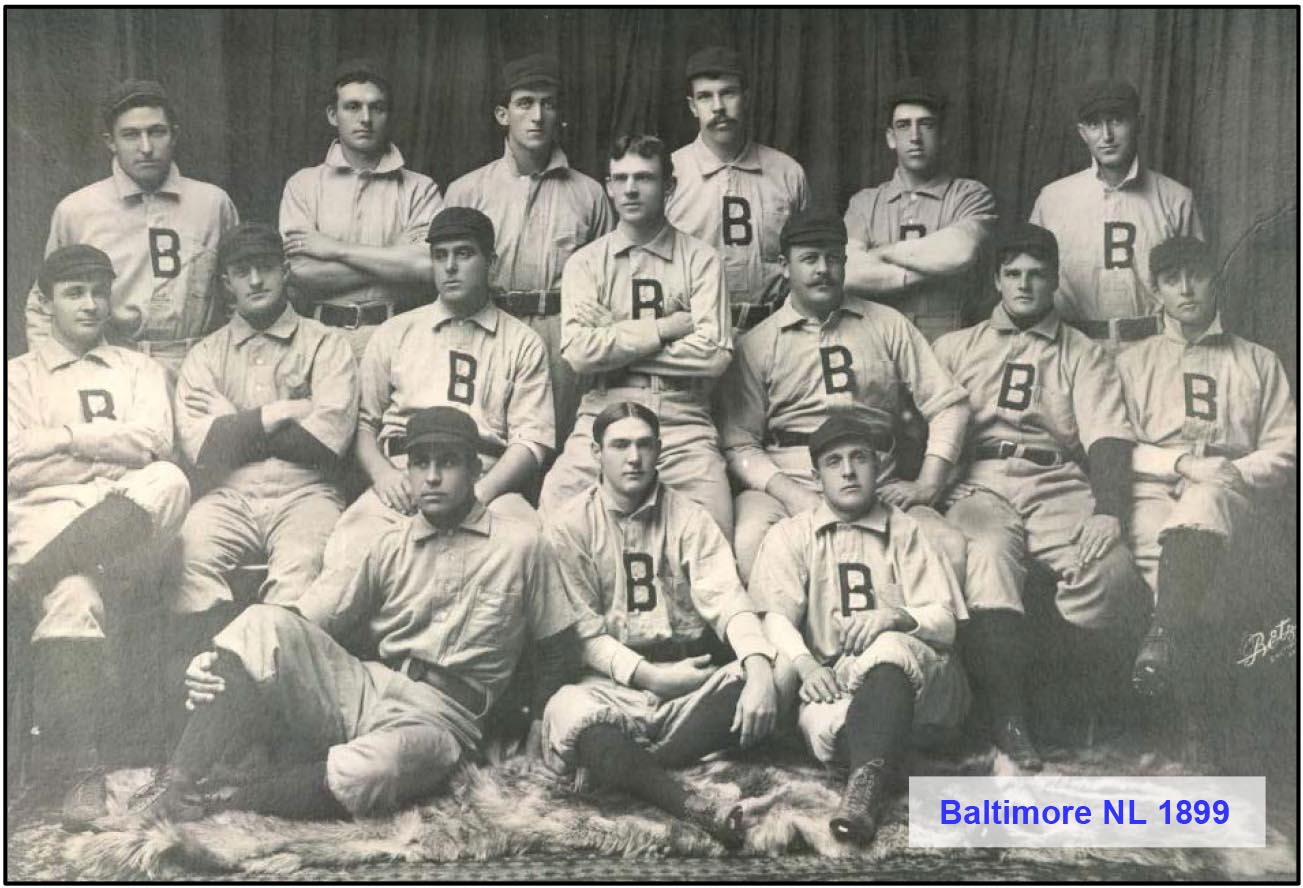
In the WSG photo the visitors are wearing dark caps and socks. Comparing this to Craig Brown’s road uniform renderings below, this is again consistent with the 1896 and 1897 seasons, but not 1898. The 1898 Baltimore team photo, taken on the road, does show white (or gray) caps. The 1899 team photo and also Threads rendering far right does show a reversion to dark caps and socks. This also indicates a likely date range for the WSG photo to 1896-1897, with 1899 still possible.
Given the large overflow crowd present in the WSG photo, let’s take a look at attendance figures for Baltimore visits to WSG in 1896, 1897 and 1899. These numbers are from the Chicago Tribune and The Daily Inter-Ocean reports. Note that the largest crowd for a Baltimore visit in 1898 was only 7,500, so that along with the uniform mismatch for both teams adds certainty to the elimination of 1898 from contention. The three candidates are shown in red.

| 1896 | |
| May 14 Thur | 2,500 |
| May 15 Fri | 4,500 |
| May 16 Sat | 9,000 |
| May 17 Sun | 18,921 |
| July 7 Tue | 4,600 |
| July 8 Wed | 6,100 |

| 1897 | |
| May 30 Sun | 17,800 |
| May 31 Mon | 2,650 |
| July 15 Thur | 4,135 |
| July 16 Fri | 5,184 |
| July 17 Sat | 10,280 |
| July 18 Sun | 12,250 |
| 1899 | |
| May 19 Fri | 2,700 |
| May 20 Sat | 7,000 |
| May 21 Sun | 17,617 |
| July 22 Sat | 7,500 |
| July 23 Sun | 9000 |
| July 24 Mon | 2,700 |
| July 25 Tue | 3,000 |
Red indicates an expectation of considerable fan overflow onto the field.
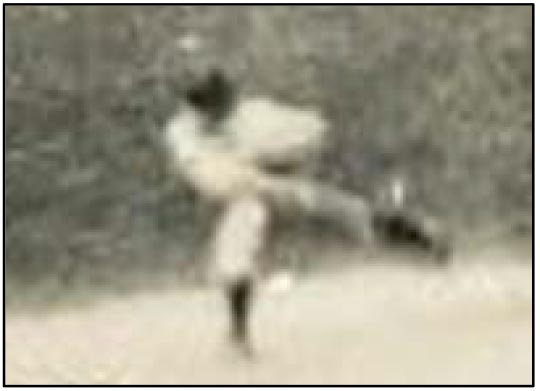
It appears from the photo that the Baltimore pitcher was a right-hander. For the dates in red, righty Bill Hoffer pitched in 1896 and 1897, and righty Joe McGinnity was the hurler in the 1899 game. That is consistent with the photo, but no help in narrowing down the date.

The largest crowd was for the 1896 game, and the May 18, 1896 Chicago Tribune described the overflow of fans onto the field (see right). For the 1897 game, The Daily Inter Ocean described a crowd “which poured out on the field.” Given the attendance figures, it seems that this must have also occurred for the 1899 game.
The 1899 game seems the less likely of the three due to the home team in the photo wearing light colored socks. What we can say is that, to date, this the earliest known photo of West Side Grounds and that it is a National League Baltimore vs. Chicago game action image that took place on one of three possible dates in the 1890s. That’s not bad.
Additional reading:
1900 snapshots of West Side Grounds




 SABR's Pictorial History Committee