
By Tom Naylor
In 2021, the Society for American Baseball Research (SABR) received a donation of more than 60,000 baseball images from Mark Rucker, a SABR member and photograph archivist. To catalog the photos, SABR recruited volunteers and taught them how to properly identify and describe the images to promote accuracy and depth of information to build The SABR-Rucker Archive database.
As one of the volunteers, I was trained in the project’s methods and assigned a few dozen images to catalog. Some photos were more interesting than others, and some were more challenging to properly and fully identify. Occasionally, I would find an image familiar to me, having seen it in a book, periodical, or online.
One such image waited in my queue, a terrific game-action photo featuring a leaping baserunner, a sprawling catcher, and an attentive umpire. In the Rucker database, some of our assigned photos include a field for any text written on the photographic slide. On this one, the text read “Earl Averill Leaping Soxs’ [sic] Leslie Jones at Fenway in 1939 Photo”. I set out to research the photo.
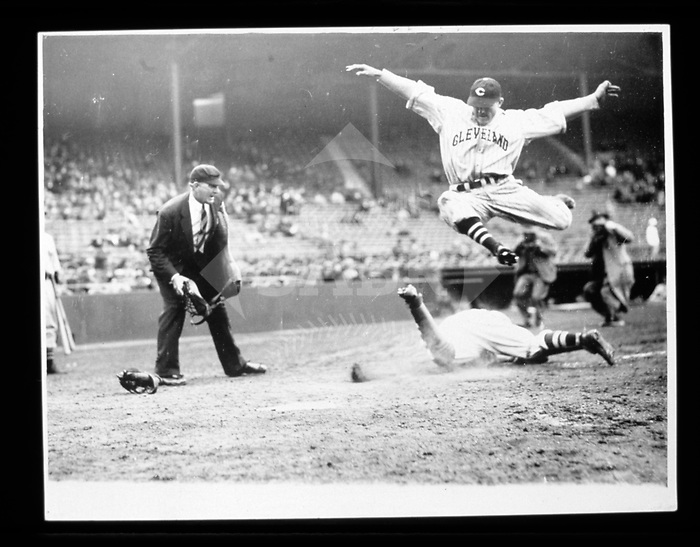
The photo showed no uniform numbers, making verification of the principals more complex than usual. As for the descriptive text, the first problem I saw was that Leslie Jones is not the name of a Red Sox catcher but rather a well-known Boston photographer of the era. The Boston Public Library has an extensive trove of Mr. Jones’s work.
Through what may have been a transcription error, Jones’ role was misstated. It seems almost certain that he was the one who took the picture, as his regular beat for the Boston Herald-Traveler included Red Sox games.
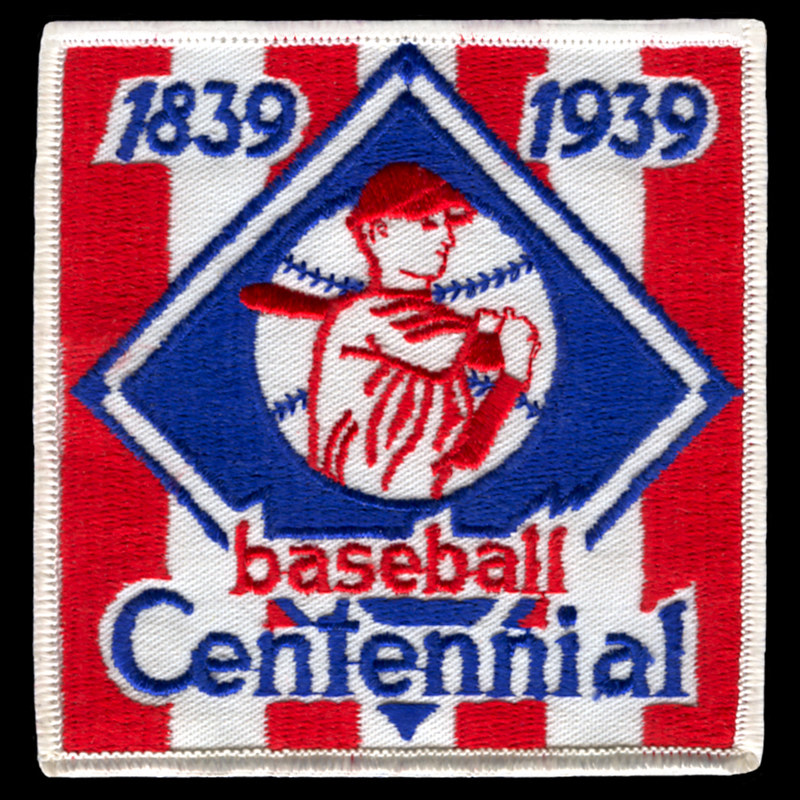
Another clue that the photo had been mislabeled was the absence of an arm patch on the leaping player’s jersey. In 1939, all major league teams wore a special Centennial insignia on a left-sleeve patch (except the St. Louis Browns, who wore it on the right sleeve). The patch commemorated the game’s invention by Abner Doubleday in Cooperstown, N.Y., in 1839 (an event we now know to be apocryphal). The absence of the patch suggested that 1939 was an incorrect date for the photo.
Given the discrepancies noted, I searched for what I could about the photo and the action it captured. A Google Image Search returned many “exact matches,” one of which, a Facebook page titled “Old-Time Baseball Photos,” included the following text: “Fenway Park, Boston, MA, May 20, 1937 -The Indians Jeff Heath leaps over prone Red Sox catcher Gene Desautels for Cleveland’s 16th and final run of the day in a 16-5 rout. The Tribe pounded out 21 hits with seven batters having at least two hits a piece[sic], led by Heath, who had three hits and knocked in four runs. On top of getting smacked around, Boston pitchers didn’t help themselves by issuing nine walks. Probably the only positive the Red Sox could take from this game was just 1,603 fans made it to Fenway Park to see this drubbing.”
Google also yielded “exact matches” for a Reddit page, MLB.com, and one from Our Game, The MLB.com/Blog of Official Major League Baseball Historian John Thorn. Other than the Rucker Archive misidentification, the others stated the date, May 20, 1937, and the catcher, Gene Desautels.
Looking at the box score for the game on Baseball-Reference.com, I confirmed that Cleveland outfielder John Geoffrey “Jeff” Heath had three hits and four RBIs but noticed that he only scored once. His run was Cleveland’s 16th and last of the day. In the top of the eighth inning, with Cleveland leading 12-4, Heath came up with the bases loaded and tripled to right-centerfield, clearing the bases. Boston then removed Ted Olson and brought Wes Ferrell into pitch to Earl Averill. Averill promptly singled to center field, scoring Heath. This sequence, however, seemed irreconcilable with the photo, as a base hit to the outfield would almost always score a runner from third base without a play at the plate.
I puzzled over the box score for a bit. I noticed that Heath had been thrown out twice at home plate earlier in the game on attempted steals and wondered if one of those plays was the one pictured, but the scene in the photo showed no batter standing close by, as you would expect with a steal of home, and the catcher was on the ground, well up the third base line. It looked nothing like an unsuccessful steal of home.
I resolved to dig deeper and consulted the Boston Globe archives. Although it was unlikely to have the Jones photograph, I hoped I might be able to sort it out in the game account.
There I hit pay dirt. In the newspaper, two photos were paired with a single caption. The second photograph was taken at approximately the same moment as the Jones photo in question but from a different vantage point. You can clearly distinguish Heath’s number 24 and Desautels’s number 23 in the image. Even better for our purposes, the accompanying text gives us the definitive identification of the action. The relevant part read: “Lower photo is not of Glenn Hardin, but rather of Johnny Heath, rookie Indian outfielder, as he was out—yes, OUT—at the plate on an attempted double steal in the fourth inning. Heath’s high hurdle carried him clean over the plate, and Gene Desautels, Sox catcher No. 23 after taking Jimmie Foxx‘ throw, tagged Heath out before he could get back to touch the plate. Handsome Harry Geisel is the umpire.”
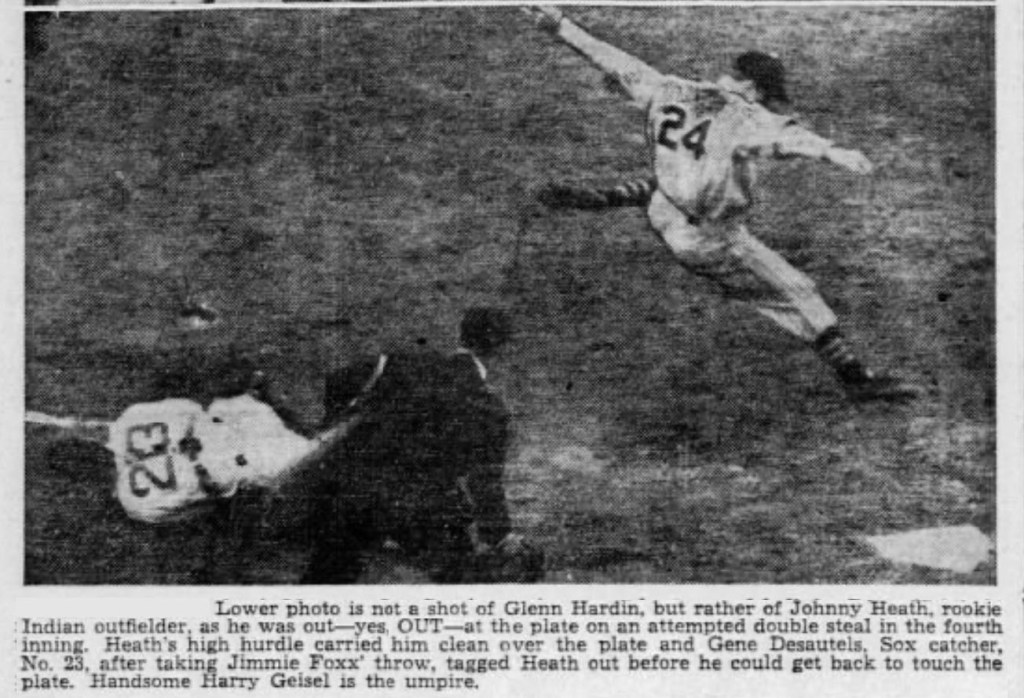
This resolved my questions. The Jones photo captured the fourth-inning steal attempt on May 20, 1937, involving Jeff Heath and Gene Desautels.
Note: Glenn Hardin was an American athlete who won a gold medal at the 1936 Olympics in the 400-meter hurdles.
See the full catalog record for Jeff Heath Leaping Oer Gene Desautels at Home Plate on the SABR-Rucker Archives website.
 SABR's Pictorial History Committee