Let’s face it. When it comes to photos, the Babe Ruth, Hank Aaron, and Willie Mays fans have it easy. A pic of the Babe pitching? No problem, take your pick! How about the Hammer hawking breakfast cereal? Sure, we’ve got that too! Or the Say Hey Kid making an incredible catch? Where do we even begin!
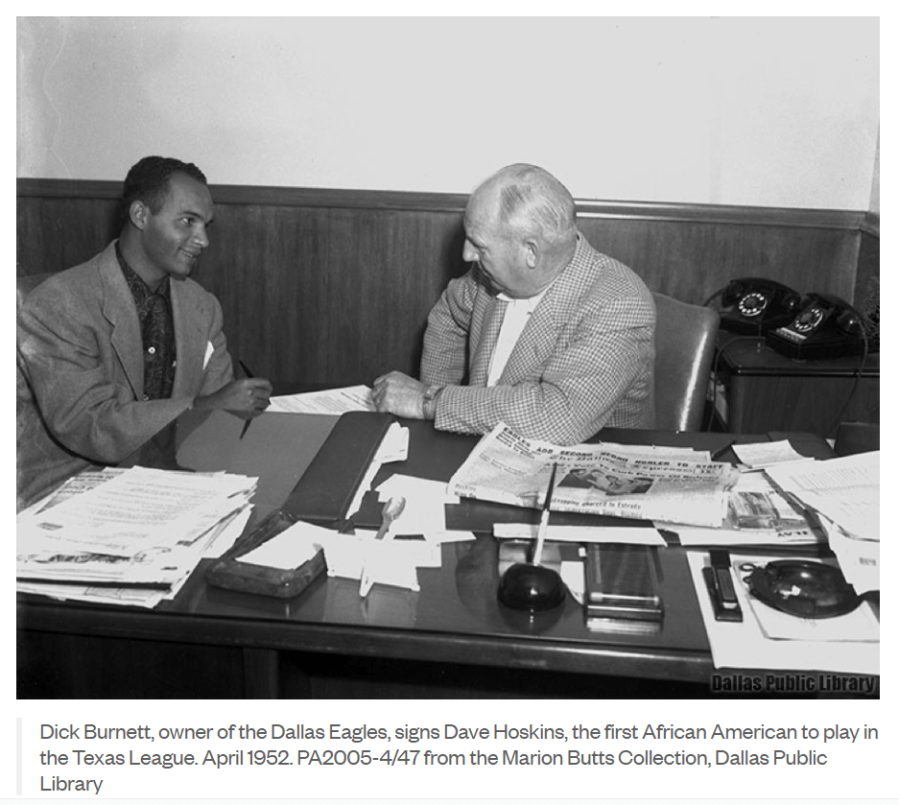
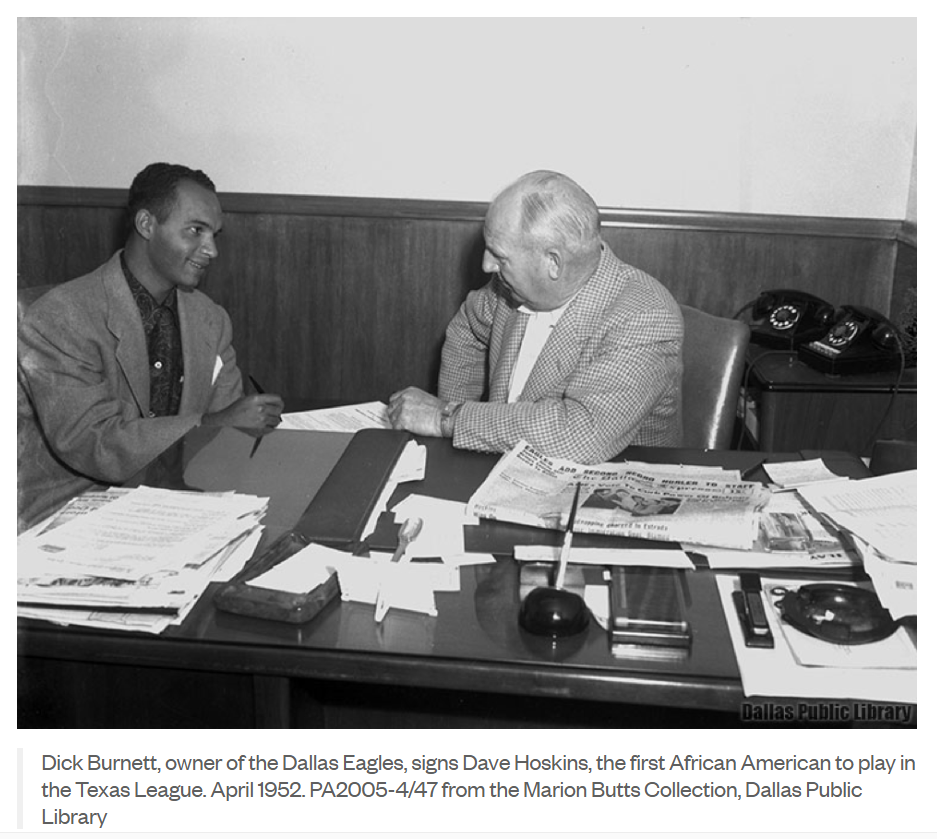
Of course, when the player of interest is a bit more obscure, finding that perfect photo can feel like a miracle. Such was certainly the case for me when my research and collecting interests in Texas League pioneer Dave Hoskins led me to the sort of photo I wouldn’t have imagined existed: Hoskins signing his contract to join the Dallas Eagles in 1952 as the Texas League’s first Black player.
True, the occasion was historic, so why shouldn’t there be a picture? But to see it so sharp and vivid, that was another matter altogether. Even better, the same Marion Butts Collection at the Dallas Public Library has several other tremendous photos of Hoskins from his historic 1952 season.
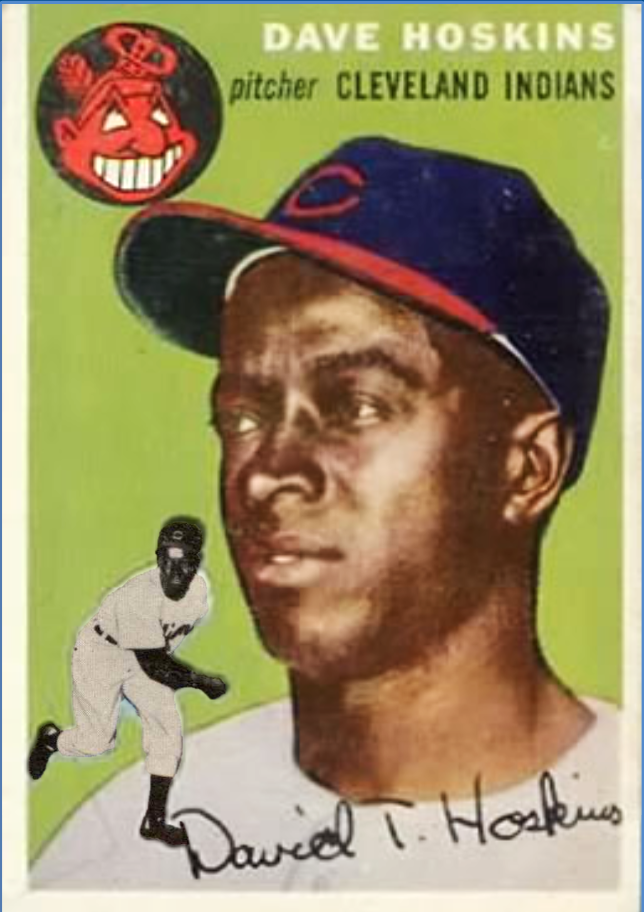
Still, there was a part of me not fully ready to celebrate this miracle. Granted I didn’t have a ton of other early 1950s images of Dave Hoskins against which to compare, but I couldn’t help thinking the ballplayer in the photo didn’t really look like Hoskins.
1954 Topps baseball card
The result was that I shied away, out of an abundance of caution, from including the photo in the various articles and presentations I was working on. Maybe it was Dave Hoskins, but maybe it wasn’t, right? Of course, we SABR members aren’t big on leaving things in limbo, and in this case the answer really was hiding in plain sight.
Though all my attention had been on the ballplayer in the photo, there was a newspaper right there on Dick Burnett’s desk, the not yet digitized Dallas Express, and while the date wasn’t readable the headline was: “EAGLES ADD SECOND NEGRO HURLER TO STAFF.”
Case closed. The player in question was not Dave Hoskins but Puerto Rican pitching legend Jose Santiago, who joined the Eagles several weeks after Hoskins.
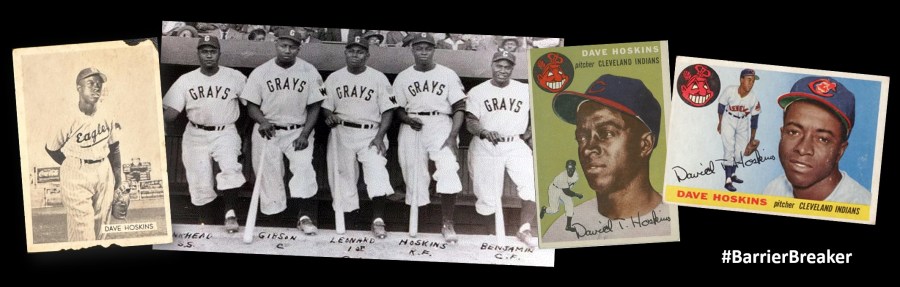
Custom baseball card
Just to put a bow around things, I sent my findings to Brandon Murray, archivist for the Dallas Public Library. Here was his response:
“I checked the microfilm, and the photo ran in the May 31, 1952, issue of the Dallas Express. It is indeed Jose Santiago according to the caption. I’ve updated the information in our new content management website and our internal records.“
So the bad news is that a would-be historic photograph documenting the integration of the Texas League really doesn’t exist after all—or at least remains unknown to me personally. But the good news, and this matters here in the world of SABR, is that the pictorial record just got a tiny bit more accurate. Plus, this is a case where Hoskins’ loss is Santiago’s gain. Santiago was not only the “Larry Doby of the Texas League” but also the circuit’s first Afro-Latino player. His signing deserved a photo, and now it has one!
For a player who is part Jackie Robinson, part Shohei Ohtani, Dave Hoskins remains a relatively unknown player in our game’s history. A former member of the Homestead Grays Murderers Row, Hoskins not only integrated the Texas League in 1952 but electrified it, braving verbal abuse and death threats to win 22 games on the mound for the Dallas Eagles (CLE-AA), tally one of the league’s top batting averages at the plate, and set attendance records everywhere he played. It was no surprise then that Cleveland Indians general manager Hank Greenberg saw fit to promote Hoskins to the big club for the 1953 season.
Mound opportunities for Hoskins proved limited as the Tribe already boasted the top four-man rotation in the league. Nonetheless, Hoskins made the most of his appearances, posting an excellent 9-3 win-loss record that trailed only Eddie Lopat of the Yankees in winning percentage among AL hurlers with 12 or more decisions. Hoskins proved he could hit American League pitching as well, tallying a .259 batting average that topped that of the team’s starting first baseman, right fielder, and catcher.
Though the 1954 season would be a historic one for Cleveland, Hoskins saw his usage dwindle significantly, starting only one contest and seeing only 26.2 innings vs. 112.2 the previous year. Underscoring his diminished role, Hoskins was left off the ballclub’s postseason roster and was not invited back for the 1955 season, rounding out the final six years of his career instead as a journeyman pitcher with various minor league and Venezuelan Winter League teams.
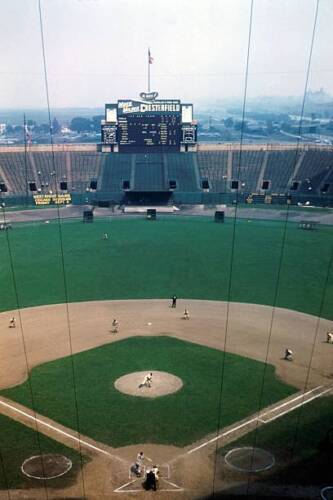
Game action photographs of Hoskins, whether with Cleveland or any other team, are few and far between, so I felt incredibly fortunate when my Hoskins eBay search yielded this wonderful color photograph.
The seller (in Australia, no less!) advertised the image as “Pitcher Dave Hoskins of the Cleveland Indians 1953 Baseball OLD PHOTO” and went on to specify size as 8.5 x 11 inches. Assuming Hoskins was indeed the man on the mound, which the action pose on my Dave Hoskins rookie card seemed to support, this photo had a definite home in my collection.
Of course none of us at SABR Pictorial can look at a photo like this and bypass the opportunity to learn even more: questions like where and when the photo was taken, what game action is taking place, and who the various subjects on the field might be. Though such questions can prove unanswerable with some photos, that will not be the case here.
Where and when?
Thanks to the prominent centerfield scoreboard, we know immediately we are looking (perhaps from the press box) at Cleveland Stadium. In other words, this is a home game for Hoskins. Still, that leaves 14 options for the specific game since Hoskins pitched at home 14 times in 1953. Fortunately, we also have a significant detail along the wall in left-center. Though the lettering is a little tough to make out, it reads that the team’s next night game will be against Chicago on Friday, September 4.
Before examining this clue further, I’ll point out first that it affirms 1953 as the year. September 4 indeed fell on a Friday that year, whereas it fell on a Saturday in 1954, the pitcher’s only other season with the team.
But can this same clue pinpoint a specific date, not simply a year, for the photograph? As it turns out, yes, quite easily. When Hoskins took the mound on September 3, the next night game was September 4. Backing up to his previous appearance, one in relief of Bob Feller on August 30, the next night game would have instead been August 31. Therefore, we are looking at September 3.
What’s going on in the photo?
With the photograph’s date firmly established as September 3, 1953, we can now say much more about the game it portrays. Let’s start with some context for the matchup.
En route to winning 111 games and the American League pennant the following year, the 1953 squad was a very, very good one despite entering the September 3 contest in third place. Cleveland’s record at the time was 78-54, a healthy 24 games above .500, but this still left then one game behind the second place White Sox and 10.5 games behind the league leading Yankees. With 22 games left on the schedule, the Tribe was not yet mathematically eliminated but not exactly in contention either.
Visiting the Forest City that day was a sixth place Philadelphia Athletics team, having already dropped the opener of this short two-game set 6-3 the night before. Cleveland would win this game as well, riding a complete game effort by Hoskins to a 9-4 victory. Hoskins would contribute at the plate also, reaching base twice, scoring once, and driving in two. The win, coupled with a White Sox loss, moved the Indians into second place where they would ultimately finish the season.
That being the general context, what other information does the photograph capture? Let’s start with the detail of a right-handed batter at the plate with runners at first and second (and possibly third).
Per the Baseball-Reference play-by-play, here are the only two instances in the game when both of these conditions would have been met.
Top of 1st – Gus Zernial batting, runners on first and second, one out
Top of 4th – Joe DeMaestri batting, runners on first and second, one out
It further appears that the batter has a double-digit uniform number. If so, this rules out DeMaestri who wore #2 for the team, leaving the Zernial at-bat the only possibility.
While the game information shown on the scoreboard is tough to make out, it appears at least consistent with such a point in the contest, that is: 0 R, 1 H for Philadelphia and 0 R, 0 H for Cleveland.
The result of the play itself, though probably not on the pitch shown, was a ground ball out to third with both runners advancing. With the next batter, Carmen Mauro, grounding out to first, Hoskins would escape the inning unscathed.
Who’s in the photo?
Though the best of our sleuths here will (and should!) search for more, I’ll complete my analysis of the photo itself simply by identifying the other subjects present. This of course comes from the Baseball-Reference game log rather than any ability on my end to discern and recognize these men visually.
Cleveland – Jim Hegan (C), Bill Glynn (1B), Bobby Avila (2B), George Strickland (SS), Larry Doby (CF)
Philadelphia – Eddie Robinson (runner on 1st), Dave Philley (runner on 2nd)
Umpires – Red Flaherty (HP), Charlie Berry (2B)
Who’s not in the photo?
Though off camera, fielding the third base position that day would have been eventual league MVP Al Rosen. Watching the action from the Cleveland dugout would have been the team’s “big four” starters, not to mention slugger Luke Easter and Hall of Fame manager Al Lopez. Finally, over in the visitors dugout would have been opposing manager Jimmy Dykes and—if you can believe it—pitching coach Chief Bender!
So yes, baseball card collectors, in attendance that day were pitchers, impossibly enough, with cards in the T206 and 1982 Donruss sets! And if you don’t know ump (and football legend) Charlie Berry’s story, well here you go!
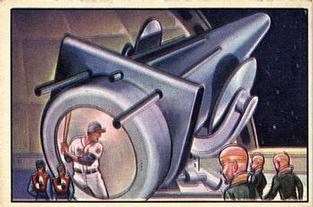
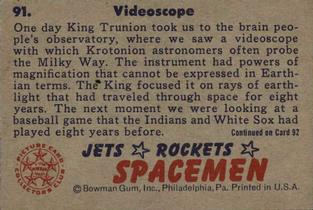
Now if you’ll excuse me, I’m off to find a photograph of the next day’s game. With the White Sox in town and catcher Hegan in the lineup, it may well be the very game King Trunion and his Krotonion astronomers picked up years later by videoscope! Let me update my eBay searches and get back to you!
Author’s note:For more on Dave Hoskins and his impact on the Texas League, see my SABR Games story, “Dave Hoskins wins 20th game for Dallas Eagles on night held in his honor.“
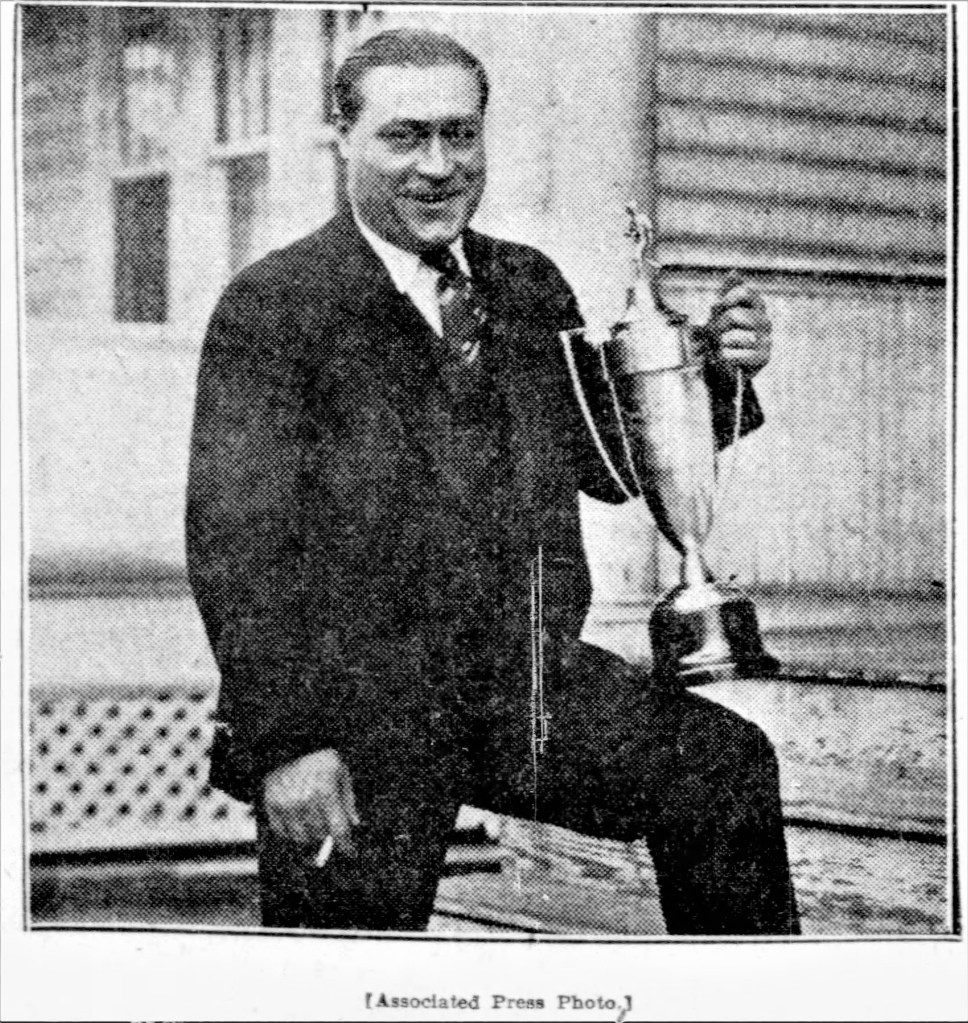
On November 13, 1930 the Martinsburg, WV police department escorted Hack Wilson, several civic leaders, and a pair of marching bands from Wilson’s home on John Street to the town square, where thousands had gathered to celebrate the home run hero. Local luminaries, including Mayor Chris Dailey, spoke at a grand ceremony that culminated in the presentation of a “handsome silver loving cup, suitably engraved” to Wilson. Photographers from World Wide Photo and the Associated Press snapped pictures of Wilson posing proudly with the trophy in front of his home.
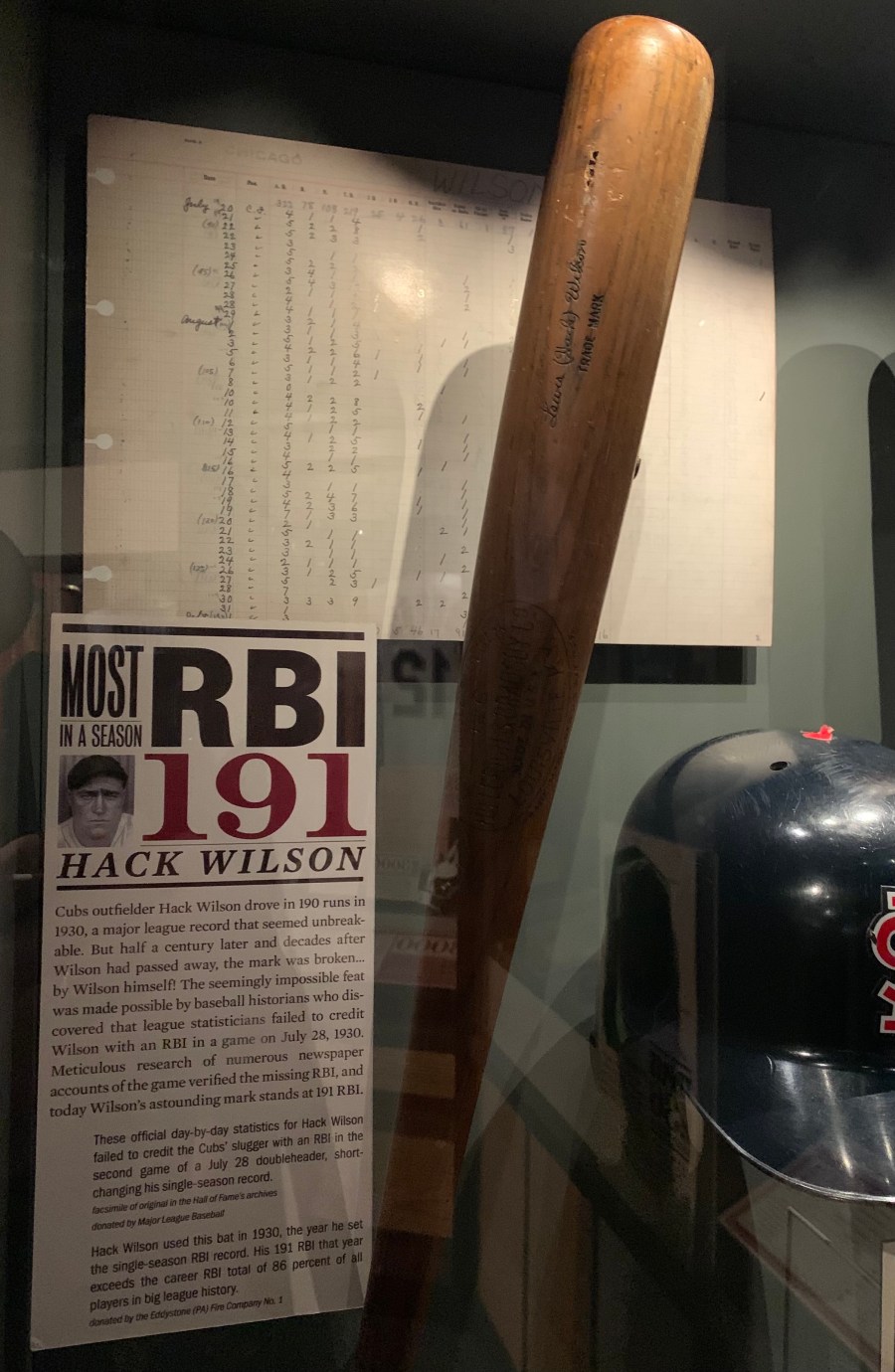
Hack Wilson’s 1930 season for the Cubs was one for the ages. Wilson set the National League record with 56 home runs, only the second player besides Babe Ruth to have eclipsed fifty in a season at the time. He slashed .356/.454/.723. (In fact, his 1.177 OPS is still a Cubs’ team record.) Wilson’s 1930 season, however, is probably best remembered for those 191 RBIs, a record that stands today—and may never be broken.
After Wilson’s Cubs teammate Rogers Hornsby was voted National League MVP in 1929, the league abandoned the custom (and the accompanying $1000 reward). The Baseball Writers’ Association of America conducted an informal MVP vote following the 1930 season and Wilson was the top vote-getter, topping Cardinals’ infielder Frankie Frisch by six votes. However, this putative MVP Award has never been officially recognized by baseball. Accordingly, a loving cup presented by some admiring locals wound up being the most enduring hardware commemorating Wilson’s incredible season. But what ever became of that handsome trophy?
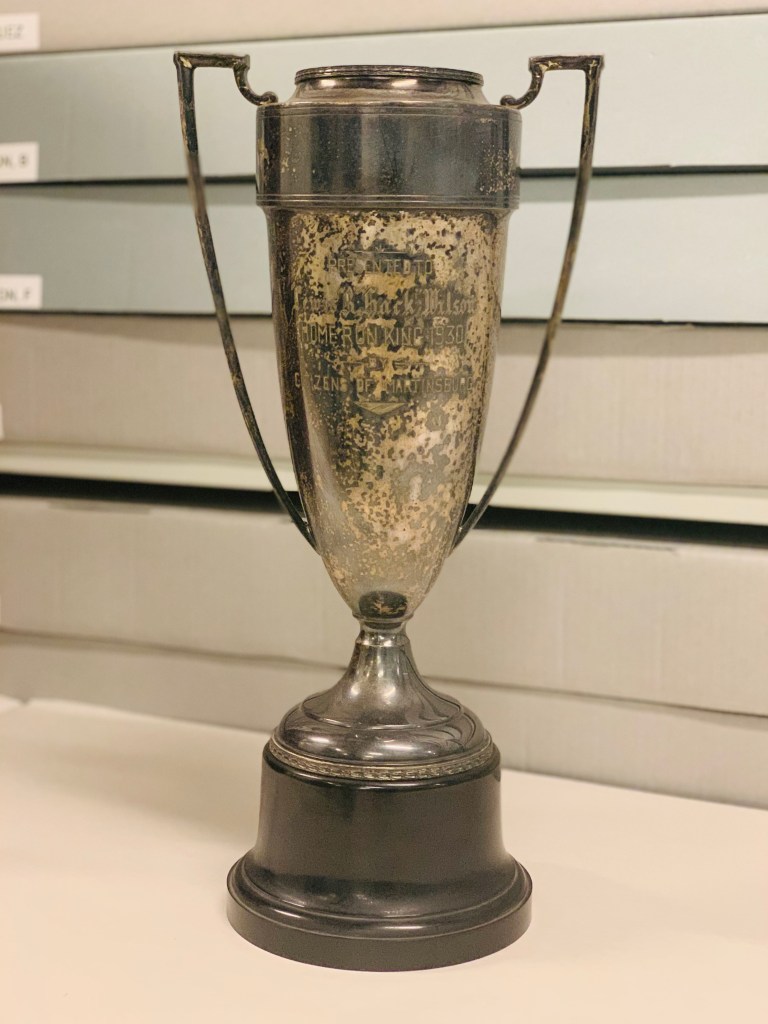
Well, it turns out the award survived and is archived at the National Baseball Hall of Fame and Museum in Cooperstown. The cup has tarnished and sustained some damage, including the loss of the ballplayer that appeared to have adorned the top.
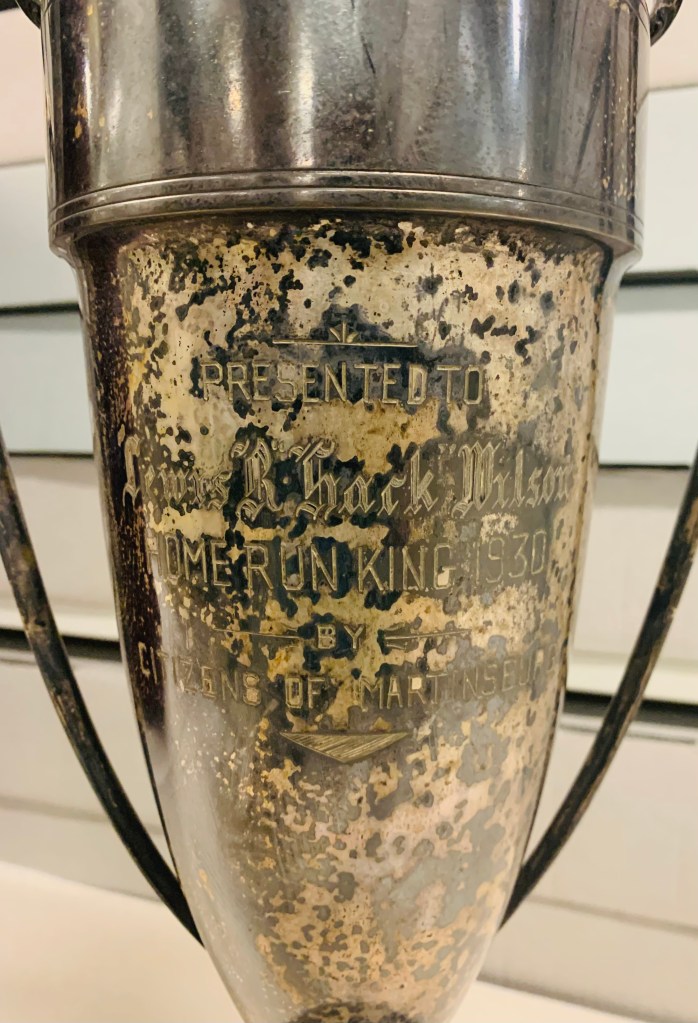
The engraving is still legible, however:
PRESENTED TO
Lewis R. “Hack” Wilson
HOME RUN KING 1930
By
Citizens of Martinsburg
Author holding Hack’s trophy. Photo credit: Bill Pearch
A loving cup, indeed.
Notes:
Very special thanks to Tom Shieber for allowing the author to see and hold the subject loving cup and Jason Schwartz for arranging the viewing with Tom in advance.
Sources:
“1930 Home Run King is Voted ‘Most Valuable’,” Messenger-Inquirer (Owensboro, Kentucky), October 8, 1930. (The Cubs agreed to pay Wilson $1000 prize that had previously accompanied the award.)
“Martinsburg Does ‘Whalen’ for Hack,” Evening Sun (Hanover, Pennsylvania), November 14, 1930.
“Cubs’ Home Run King Greeted in Home Town,” Chicago Tribune, November 17, 1930.
“Home Run King Who Succeeded Ruth Poses with His Family and Trophy,” Portland (Maine) Press Herald, November 17, 1930.
“Leo Durocher was like my father away from home.”–Willie Mays
“What can I say about Willie Mays after I say he’s the greatest player any of us has ever seen. If he could cook, I’d marry him!” – Leo Durocher
“Leo Durocher has the uncanny ability to make a bad situation worse.”-Branch Rickey
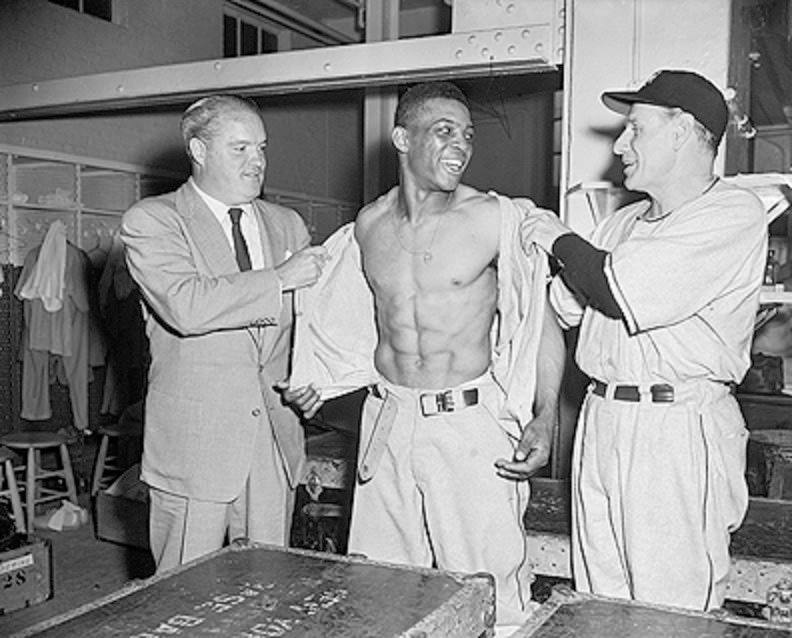
New York Giants owner Horace Stoneham (left) and manager Leo Durocher (right) help Willie Mays (center) with his jersey.
A while back I wrote about Jackie Robinson and Leo Durocher. It always makes me sad whenever I think about how things might have been significantly better for Jackie if he had the bold and brash Leo Durocher leading interference for him back in 1947, the year Jackie broke the infamous color barrier.
Instead, Leo had been suspended for what many think were frivolous reasons by Commissioner Happy Chandler just as the season began; and so he was not around to protect Jackie. In my opinion, Leo never would have let anyone get away with giving his star player grief. Had they done so, Leo would have given it right back…and they would have regretted it.
That got me thinking about Leo Durocher and Willie Mays, and how Leo acted as a mentor and father-figure for Willie during his rookie year of 1951. In the case of Leo and Willie Mays, we don’t have to speculate. We know what happened.
Leo had his faults…lots of them. As many players hated his guts as loved him. But, as I’ve been saying for a long time, in spite of what you might think about him, his greatest and most lasting contribution to baseball was taking a young, homesick Willie Mays under his wing and guiding him during his difficult transition into the major leagues. In doing so, Leo allowed Mays to blossom into arguably the greatest player in the history of the game. I don’t know if there was anyone else around at the time besides Durocher who could have done this.
I always love to think about the wonderful scene in the Giants’ clubhouse after rookie Willie Mays got off to his disastrous start going 0-12 and eventually 1-26. Giants’ coach Freddie Fitzsimmons saw Willie sitting alone in front of his locker crying. “Leo,” Franks said, “I think you better have a talk with your boy over there.”
What would have become of the Willie Mays if Leo wasn’t there to console him at this crucial time? I still get goose-bumps whenever I think about it. Leo went over to Willie and asked, “What’s the matter, son?” Willie turned to his manager and with tears streaming down his cheeks, replied:
“I don’t belong up here…I can’t play here…I can’t help you Missa’ Leo. Send me back to the minors.”
Leo smiled, patted Willie on the back, and simply said:
“Look son, I brought you up here to do one thing. That’s to play center field. You’re the best center fielder I’ve ever seen. As long as I’m here, you’re going to play center field. Tomorrow, next week, next month. As long as Leo Durocher is manager of this team you will be on this club because you’re the best ball player I have ever seen.”
The rest, as they say, is history. On his 24th at bat, Willie hit a homer over the left field fence off Warren Spahn who later joked, “I’ll never forgive myself. We might have gotten rid of Willie forever if I’d only struck him out.”
Years later, Willie was asked in an interview to expand on his relationship with Leo. Here’s what he said:
“I had such a good time with Leo. I met so many good people in Hollywood. Jeff Chandler used to come to spring training with me, Pat O’Brien, all the movie stars. Leo was like my father away from home. When I went to California I stayed with Leo in his house. His kid, Chris Durocher, was my roommate on the road. Chris would go to the black areas and stay with me. Leo trusted me. He knew that if his kid was going to stay with me, nothing was going to happen to that kid.”
Yes, Leo Durocher had his faults. He was “the All-American Out” as Babe Ruth so famously branded him. He was a scrappy, marginal player who couldn’t hit, but won three pennants and one World Series title as a manager. So you can debate back and forth whether he belongs in the Hall of Fame. To me, he’s a Hall-of-Famer just for the way he took care of a frightened and homesick rookie named Willie Mays.
If only he had had the chance to do the same for Jackie Robinson!
Long before Stan Hack was named Cubs pilot in 1954, “Smiling Stan” was literally an airplane pilot, quite possibly the first player ever to fly himself to spring training.
Born and raised in Sacramento, Hack’s first professional experience came with his hometown Pacific Coast League Sacramento Senators in 1931. He appeared in 164 games for the Senators, where he hit .352, legged out 13 triples, and racked up 300 total bases. Following the season, the Cubs purchased Hack from Sacramento for the hefty sum of $40,000 (nearly $750,000 today).
Hack appeared in 72 games for the 1932 Cubs and slashed .236/.306/.365, with two home runs and five stolen bases. He had a single appearance in the 1932 World Series as a pinch runner for Gabby Hartnett, who had reached on an error in Game Four.
Almost immediately after the World Series ended, Hack began taking flying lessons in Sacramento and was granted his pilot’s license in January 1933. Using his World Series bonus share, Hack purchased a 225-horsepower Stearman biplane for $4400 and announced he would be flying himself from Sacramento to the Cubs training camp at Catalina Island, located 22 miles off the coast of southern California.
Chicago Tribune, February 19, 1933
On February 19, Hack and two passengers escaped injury as Hack was attempting to land his airplane at Sacramento’s municipal airport. Witnesses reported seeing Hack approach at an excessive speed when his plane suddenly swerved and tipped over onto its wing, causing extensive damage. Despite the accident, Hack announced his intent to repair the craft immediately and fly it to Catalina.
Hack had invited Cubs outfielder Frank Demaree, a fellow Sacramentan, to fly with him to Catalina Island, but Demaree declined. Demaree quipped, “they couldn’t give me an airship, much less sell me one. I have yet to take my first ride in an airplane.” (Perhaps news of the crash landing influenced his decision?)
Following spring training, Hack’s flying instructor, Kenneth Kleaver, was hired to fly the plane to Chicago so Hack would have it available just “to ride around in.”
Hack began the 1933 season on the Cubs roster but was used sparingly by player-manager Charlie Grimm, appearing in just three April games as a pinch runner. He was demoted to the Albany Senators of the International League on May 3, sent along with outfielder Vince Barton.
Hack hit .299 in 137 games for Albany and was recalled to the Cubs once the Senators’ season ended. Irving Vaughn of the Chicago Tribune, however, was not impressed, “the .300 mark. . .isn’t much for the International League.”
Hack flew himself back to Chicago, along with his terrier Splinters, to re-join the Cubs. This photo appeared in the (Minneapolis) Star Tribune on September 10, 1933.
Stan Hack and his dog, Splinters
Backside of photo, including clipped caption
Back in Chicago, Hack worked his way into the lineup as the 1933 campaign closed and ended up holding onto the Cubs’ starting third base job for the next decade. Hack soared in his career as he recorded 2193 hits, posted a career slash line of .301/.394/.397, was a five-time All-Star, and garnered MVP votes in eight different seasons. His lifetime bWAR of 55.5 ranks 15th overall for third basemen.
Following his final Major League season in 1947, Hack was named manager for the Cubs’ farm team in Des Moines. He worked his way up through the minor leagues and was named Cubs skipper for the 1954 season. It is unknown whether Hack flew himself to Chicago to pilot the Cubs.
Notes:
Stan Hack appeared in 17 World Series games after 1932 and slashed .348/.408/.449/.857 across 1935 (L-DET), 1938 (L-NYY) and 1945 (L-DET).
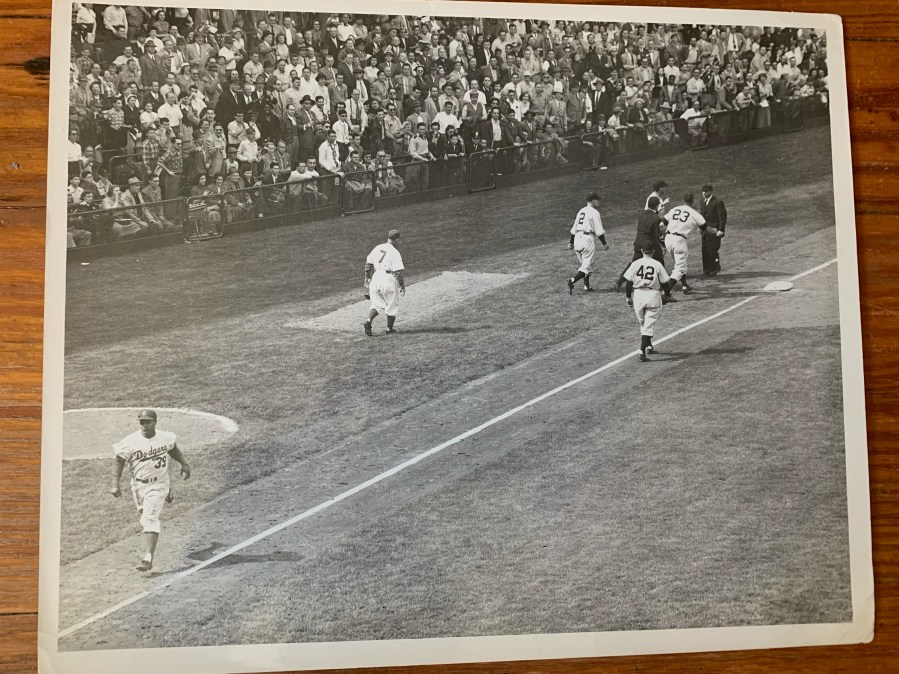
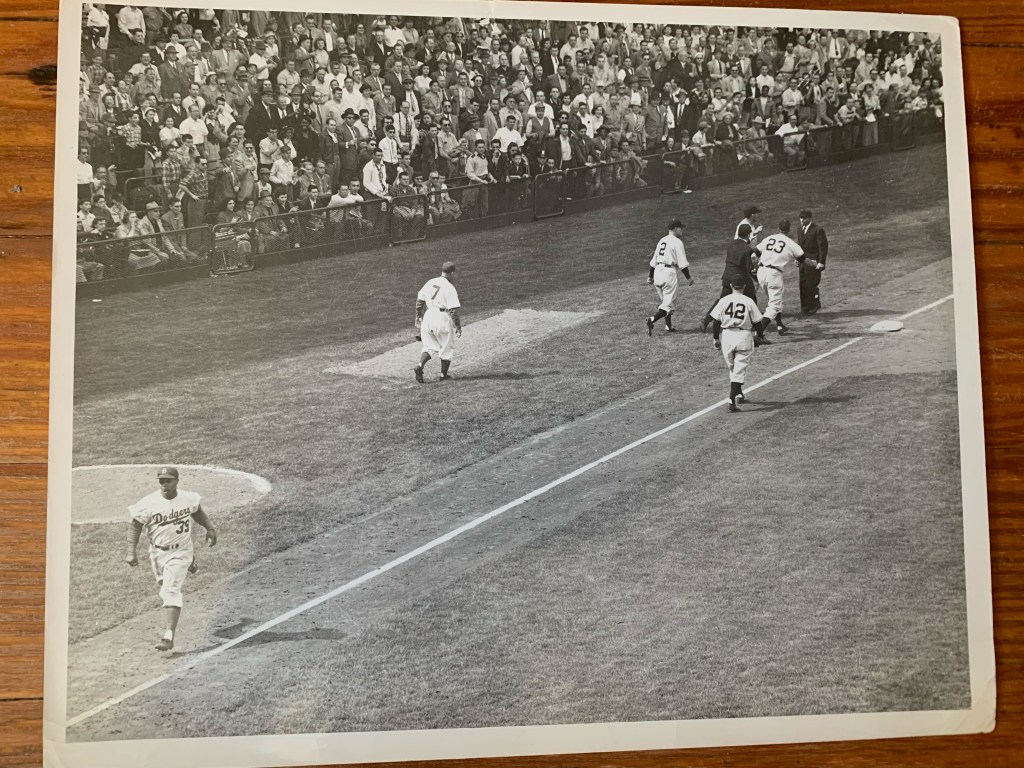
Roy Campanella Heads for Home Plate as New York Giants Argue With the Umpire.
One of the fun things about collecting old photos is looking at them and imagining being there, watching live, experiencing the action the photo shows. Lots of times this is easy, posed swings or pitches, a guy warming up, or players chatting before a game. Other times the photo comes with the caption tag telling you exactly what’s happening. The real fun begins when there is a photo and some notes on the back, but not enough to be sure.
A few years ago I got a photo of Roy Campanella strolling home against the Giants. The information on the back was interesting but not complete. The main draw was the fact that it was a shot of Campy, I collected him, and the Barney Stein stamp on the back. Asmany know Stein was the de facto official photographer for the glory days of the Brooklyn Dodgers. I often think his photos are undervalued; you sometimes see them get good prices but he has yet to reach the consistent prices you see from some of the other big names in baseball photography.
It’s a fantastic photo, Campanella with a smile on his face heading home while a group of Giants surrounds the ump and others head to him. I loved it as soon as I got it in the mail but also wondered exactly what was happening. Thus, as Sherlock Holmes said, the game was afoot.
As simple as it seems I decided to try to figure out Who and Where, to get to the What and When.
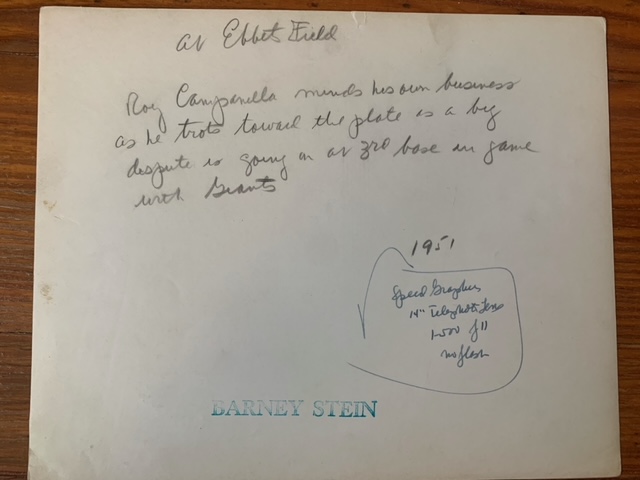
The back of the photo gives some info, a quick description of the action, a location, a year, and some random notes that I believe describes the equipment used to take the photo. I have always found hand written notes to be misleading so I decided to basically ignore them.
The easiest first step was the Where. The photo clearly shows the “Dodgers” across Campanella’s chest. Based on this, I knew where: Ebbets Field.
I went to Who. Campanella is easy, he is clearly recognizable. So the question is who else is in this photo? The photo shows three numbered Giants, and its the third that is the key. First is number 2, easy Leo Durocher. Next is 23, not too tough, Bobby Thompson. Then we get to 42 and the plot thickens. Anytime you are looking at a Dodgers game in the 50s there is one name that connects to the number 42, Jackie Robinson. I crossed his name out quickly though, can’t see any logical reason he would be running into a group of Giants arguing with the umpire.
Next I took to twitter and licked out with some help from @HeavyJ28 and @vossbrink, the two esteemed heads of the SABR Baseball Card Committee. With their help we learned that no Giant wore 42 in 1951 but soon found that one did in 1952, Max Lanier, a pitcher.
From there it’s over to the game archives on Baseball Reference to look for a game in Brooklyn, that Campanella played, Thompson played 3rd, and Lanier pitched. I found April 19, 1952, all of them played but there was no Home Run by Campanella. Could be the game but not sure, better check the rest. Oddly nothing else matched so I enlisted some help and if you are going to ask for help figuring out a baseball photo you can’t ask for better help than a friend and fellow SABR member who also happens to be an archivist at the National Archives. It helps even more when you are asking for help in late November when half of DC is out of town. I texted him the info and was surprised that I got an answer the next day. Not only did he find the game but he also found a NY Times article describing exactly what the photo showed.
In the bottom of the 4th Campanella came up with Jackie Robinson and Duke Snider on base. Facing Lanier he hit a ball down the left field line, started running and didn’t stop till he crossed home plate. Somewhere on its travels the ball ran into the hand of a fan and disappeared into the stands.Somehow this was completely missed by the umpire, you can insert any sort of umpire joke here. It didn’t take long before third base umpire Augie Guliemo was surrounded by Giants protesting, the mistake was realized and the hit was ruled a ground rule double, sending Campy back to second. He would eventually come around to score on a Carl Furillo home run later in the inning.
To say I was lucky would be an understatement. Lucky or not this was a lot of fun and quickly made this a favorite photo in my collection.
Special thanks to Jason Schwartz and Nick Vossbrink for the help on twitter and Adam Berenbak for all their help and encouragement.
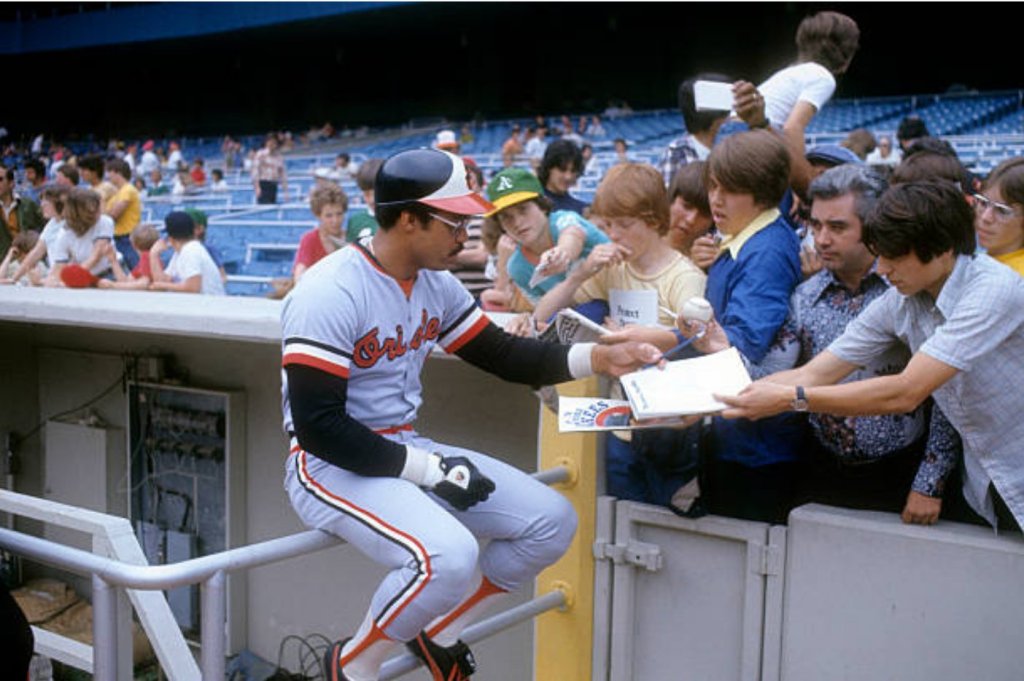
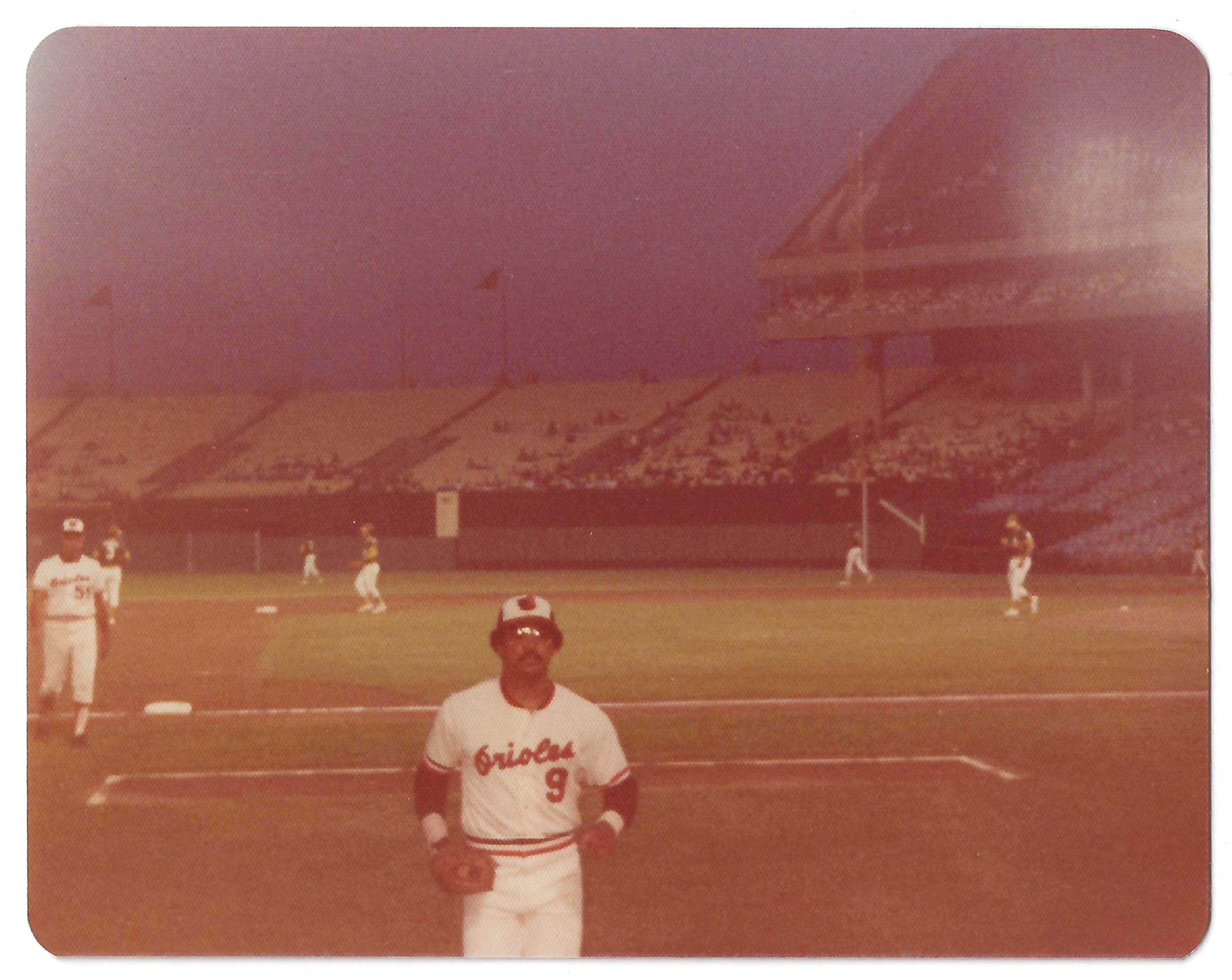
Reggie Jackson Signs Autographs at Yankee Stadium May 14-16 1976. Focus on Sports photograph.
Sometimes photographs are great because of the story that they tell. It took a while for the story in this photograph to unfold. Like Ebenezer Scrooge in A Christmas Carol, this photo tells of Reggie Jackson’s past, present, and future in 1976.
Past
Jackson joined the Kansas City Athletics in 1967 and moved with the team to Oakland in 1968. With the Athletics, he was a six-time all-star, won a most valuable player award, and was the face of the team for a decade. Then the new era of free agency entered baseball in 1976, and it struck Oakland like a thunderbolt. Oakland owner Charles Finley tried to trade or sell many of the team’s marquee players. He was hoping to get something in return for them before losing them in the free-agent process. On April 2, Jackson, with Ken Holtzman and minor leaguer Bill VanBommel was traded to the Baltimore Orioles for Don Baylor, Paul Mitchell, and Mike Torrez.
Jackson had a love-hate relationship with Oakland and Finley. He enjoyed playing on a team that had been to the post-season five straight times and won the World Series three of those years. Jackson wanted to stay in Oakland because he and the other players knew the team had a unique chemistry. However, he and the other players hated playing for Finley. At the start of the 1976 season, Finley gave everyone on the team a 20% maximum pay cut. He knew he would lose most of the players to free agency after the season, so he decided to pay as little as possible. Jackson had his salary cut by $30,000.
In the photograph, there is a kid in the crowd wearing an Oakland Athletics hat. He is desperately reaching toward Jackson, trying to get an autograph. No one else in the group of autograph seekers seems to be working as hard as he is. Jackson probably does not see the kid because he is in his peripheral view. However, because of how the photograph is framed, it appears Jackson is ignoring him. It conveys Jackson’s bitterness toward Finley for taking him away from the teammates he loved playing within Oakland. At the same time, he could be trying to ignore his past in Oakland to look toward his future.
Present
Jackson may have had mixed emotions about leaving Finley and his teammates in Oakland. His feelings about landing in Baltimore were clear; he did not want to play on the East Coast. He claimed that his businesses outside of baseball in Oakland and Arizona would suffer if he were not on the West Coast. He asked the Orioles to make up the difference with an increase in his contract. The Orioles’ season started on April 9, just a week after the trade, and Jackson had still not joined the team. There was some question if he would join the team at all. Could he sit out the season and become a free agent at the end of the year? No one knew the answer because free agency was so new. The Orioles agreed to give him back the 20% pay cut Finley had taken to match his contract from 1975. On May 2, Jackson made his Baltimore Orioles debut, and it happened to be against his former team, the Oakland Athletics. He went 0-2 with a walk and an RBI and was hit by a pitch thrown by Rollie Fingers.
Things started rocky when Orioles’ manager Earl Weaver fined Jackson for not wearing a necktie during a road trip to Milwaukee. Jackson did not like wearing a tie because he thought it was an East Coast tradition, and he was a West Coast guy. However, for the rest of the road trip, he wore a different tie every day. He also received what he thought was an undeserved talking-to from Weaver for showing up five minutes late to batting practice. For the rest of the season, Jackson never got comfortable in Baltimore and sulked about how he was unappreciated.
The photograph taken between May 14-16, slightly less than two weeks into his time with the Orioles, shows how uncomfortable he appears in his new uniform. Sitting on the railing, he keeps his distance instead of standing at the wall to engage with the fans. His blank emotions and limp body language show his interest in signing autographs.
Future
At the end of the 1976 season, everyone wondered what team Reggie would sign with as a free agent. The Montreal Expos offered him the most money, but he was not interested in playing in Canada for the last-place team. San Diego Padres owner Ray Kroc offered him a chance to return to the West Coast. Jackson was not interested in playing for a team that finished 73-89. Finally, George Steinbrenner and the New York Yankees made their pitch to Reggie. Jackson, who once said, “If I played in New York, they would name a candy bar after me,” was going to get his wish. The situation had all the glamour of a large city with the fame and endorsements that Jackson craved. He was also excited about joining a team that had played in the previous season’s World Series. Jackson signed for 3.5 million dollars over five years. It was the largest contract in baseball history at the time.
What is Jackson doing in the photograph? He is reaching for the fan’s scorecard so he can sign it. However, there is more to it than that; the scorecard is a New York Yankees scorecard. It is like George Steinbrenner is handing him a contract to sign eight months before it happened. In Jackson’s mind, did he already know he was leaving Baltimore? Was he already planning on going to New York?
The photograph nicely captures Jackson’s past with the Oakland Athletics, his present with the Baltimore Orioles, and his future with the New York Yankees.
Welcome to the new Society of American Baseball Research’s Pictorial Committee blog. Here you will find research articles about baseball in photography and moving images. We also hope to provide updates for ongoing committee projects. If you are a SABR member and would like to write an article for the blog please contact us.