By Ken Samoil

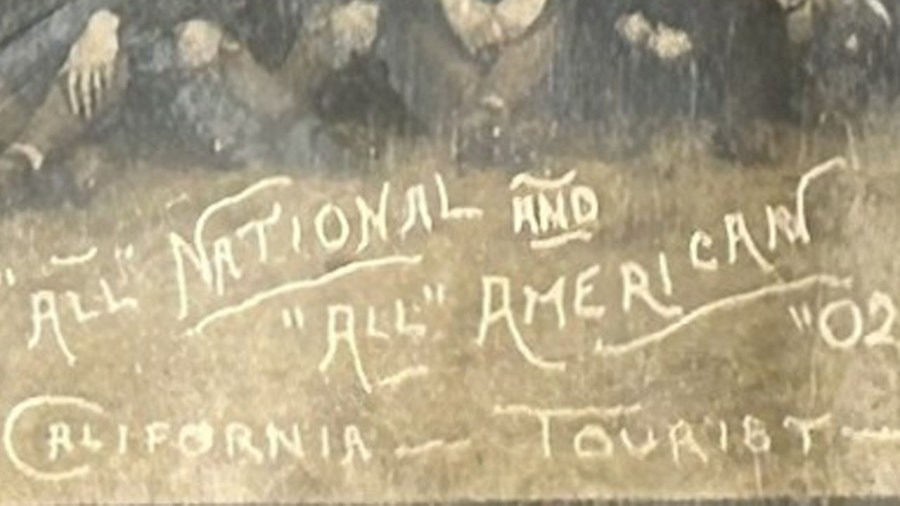
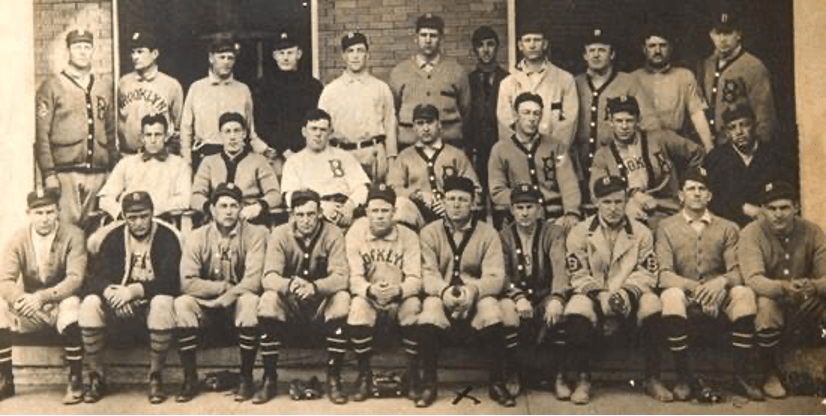
A group photograph of major league baseball players on a 1902 post-season tour of the Midwest and West Coast appears on page 136 of The Life, Times, and Tragic Death of Pitcher “Win” Mercer, written by SABR-member Jimmy Keenan. The photo is labeled “ALL” NATIONAL AND “ALL” AMERICAN “02” CALIFORNIA TOURIST, and the photographer’s name (presumably) is in the lower left corner–G.H. Meyer of Kansas City, Missouri. Those who had played for National League teams during that season are wearing dark uniform shirts and caps in the photo, and those who had played in the American League are wearing white shirts with contrasting collars and light-colored caps. Bob Harley, the grandson of Dick Harley, had sent the photo to Keenan. Recently, a scan of another print of the same photo was posted on an online collectors’ forum, with a request for player identifications. After confirming who was on the tour, I suggested the following identifications:
Back Row (L-R): Mike Kahoe, Jack Chesbro, Bill Donovan, Sam Crawford, Jake Beckley, Joe Cantillon, Win Mercer, Harry Davis, Dick Harley, Bill Bernhard, Monte Cross.
Front Row (L-R): Dick Cooley, Claude Ritchey, Charley Irwin, Charley Dexter, Willie Keeler, child mascot, Topsy Hartsel, Billy Sullivan, Nap Lajoie.
Fielder Jones is on the far right, between the front row and the back row, behind Lajoie.
Most of these IDs seem pretty certain, but the image of the player on the lower left (that I have identified as Cooley) is blurred. Cy Young and Honus Wagner had been on the tour for a few early games, but are definitely not in this picture. Jesse Tannehill, Addie Joss, Jimmy Williams, and Bill Coughlin were with the group for most or all of the tour; of these, only Tannehill was a National Leaguer in 1902 who could potentially be the man on the lower left, instead of Cooley. The teams had scheduled two games in Kansas City, but it is unclear whether both games took place. In the one game that is described in the newspapers, Tannehill pitched for the All-Nationals, making it unlikely that this photo was taken at that game unless I have failed to recognize him. I could not find a complete box score for that game to confirm who else played that day other than pitchers and catchers. Dick Cooley was a native Kansan who had received a lot of press coverage as the tour approached and was unlikely to have missed games in the Missouri/Kansas region; he would probably have been in any group photo taken during that stretch of the tour. The photo may have been taken at one of the other game sites near Kansas City, or during a second game in Kansas City if it occurred.

A few other players joined the tour after it had left the Kansas City area. These included Tom Leahy, Jack Burns, Gene DeMontreville, Bill Bradley, and Bill Dahlen. Dolly Gray, who was still a minor leaguer in ’02, pitched a few games for the All-Americans in California; he would reach the major leagues in 1909. Sylvester Loucks, a career minor leaguer, pitched for the All-Nationals on the West Coast.
Joe Cantillon, then a National League umpire, but later the manager of the Washington Nationals (1907-1909), organized the tour. The original itinerary was as follows:
October 12-Chicago Illinois, 13-Cedar Rapids, Iowa, 14-Des Moines, Iowa, 15-Sheldon Illinois, 16-Lamar Iowa, 17-Sioux City, Iowa, 18 and 19-Omaha Nebraska, 20-St. Joseph Missouri, 21 and 22-Kansas City Missouri, 23-Topeka Kansas, 24-Sabine Kansas, 25 and 26-Denver Colorado, 27-Colorado Springs Colorado, 28-Pueblo Colorado, 29-Trinidad Colorado, 30-Las Vegas New Mexico, 31-Santa Fe New Mexico.
November 1-Albuquerque, New Mexico, 2-El Paso, Texas, 3-Benson, Arizona, 4-Tucson, 5-Phoenix, 6-San Bernardino, California, 9-Los Angeles, 10 through 29-other sites in southern California, 30-San Francisco.
After two to three weeks in the San Francisco Bay area, the teams would perhaps sail to Honolulu for some exhibitions in Hawaii. The All-Americans preceded the tour with a two-game set against the National League champion Pittsburg Pirates on October 7 and 8.
Ultimately, the teams never got to Hawaii; they remained in California through mid-January. After returning east, Dick Harley was quoted as saying, “It was the greatest trip I ever had in all my experience. We had a fine crowd of fellows and we all enjoyed ourselves immensely. The scenery in the various states which we visited was simply grand and the climate was wonderful. At some places, particularly Denver, Albuquerque, and Las Vegas, the climate affected our ballplaying to a considerable extent. Being so accustomed to playing in the East, the rare atmosphere, of course, interfered with our wind. This was particularly noticeable in running, and after making a dash around the bases we were frequently compelled to lie down for several minutes before we could again breathe naturally. The air also had an odd effect on our batting. We would seem to hit the ball as hard as ever, but somehow or other it didn’t seem to go as far or as quickly. The reason, I guess, was that the air affected our eyesight somewhat, and we did not time the ball the way we thought we were doing. From a financial viewpoint, the trip was a success. After having a good time and visiting many points of interest, we cleared more than $550 each over and above all expenses.”1

Though financially successful, the tour was marked by a significant tragedy. On the night of January 12/13, Win Mercer died, apparently by suicide at the Occidental Hotel in San Francisco. He had registered there under an alias; the teams were staying at another hotel. Mercer’s death caught his tour-mates by surprise; he had not seemed depressed. Several suicide notes were found, though some aspects of the notes have led some to suggest that Mercer may not have written them. An excellent discussion of these notes and the events leading to Mercer’s death are in Keenan’s biography referenced above. The last few scheduled games of the tour were played after this event, with the final game serving as a benefit for Mercer’s mother; a sum of $1575 was raised for the cause. Joe Corbett, who had pitched for Washington and Baltimore in the 1890s and would pitch for the Cardinals in 1904, was in the box for the All-Nationals in that game, and Ham Iburg pitched for the All-Americans, though he had played for the Phillies in 1902, his only major league season. Former major league outfielder Bill Lange served as an umpire in the game.
Harley said, “The death of Mercer was a shock to every one of us. He was one of the finest fellows I ever travelled with. Win always was ready for a joke or a good time and made friends with everyone he met on the trip.”2
1 From the Philadelphia Press, quoted in the Washington Evening Star and the Buffalo Courier Express, January 26, 1903.
2 Ibid.
The Win Mercer photo was published in the San Francisco Call and Post on January 14, 1903.



 SABR's Pictorial History Committee