I mainly enjoy writing about baseball and baseball cards, but I've also dabbled in the sparsely populated Isaac Newton trading card humor genre. As of January 2019 I'm excited to be part of the SABR Baseball Cards blogging team, and as of May 2019 Co-Chair of the SABR Baseball Cards Research Committee.
Let’s face it. When it comes to photos, the Babe Ruth, Hank Aaron, and Willie Mays fans have it easy. A pic of the Babe pitching? No problem, take your pick! How about the Hammer hawking breakfast cereal? Sure, we’ve got that too! Or the Say Hey Kid making an incredible catch? Where do we even begin!
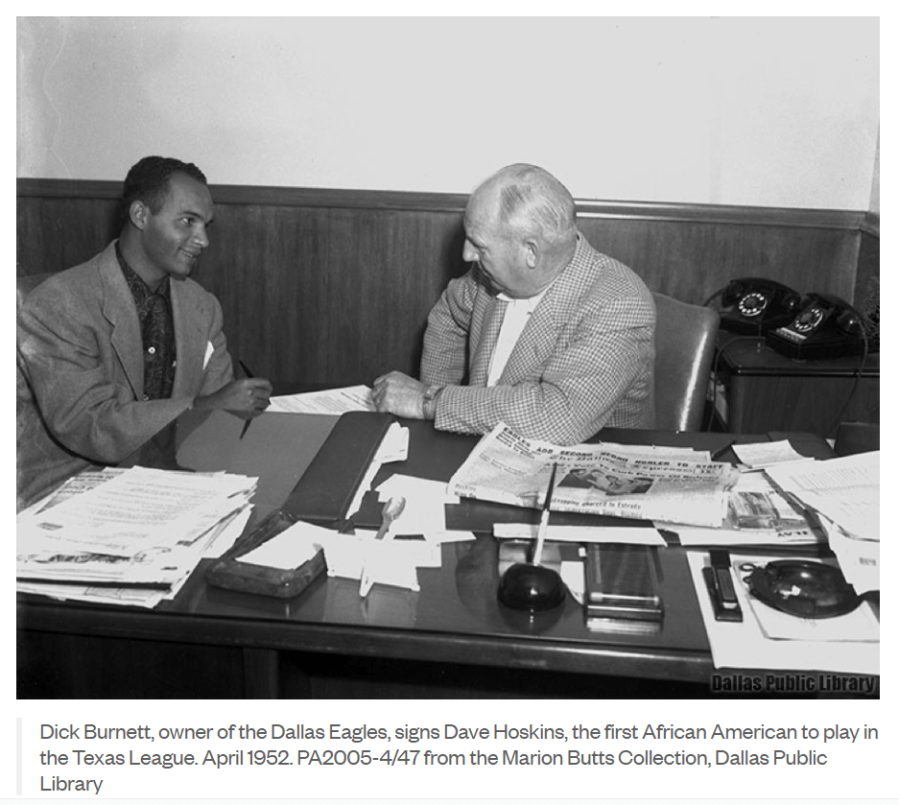
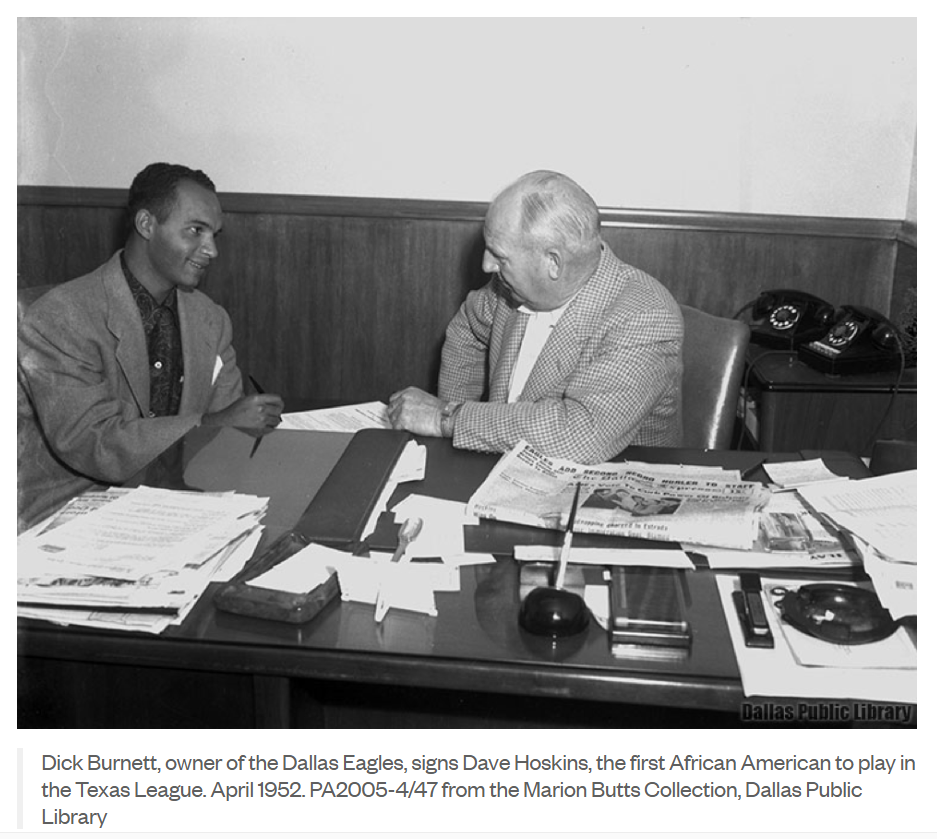
Of course, when the player of interest is a bit more obscure, finding that perfect photo can feel like a miracle. Such was certainly the case for me when my research and collecting interests in Texas League pioneer Dave Hoskins led me to the sort of photo I wouldn’t have imagined existed: Hoskins signing his contract to join the Dallas Eagles in 1952 as the Texas League’s first Black player.
True, the occasion was historic, so why shouldn’t there be a picture? But to see it so sharp and vivid, that was another matter altogether. Even better, the same Marion Butts Collection at the Dallas Public Library has several other tremendous photos of Hoskins from his historic 1952 season.
Still, there was a part of me not fully ready to celebrate this miracle. Granted I didn’t have a ton of other early 1950s images of Dave Hoskins against which to compare, but I couldn’t help thinking the ballplayer in the photo didn’t really look like Hoskins.
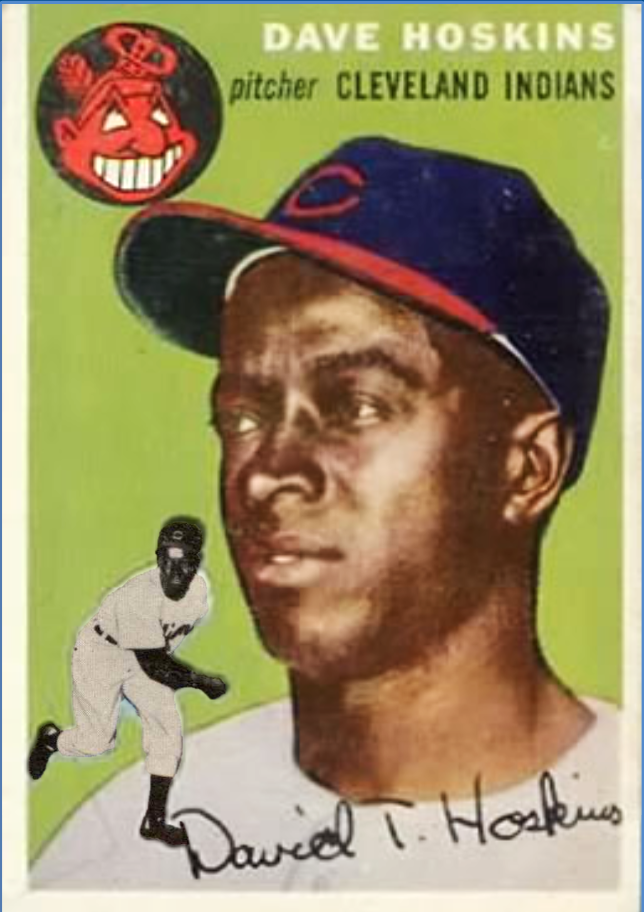
1954 Topps baseball card
The result was that I shied away, out of an abundance of caution, from including the photo in the various articles and presentations I was working on. Maybe it was Dave Hoskins, but maybe it wasn’t, right? Of course, we SABR members aren’t big on leaving things in limbo, and in this case the answer really was hiding in plain sight.
Though all my attention had been on the ballplayer in the photo, there was a newspaper right there on Dick Burnett’s desk, the not yet digitized Dallas Express, and while the date wasn’t readable the headline was: “EAGLES ADD SECOND NEGRO HURLER TO STAFF.”
Case closed. The player in question was not Dave Hoskins but Puerto Rican pitching legend Jose Santiago, who joined the Eagles several weeks after Hoskins.
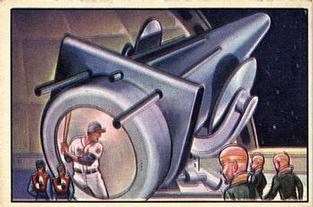
Custom baseball card
Just to put a bow around things, I sent my findings to Brandon Murray, archivist for the Dallas Public Library. Here was his response:
“I checked the microfilm, and the photo ran in the May 31, 1952, issue of the Dallas Express. It is indeed Jose Santiago according to the caption. I’ve updated the information in our new content management website and our internal records.“
So the bad news is that a would-be historic photograph documenting the integration of the Texas League really doesn’t exist after all—or at least remains unknown to me personally. But the good news, and this matters here in the world of SABR, is that the pictorial record just got a tiny bit more accurate. Plus, this is a case where Hoskins’ loss is Santiago’s gain. Santiago was not only the “Larry Doby of the Texas League” but also the circuit’s first Afro-Latino player. His signing deserved a photo, and now it has one!
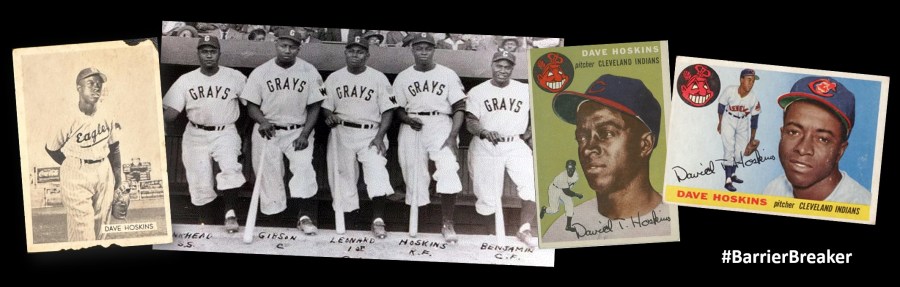
For a player who is part Jackie Robinson, part Shohei Ohtani, Dave Hoskins remains a relatively unknown player in our game’s history. A former member of the Homestead Grays Murderers Row, Hoskins not only integrated the Texas League in 1952 but electrified it, braving verbal abuse and death threats to win 22 games on the mound for the Dallas Eagles (CLE-AA), tally one of the league’s top batting averages at the plate, and set attendance records everywhere he played. It was no surprise then that Cleveland Indians general manager Hank Greenberg saw fit to promote Hoskins to the big club for the 1953 season.
Mound opportunities for Hoskins proved limited as the Tribe already boasted the top four-man rotation in the league. Nonetheless, Hoskins made the most of his appearances, posting an excellent 9-3 win-loss record that trailed only Eddie Lopat of the Yankees in winning percentage among AL hurlers with 12 or more decisions. Hoskins proved he could hit American League pitching as well, tallying a .259 batting average that topped that of the team’s starting first baseman, right fielder, and catcher.
Though the 1954 season would be a historic one for Cleveland, Hoskins saw his usage dwindle significantly, starting only one contest and seeing only 26.2 innings vs. 112.2 the previous year. Underscoring his diminished role, Hoskins was left off the ballclub’s postseason roster and was not invited back for the 1955 season, rounding out the final six years of his career instead as a journeyman pitcher with various minor league and Venezuelan Winter League teams.
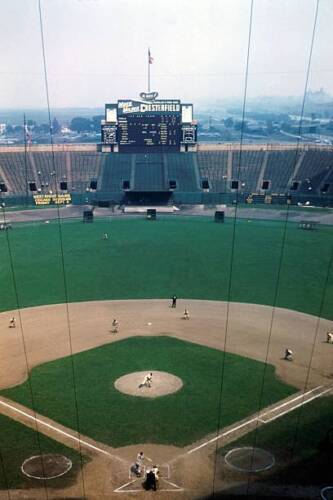
Game action photographs of Hoskins, whether with Cleveland or any other team, are few and far between, so I felt incredibly fortunate when my Hoskins eBay search yielded this wonderful color photograph.
The seller (in Australia, no less!) advertised the image as “Pitcher Dave Hoskins of the Cleveland Indians 1953 Baseball OLD PHOTO” and went on to specify size as 8.5 x 11 inches. Assuming Hoskins was indeed the man on the mound, which the action pose on my Dave Hoskins rookie card seemed to support, this photo had a definite home in my collection.
Of course none of us at SABR Pictorial can look at a photo like this and bypass the opportunity to learn even more: questions like where and when the photo was taken, what game action is taking place, and who the various subjects on the field might be. Though such questions can prove unanswerable with some photos, that will not be the case here.
Where and when?
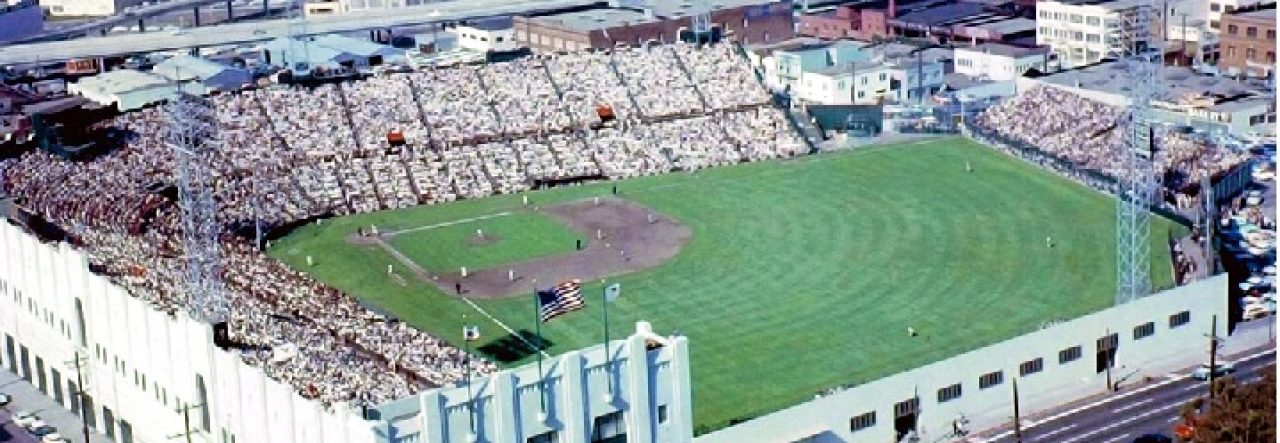
Thanks to the prominent centerfield scoreboard, we know immediately we are looking (perhaps from the press box) at Cleveland Stadium. In other words, this is a home game for Hoskins. Still, that leaves 14 options for the specific game since Hoskins pitched at home 14 times in 1953. Fortunately, we also have a significant detail along the wall in left-center. Though the lettering is a little tough to make out, it reads that the team’s next night game will be against Chicago on Friday, September 4.
Before examining this clue further, I’ll point out first that it affirms 1953 as the year. September 4 indeed fell on a Friday that year, whereas it fell on a Saturday in 1954, the pitcher’s only other season with the team.
But can this same clue pinpoint a specific date, not simply a year, for the photograph? As it turns out, yes, quite easily. When Hoskins took the mound on September 3, the next night game was September 4. Backing up to his previous appearance, one in relief of Bob Feller on August 30, the next night game would have instead been August 31. Therefore, we are looking at September 3.
What’s going on in the photo?
With the photograph’s date firmly established as September 3, 1953, we can now say much more about the game it portrays. Let’s start with some context for the matchup.
En route to winning 111 games and the American League pennant the following year, the 1953 squad was a very, very good one despite entering the September 3 contest in third place. Cleveland’s record at the time was 78-54, a healthy 24 games above .500, but this still left then one game behind the second place White Sox and 10.5 games behind the league leading Yankees. With 22 games left on the schedule, the Tribe was not yet mathematically eliminated but not exactly in contention either.
Visiting the Forest City that day was a sixth place Philadelphia Athletics team, having already dropped the opener of this short two-game set 6-3 the night before. Cleveland would win this game as well, riding a complete game effort by Hoskins to a 9-4 victory. Hoskins would contribute at the plate also, reaching base twice, scoring once, and driving in two. The win, coupled with a White Sox loss, moved the Indians into second place where they would ultimately finish the season.
That being the general context, what other information does the photograph capture? Let’s start with the detail of a right-handed batter at the plate with runners at first and second (and possibly third).
Per the Baseball-Reference play-by-play, here are the only two instances in the game when both of these conditions would have been met.
Top of 1st – Gus Zernial batting, runners on first and second, one out
Top of 4th – Joe DeMaestri batting, runners on first and second, one out
It further appears that the batter has a double-digit uniform number. If so, this rules out DeMaestri who wore #2 for the team, leaving the Zernial at-bat the only possibility.
While the game information shown on the scoreboard is tough to make out, it appears at least consistent with such a point in the contest, that is: 0 R, 1 H for Philadelphia and 0 R, 0 H for Cleveland.
The result of the play itself, though probably not on the pitch shown, was a ground ball out to third with both runners advancing. With the next batter, Carmen Mauro, grounding out to first, Hoskins would escape the inning unscathed.
Who’s in the photo?
Though the best of our sleuths here will (and should!) search for more, I’ll complete my analysis of the photo itself simply by identifying the other subjects present. This of course comes from the Baseball-Reference game log rather than any ability on my end to discern and recognize these men visually.
Cleveland – Jim Hegan (C), Bill Glynn (1B), Bobby Avila (2B), George Strickland (SS), Larry Doby (CF)
Philadelphia – Eddie Robinson (runner on 1st), Dave Philley (runner on 2nd)
Umpires – Red Flaherty (HP), Charlie Berry (2B)
Who’s not in the photo?
Though off camera, fielding the third base position that day would have been eventual league MVP Al Rosen. Watching the action from the Cleveland dugout would have been the team’s “big four” starters, not to mention slugger Luke Easter and Hall of Fame manager Al Lopez. Finally, over in the visitors dugout would have been opposing manager Jimmy Dykes and—if you can believe it—pitching coach Chief Bender!
So yes, baseball card collectors, in attendance that day were pitchers, impossibly enough, with cards in the T206 and 1982 Donruss sets! And if you don’t know ump (and football legend) Charlie Berry’s story, well here you go!
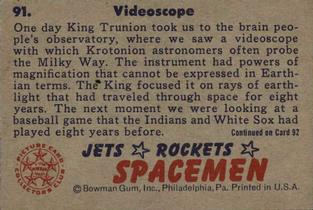
Now if you’ll excuse me, I’m off to find a photograph of the next day’s game. With the White Sox in town and catcher Hegan in the lineup, it may well be the very game King Trunion and his Krotonion astronomers picked up years later by videoscope! Let me update my eBay searches and get back to you!
Author’s note:For more on Dave Hoskins and his impact on the Texas League, see my SABR Games story, “Dave Hoskins wins 20th game for Dallas Eagles on night held in his honor.“




 SABR's Pictorial History Committee